

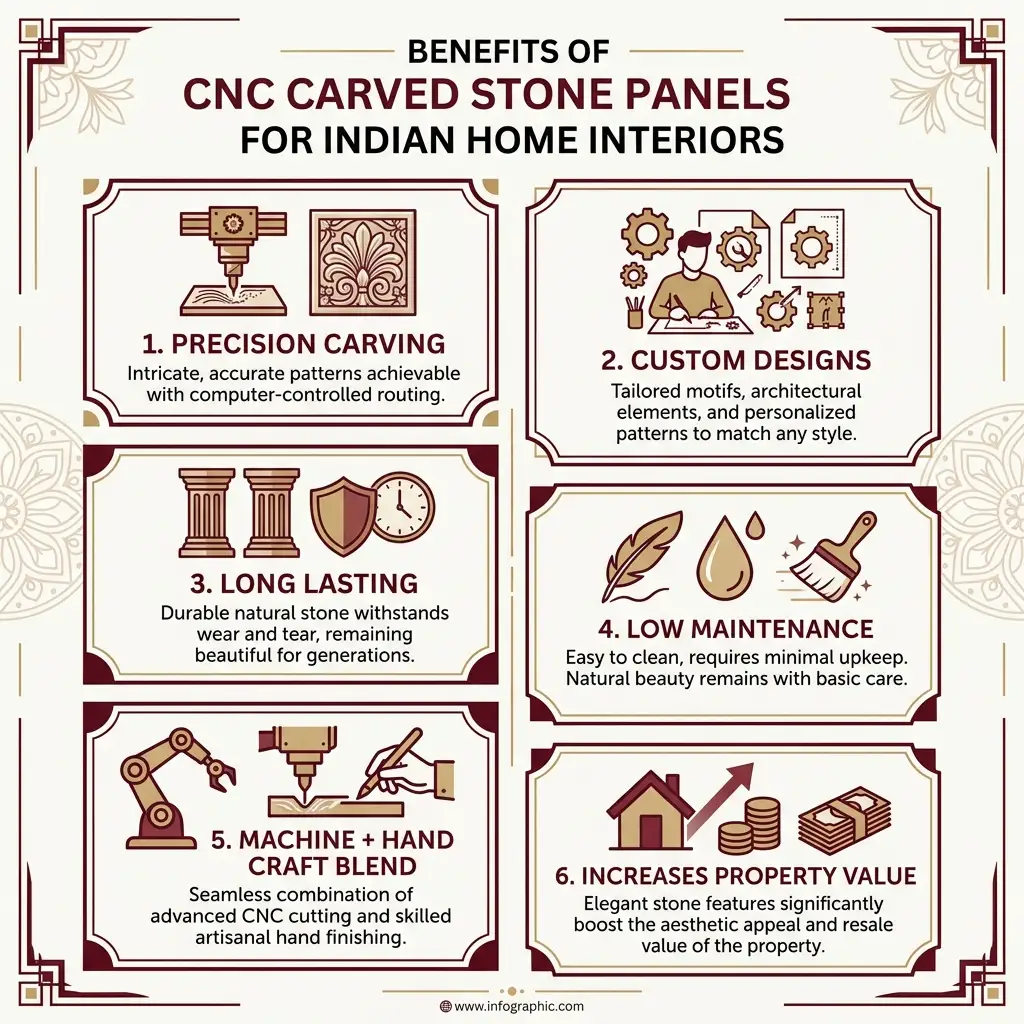
The benefits of CNC carved stone panels go well beyond looks. If you are building a premium home in India and want walls that are precise, permanent and genuinely custom, this material is worth understanding properly. Stone World in Indore is Central India's natural stone design studio, specialising in natural stone claddings, CNC carved stone designs, stone jaalis and custom stone installations. Visit our 12,000 sq ft live-concept showroom in Indore or enquire via WhatsApp.
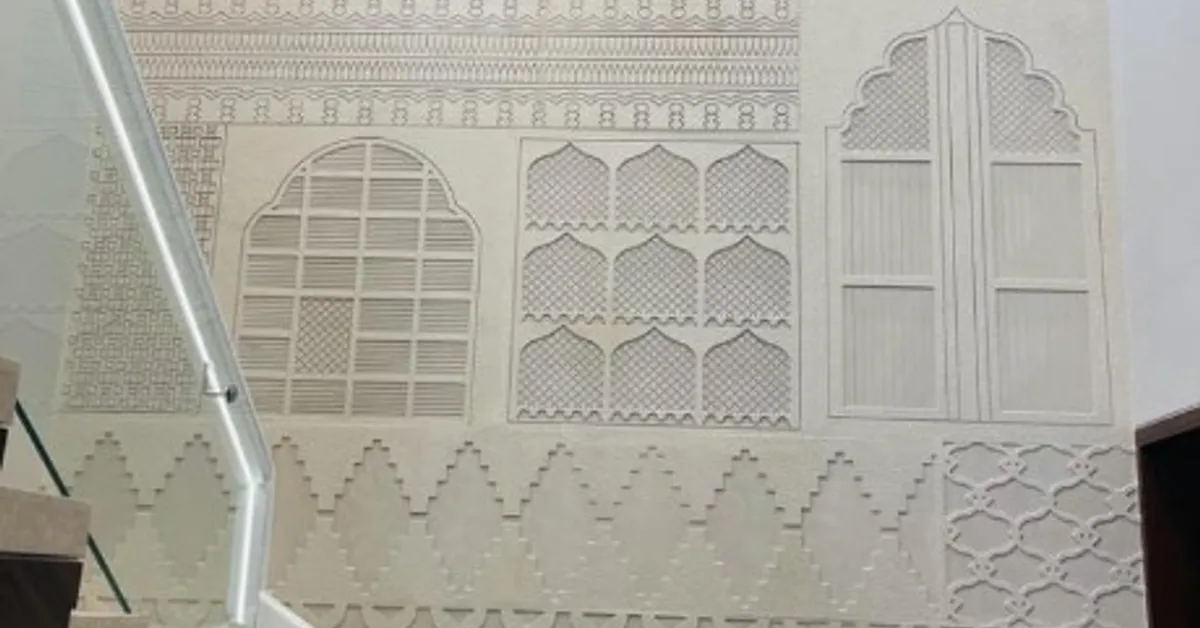
You’ve thought about the flooring, the furniture, the lighting. But the walls, the biggest surface in any room, are still blank. Most homeowners in India settle for wallpaper, textured paint, or wood panelling. All fine choices, but none of them permanent, none of them truly artisan.
This guide walks you through every key benefit of CNC carved stone panels: the precision, the customisation, the durability, where they work best and what separates machine-carved stone from hand-carved work. Read on.
Table of Contents
What is CNC Stone Carving?
CNC stands for Computer Numerical Control. In simple terms, it’s a process where a digital design is fed into a computer-controlled router equipped with diamond-tipped cutting bits. The machine carves the exact pattern into natural stone, whether sandstone, marble, quartzite, or limestone, with mathematical precision that no human hand can consistently replicate. This technology has been used in architectural stone manufacturing for over two decades and has become the preferred method for large-format feature wall panels in premium residential and commercial projects across India.
The process starts with your design idea. At Stone World, our team converts your concept into a 3D digital model. Once you approve the design, the file is loaded into the CNC router. The machine runs with water cooling to prevent cracking and surface chipping, carving layer by layer, millimetre by millimetre. The finished panel has sharp edges, consistent depth and a surface quality that’s ready for installation. Depending on the complexity of the pattern and the size of the panel, the carving process typically takes one to three days per piece.
What makes this different from regular stone tiles is the relief depth. A CNC carved stone panel has three-dimensional texture: grooves, raised sections, carved motifs that interact with light and shadow in a way flat stone simply can’t. In a well-lit room, this depth creates a living wall that looks different at different times of day, shifting with the quality and angle of natural light.
Key Benefits of CNC Carved Stone Panels
1. Unmatched Precision in Every Carving
Hand carving is beautiful and skilled stone artisans produce extraordinary work. But two hand-carved panels are never identical. For a homeowner wanting a repeated geometric pattern across a 10-foot feature wall, small inconsistencies add up visually and can ruin the effect.
CNC carving eliminates this. The machine repeats every cut to within a fraction of a millimetre. You get a panel where every motif, every groove, every carved edge matches its neighbour exactly. This precision matters most with complex geometric patterns like interlocking hexagons, linear fluting, or repeating mandala borders where even a slight mismatch is immediately visible. For large-scale installations spanning multiple panels across a continuous wall, this level of consistency is simply not achievable by hand at any reasonable cost or timeline.
2. Full Design Customisation for Your Space
For homeowners working on bespoke projects, this is where CNC really changes things. The design isn’t chosen from a catalogue. It’s created specifically for your wall, your dimensions, your aesthetic.
Want a jaali-inspired screen with a custom lattice pattern? We can do that. Your family name carved in Devanagari script across the entry wall? That too. A flowing Mughal arch motif scaled to a 14-foot double-height wall? Absolutely. If you’re interested in the screen and partition side of things, take a look at our stone jaali designs for a sense of how varied these patterns can be.
At Stone World, every custom stone wall project begins with our design team creating 3D renders so you can see exactly what the finished wall will look like before a single stone is cut. No surprises, ever.
3. Decades of Durability: No Repainting, No Replacing
Paint fades. Wallpaper peels. Even good wooden panelling warps with humidity over time. A CNC carved natural stone panel installed correctly on a solid wall can last 50 to 100 years with minimal maintenance. The stone itself, whether Banswara White Marble, Dholpur sandstone, or Gwalior mint, doesn’t absorb moisture the way wood does and doesn’t chip like ceramic tiles. Natural stone is a geological material formed over millions of years under pressure. It doesn’t deteriorate the way manufactured products do.
Here’s what that looks like in practice. Paint needs refreshing every 3-5 years. Wallpaper, every 7-10 years. Stone panels? One installation and it outlasts the building. That’s not a marketing claim. Stone carvings from Mughal-era buildings across Rajasthan are still intact after 400 years. Modern installation techniques make today’s panels even more durable.
4. Very Low Maintenance in Daily Use
A concern many homeowners raise: stone looks beautiful, but isn’t it hard to clean? For CNC carved panels, the answer is no, provided the carvings are designed with maintenance in mind. The standard practice is to keep carving depths between 5mm and 8mm and use rounded profile cuts that don’t create narrow, dust-trapping crevices.
Day-to-day maintenance is simply dusting with a soft brush or microfibre cloth. For marble panels, a damp cloth with a mild pH-neutral stone cleaner handles any marks. Avoid acid-based cleaners and abrasives. That’s genuinely about all there is to it.
5. Genuine Increase in Property Value
A home with custom CNC carved stone feature walls reads differently from one without and serious buyers notice it. Real estate developers working on premium villa projects in India factor this in regularly. A distinctive stone foyer, a carved marble backdrop to the family mandir, a jaali partition between the living and dining areas: these are the design details that survive in photographs and stay in buyers’ memories long after the site visit. In high-value residential markets across cities like Mumbai, Pune and Bangalore, custom stone work has become a recognised marker of premium construction quality.
A custom stone wall is one of the few interior investments that doesn’t date. Trends change; good stone doesn’t. Marble and sandstone have been used in Indian architecture for over a thousand years precisely because they age beautifully, gaining character rather than losing it.
6. Technology and Craft, Working Together
Something people sometimes miss about CNC carving: the machine doesn’t replace artisans. It works alongside them. The CNC router does the high-precision cutting, but it’s skilled stone workers who secure the slabs, manage the cutting process, handle the fine finishing, polish the edges and install the panels. Stone World has worked with expert stone artisans for over 18 years.
CNC carved stone panels get their character from this combination: the geometric consistency of a machine applied to the natural beauty of real Indian stone. You can’t get that from a composite panel.
7. Wide Range of Natural Stones to Choose From
Manufactured composite panels tend to look much the same regardless of brand. Every natural stone used for CNC carving is different. Banswara White Marble has a subtle translucency that glows beautifully when backlit. Dholpur red sandstone has a warm, earthy tone that works well in traditional homes. Gwalior mint sandstone has a cool grey-green that suits modern interiors well.
You’re not picking from a template. You’re choosing a stone with its own grain, its own colour variation, its own natural history.
See It in Person at Our Indore Showroom
Want to see what CNC carved stone panels actually look like in a finished space? Visit Central India's largest natural stone showroom, 12,000 sq ft in Indore. Every wall is a live concept installation. No catalogue guessing, no surprises. Just real stone, real finishes, ready to see.
CNC Carved vs Hand Carved Stone: Which is Better?
It depends on what you’re making and being honest about that matters.
For large-format feature walls, geometric patterns, repeated motifs and jaali-style screens with consistent lattice, CNC carved stone is the right choice. The precision and reproducibility can’t be matched by hand at that scale.
For one-of-a-kind sculptural pieces, deeply organic forms and decorative artefacts where slight imperfections add character, hand carving has its place. Our artisans at Stone World still do hand carving for specific work, particularly for stone murals and detailed figurative carvings.
For most premium home projects, it’s a combination. CNC carving handles the panel structure and hand finishing takes care of the surface polish and edge detailing.
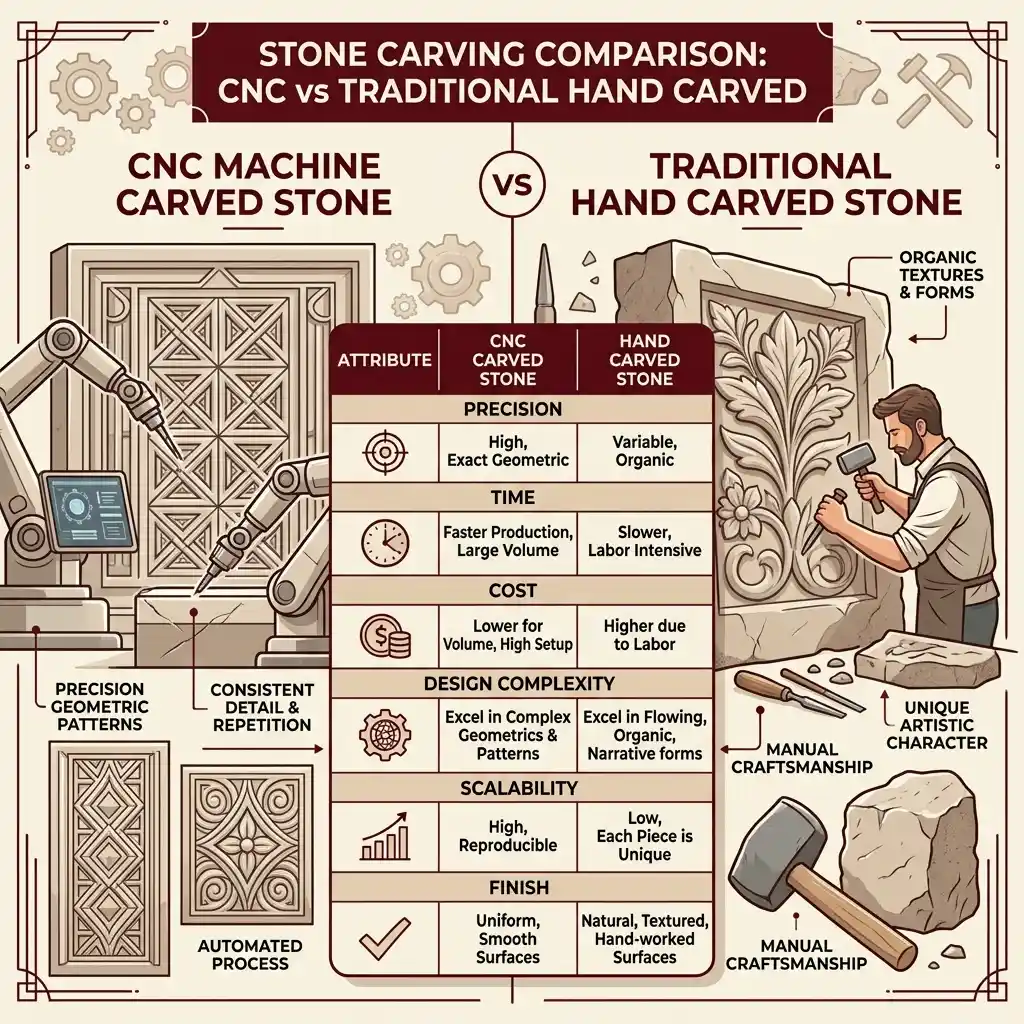
| Feature | CNC Carved Stone | Hand Carved Stone |
|---|---|---|
| Precision | Exact, repeatable to fractions of a mm | Slight natural variation between pieces |
| Design Complexity | Geometric, text, complex jaali patterns | Organic sculptures, figurative relief |
| Time to Complete | Faster, typically days to weeks depending on scale | Weeks to months for complex pieces |
| Cost | More cost-effective for large-format work | Higher labour cost for detailed pieces |
| Scalability | Identical panels can be reproduced | Each piece is unique |
| Best For | Feature walls, facades, jaali screens | Murals, artefacts, sculptural detail |
Where Do CNC Carved Stone Panels Work Best?
CNC carved stone panels work across nearly every space in a premium Indian home. Here are the five most popular applications our clients choose:
Living Room Feature Walls
The television wall or the main accent wall is the most popular application. A carved sandstone or quartzite panel behind the TV, with deeply carved linear fluting or geometric patterns, creates a texture that looks striking in daylight and becomes quite dramatic under warm LED accent lighting in the evening.
See Drawing Room Designs →Double-Height Walls
Double-height spaces look stunning but feel cold if left plain. A carved stone panel rising 15 to 18 feet creates a permanent anchor for the room, something that tells visitors immediately this home is not ordinary. The carving depth plays with natural light all day as the sun moves.
Explore Double-Height Ideas →Stone Mandir Backdrops
The mandir is where CNC carving gets deeply personal. Intricate lotus patterns, peacock motifs, geometric mandala borders: all of these can be carved into Banswara White Marble to create a backdrop that is both sacred and architecturally striking. Semi-translucent stones with back-lighting add a beautiful glow.
Browse Mandir Designs →Foyer and Entry Walls
Your entrance sets the tone for the entire home. A carved stone panel or jaali screen in the foyer, whether it is a welcome message in carved script or a bold geometric relief, is the first thing guests see and the last thing they forget. First impressions here are permanent.
View Foyer Stone Ideas →Facade and Exterior Elevation
CNC carved panels are not limited to interiors. Agra red sandstone or Gwalior mint carved panels on sections of the home's facade create deep shadow play under the Indian sun. Paired with smooth plaster walls and large glass panes, the textured stone sections look intentional and architecturally composed, giving your home a distinctive exterior character that most villas simply don't have.
See Exterior Stone Designs →CNC carved stone panels respond dramatically to light angle. Install warm LEDs at 30 to 45 degrees to the panel surface to maximise shadow depth and bring out the full three-dimensional carving effect.
Production only begins after you've approved the 3D render of your carved panel. No surprises, no second-guessing once the stone is cut. That's how we've worked for 18+ years.
See CNC Carved Stone Panels in Our Live Showroom
Central India's largest natural stone showroom. 12,000 sq ft, Indore. Every wall is a live concept installation. See finished examples before you decide.
Which Stones Work Best for CNC Carving?
Not every stone can handle CNC carving. Stones with excessive natural fissures, uneven grain, or soft mineral compositions can crack or chip during the cutting process. Here’s a practical guide to the stones Stone World works with most:
| Stone | Colour & Character | CNC Carving Suitability | Best Applications |
|---|---|---|---|
| Banswara White Marble | White, slightly translucent | Excellent, takes fine detail very well | Mandir backdrops, premium TV walls, foyer panels |
| Dholpur Sandstone | Warm beige-cream | Very Good, carves cleanly | Double-height walls, interior feature walls |
| Gwalior Mint Sandstone | Beige color with green lines | Excellent, weather resistant | Exterior facades, partition screens, jaalis |
| Agra Red Sandstone | Warm red-brown tones | Good, carves with character | Heritage-style elevations, garden features |
| Jaisalmer Yellow Limestone | Rich golden yellow | Good, best for interiors | Courtyards, traditional homes, mandir areas |
| Jodhpur Sandstone | Pink & Red | Very Good | Modern interiors, geometric designs |
Stone selection is not just about aesthetics. It’s about the environment the panel will live in. Exterior applications need stones that handle moisture and UV exposure well. Interior mandirs benefit from stones with some translucency for backlighting. Our team at Stone World advises on all of this at the design stage, well before any stone is ordered. We also consider the weight of the finished panel relative to the wall structure, the finish that best suits the lighting conditions in the room and the long-term sealing requirements for each stone type. Getting this right at the start saves significant cost and effort later. If you are exploring wall and facade applications more broadly, our natural stone claddings collection covers a wide range of stone types and finishes suitable for both interior and exterior use.
Frequently Asked Questions
What are the main benefits of CNC carved stone panels for homes?
How much do CNC carved stone panels cost in India?
Is CNC carved stone better than hand carved stone?
Can I customise the design of CNC carved stone panels?
What maintenance do CNC carved stone panels require?
Does Stone World deliver CNC carved stone panels outside Indore?
What is the standard thickness of CNC carved stone panels?
Interested in CNC carved stone for your home?
Browse our full range of CNC carved stone designs, from geometric feature walls and jaali screens to mandir backdrops and fluted columns. Every piece is made to order at our studio in Indore.
Making the Right Choice for Your Home
Building a home is a serious, long-term decision. The walls are the largest surface in every room and the one thing you look at every single day, for decades. Choosing a wall finish that you won’t need to revisit for the lifetime of the house is one of the smartest decisions you can make at the build stage.
CNC carved stone panels are not a trend. They’re a material choice that connects your home to centuries of Indian stone craft, using modern precision to deliver something no wallpaper or laminate ever can: a wall that improves as light changes, that carries real texture and that never needs replacing. Every stone panel we produce at Stone World is a one-off piece, made for a specific wall in a specific home. If you want to see the full range of design possibilities, our feature wall application gallery is a good place to start.
At Stone World, founded in 2008 and operating from Central India’s largest stone showroom in Indore, we’ve worked on hundreds of projects with architects, interior designers and homeowners who wanted something different. Every project starts with a 3D design consultation. Every panel is produced only after your approval. Every installation is backed by our 18+ years of stone expertise. We take the time to understand your space, your stone preferences and your timeline before a single quote is prepared.
If you’re serious about your home, come see the possibilities in person.