


A driveway or residential parking court represents the true entrance to an architectural estate, yet it endures more physical punishment than any other outdoor surface. Every day, multi-ton vehicles accelerate, brake, turn hot rubber tyres and track monsoon rainwater across the ground plane. Standard precast concrete pavers fade, chip at chamfered edges and crumble under point loads, while glazed vitrified tiles become hazardous slip surfaces that crack under direct axle torque. That is why leading architects, landscape planners and civil engineers specify natural stone driveway pavers to engineer driveways that endure for decades without settling, delaminating or losing their refined character.
At Stone World, our stone studio and stone experience center in Indore works directly with architects, estate developers and discerning homeowners across Central India to deliver calibrated, heavy-duty paving slabs, split cobbles and custom kerbstones. Explore our architectural showcase of dedicated natural stones for parking areas engineered for intense vehicular movements. This technical guide examines the top eight natural stones for driveway and parking floors, sub-base preparation mechanics, anti-skid surface texturing, permeable joint dynamics, kerb edge restraints and professional maintenance practices.
Table of Contents
Why Specifying the Best Stone for Driveway Paving Outperforms Concrete Pavers
Natural stone driveway paving provides superior compressive strength (exceeding 180 MPa), natural slip resistance and permanent colour stability. Unlike synthetic tiles or precast concrete blocks that erode, fade and crack under vehicle weight, dense dimension stone resists oil penetration, tyre scrub and tropical weather cycles across decades.

When selecting the best stone for driveway paving, property owners often weigh initial material costs against structural longevity. Precast cement interlocking blocks offer short-term utility, but ultraviolet sunlight oxidizes their artificial pigments within two years, turning rich charcoal or terracotta shades into a chalky grey. Furthermore, point loads from sports utility vehicles and heavy delivery trucks fracture thin cement blocks along their bevelled shoulders, leading to unsightly rutting and loose units.
Authentic natural dimension stone solves these engineering vulnerabilities completely. Formed under immense tectonic heat and pressure across millions of years, igneous granites, quartzites and dense dolomitic limestones possess interlocked crystalline lattices that disperse vertical axle loads laterally across the sub-base. Furthermore, natural stone does not rely on synthetic surface dyes; its mineral coloration runs through the entire thickness of each block. If an edge chips naturally under extreme impact, the exposed face reveals the identical organic tone beneath, aging with a refined patina rather than displaying ugly grey cement aggregates. To see how architectural stone elevates private landscapes, review our curated collection of natural stone landscape installations.
Sub-Base Engineering: Structural Anatomy of Heavy Duty Stone Pavers
Driveway stability relies on a multi-layered civil foundation. Engineered sub-bases require non-woven geotextile soil barriers, compacted graded crushed stone (150 mm minimum), reinforced M20 concrete slabs for heavy axle loads and semi-dry mortar bedding to prevent differential settlement and rutting.
A natural stone driveway is only as reliable as the foundation beneath it. Even the hardest granite slab will fracture if bedded over soft subgrade soil or poorly compacted sand. Constructing an enduring driveway requires specifying heavy duty stone pavers calibrated to appropriate thicknesses and installed over an engineered multi-tier substrate compliant with Indian Standard IS: 13757 and British Standard BS 7533 specifications.
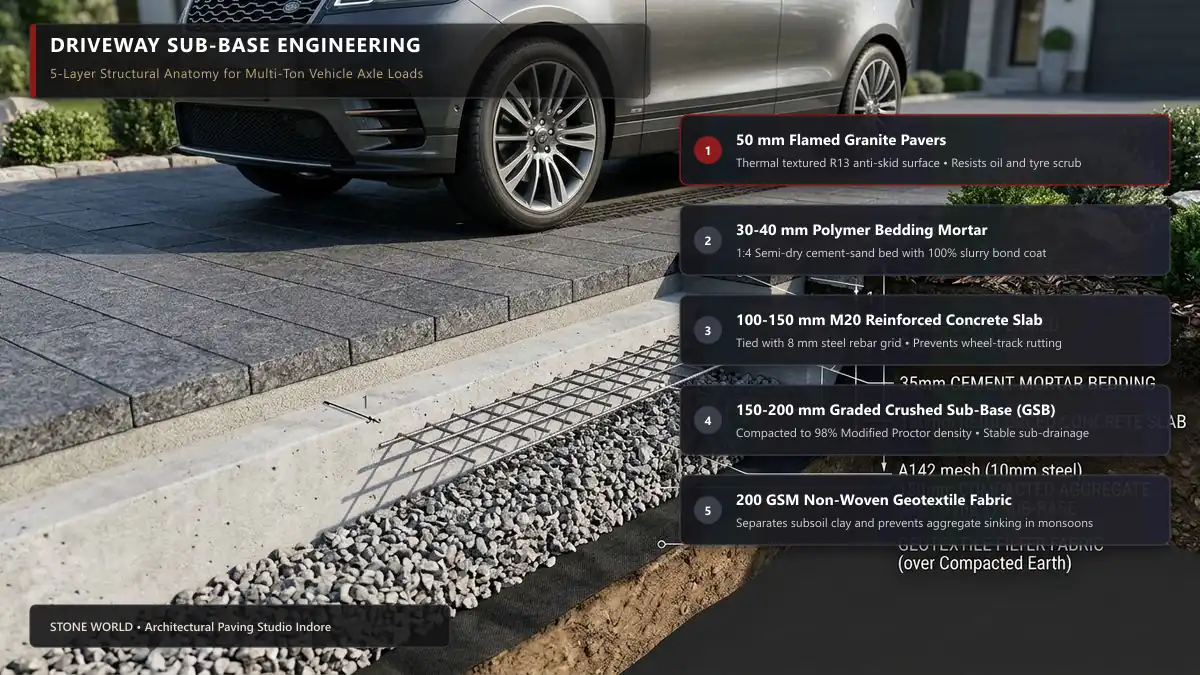
The structural cross-section of a vehicular stone paving assembly comprises five critical civil engineering components:
- Subgrade Preparation and Geotextile Membrane: The natural ground is excavated down to virgin subsoil, removing all organic matter and soft black cotton clay. A heavy-duty 200 GSM non-woven polypropylene geotextile fabric is laid across the excavation to prevent fine subgrade soil particles from migrating upward into the aggregate bed during monsoon saturation.
- Granular Sub-Base (GSB / WBM): A 150 mm to 200 mm layer of graded crushed blue metal aggregate (40 mm down to stone dust) is spread and mechanically compacted in 75 mm lifts using a heavy vibratory plate compactor to achieve 98 percent Modified Proctor Density.
- Reinforced Concrete Base Slab: For residential driveways carrying luxury SUVs or commercial service access, casting a 100 mm to 150 mm M20 grade reinforced concrete slab tied with an 8 mm structural steel rebar grid is essential. This rigid concrete raft spans local subsoil voids and prevents wheel track depressions.
- Calibrated Bedding Mortar: Stones are bedded on a 30 mm to 40 mm thick layer of semi-dry 1:4 cement-coarse sand mortar mixed with polymer bonding additives. Applying a neat polymer-modified cement slurry bond coat to the underside of each stone paver guarantees full 100 percent adhesive contact.
- Surface Paver Sizing and Thickness: For pedestrian areas, 20 mm to 30 mm stone suffices, but vehicular driveways demand calibrated stone thicknesses of 40 mm to 50 mm for passenger cars and 60 mm to 80 mm for heavy delivery trucks or multi-axle trailers.
To inspect various mechanical finishes suitable for exterior paving assemblies, read our technical overview of architectural stone finishes tailored for exterior durability.
8 Best Natural Stones for Driveway and Parking Paving
The eight best stones for vehicular surfaces include flamed granite, Kota limestone, granite cobbles, tumbled sandstone, split quartzite, Kadappa basalt, Dholpur sandstone and Mandana stone. Each provides distinct compressive load ratings, slip resistance and architectural aesthetics.
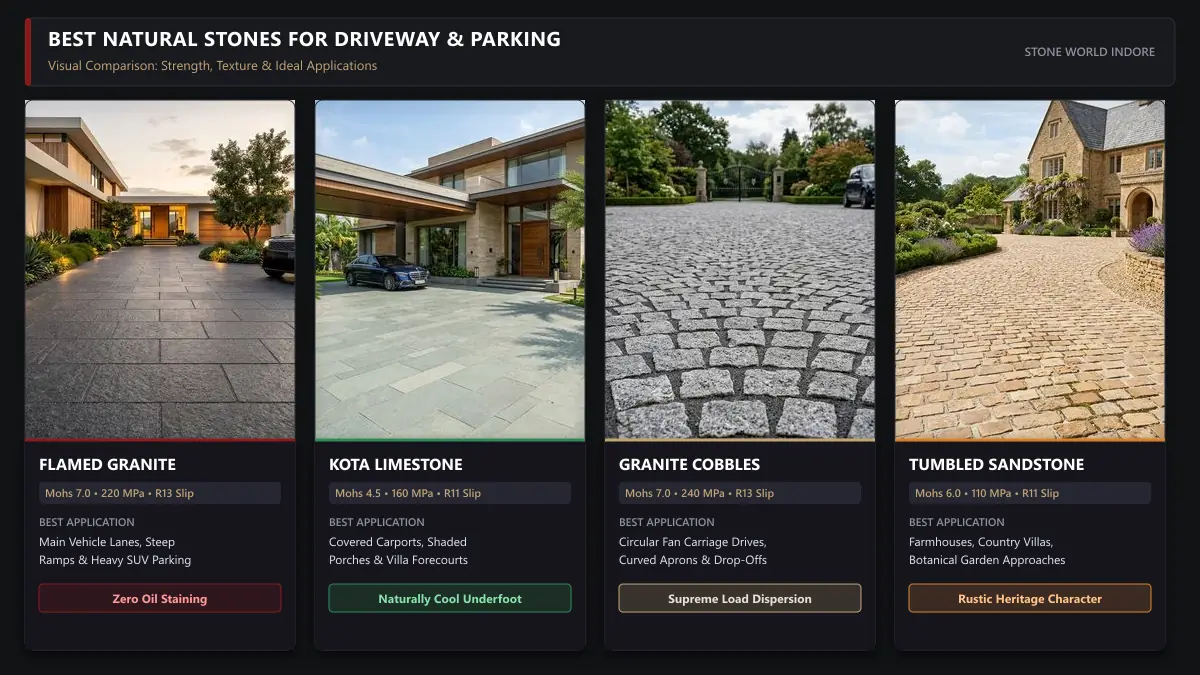
Every architectural project presents distinct landscape aesthetics, drainage slopes and traffic frequencies. Below are the eight most dependable indigenous Indian stones specified by seasoned civil engineers and landscape architects.
1 Flamed Granite Paving Slabs: Unrivaled Load Resilience
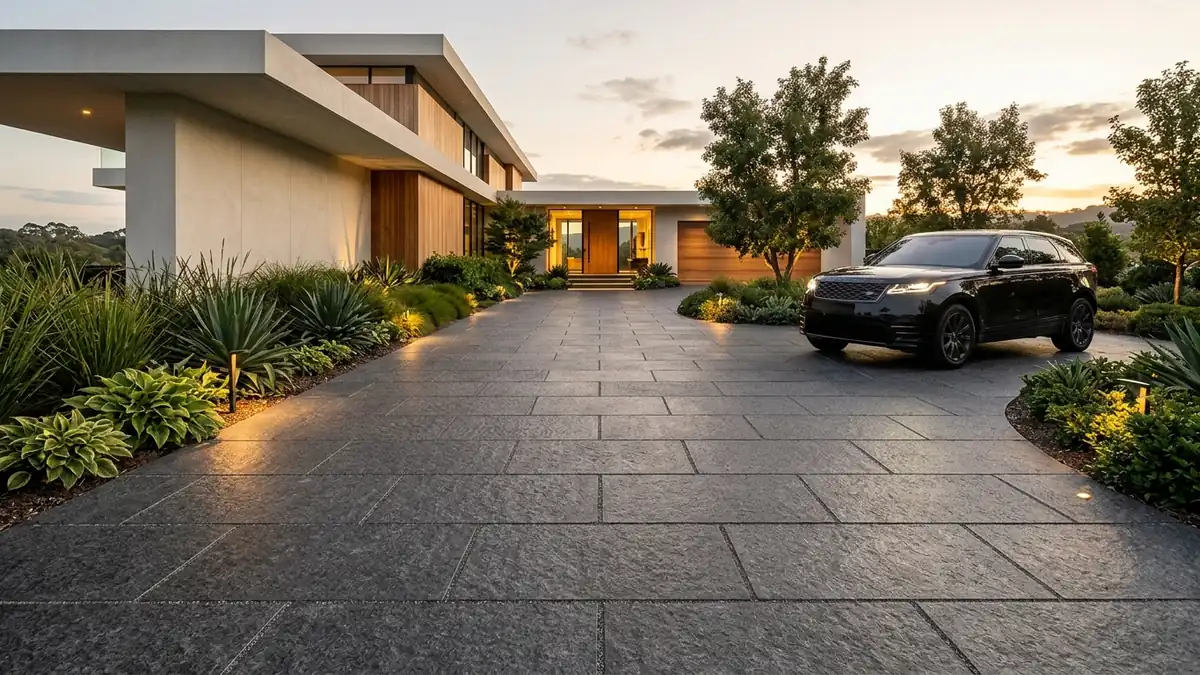
When engineering high-traffic driveways and entry ramps, a flamed granite parking floor represents the gold standard. Granite is an igneous rock formed by the slow crystallization of magma below earth surface, providing a Mohs hardness of 6.5 to 7.0 and compressive strength exceeding 200 MPa. Slabs quarried from Rajasthan Black, Chima Pink or Steel Grey deposits are subjected to high-temperature thermal flaming, bursting quartz crystals to create an aggressive, non-directional textured face.
Flamed granite features negligible water absorption (under 0.25 percent), ensuring complete resistance to motor oil, brake fluid and battery acid spills that permanently stain concrete.
2 Kota Stone Paving: Central India's Enduring Natural Workhorse

For covered carports, shaded porches and residential drives across Madhya Pradesh, Kota stone driveway flooring offers a balance of functional durability and regional authenticity. Quarried in nearby Ramganj Mandi, Kota stone is an exceptionally dense, fine-grained dolomitic limestone containing natural silica and calcite binders. When cut into 40 mm to 50 mm thick pavers and finished with a rough-honed, river-washed or natural-cleft texture, Kota stone provides natural slip resistance.
Its natural greenish-blue and warm honey tones remain naturally cool under foot, creating comfortable transition zones between open garden turf and covered vehicle bays.
3 Granite Cobblestones: Old-World Elegance with Supreme Load Distribution
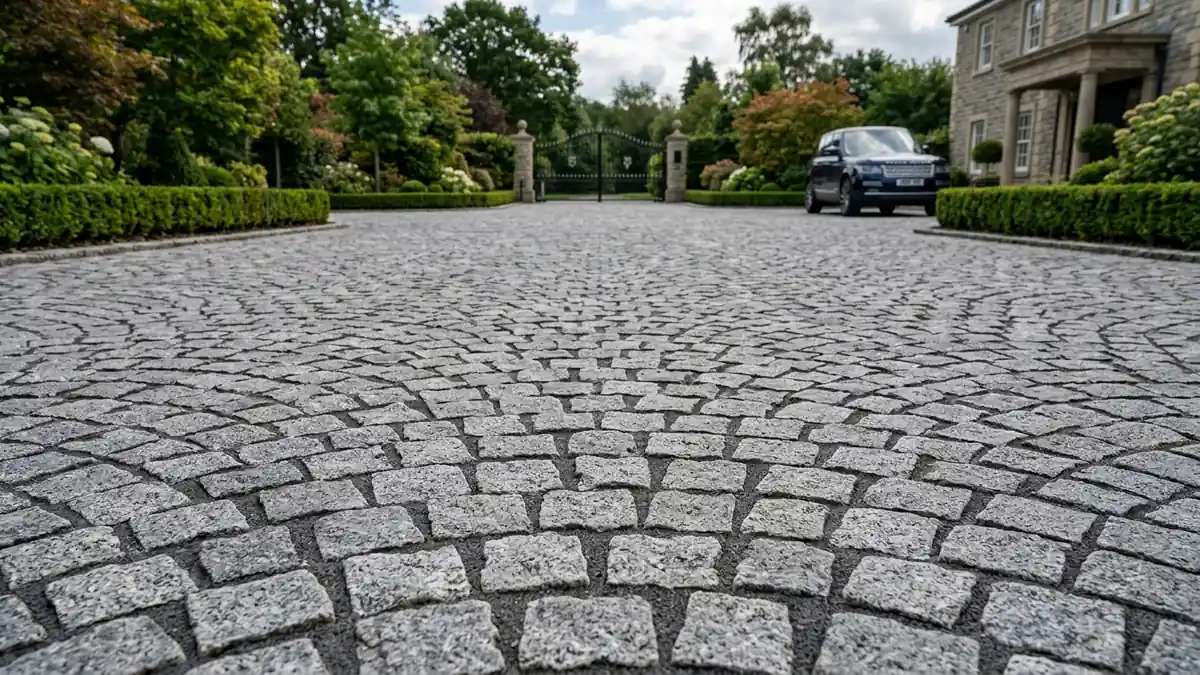
Timeless European-style circular carriage drives and heritage courtyard entries rely on cobblestone driveway pavers. Hand-split or machine-sawn granite cubes measuring 100 x 100 x 100 mm or 100 x 100 x 60 mm are laid in interlocking fan, herringbone, bogen or running bond patterns. Because cobbles feature a low aspect ratio (length-to-thickness ratio close to 1:1), vertical tyre loads cannot create bending stress or tensile cracking across the unit.
The dense grid of joints between cobblestones provides mechanical traction for vehicle tyres on steep entrance ramps while allowing rainwater to permeate into the sub-base.
4 Tumbled Sandstone Cobbles and Pavers: Soft Earthy Warmth
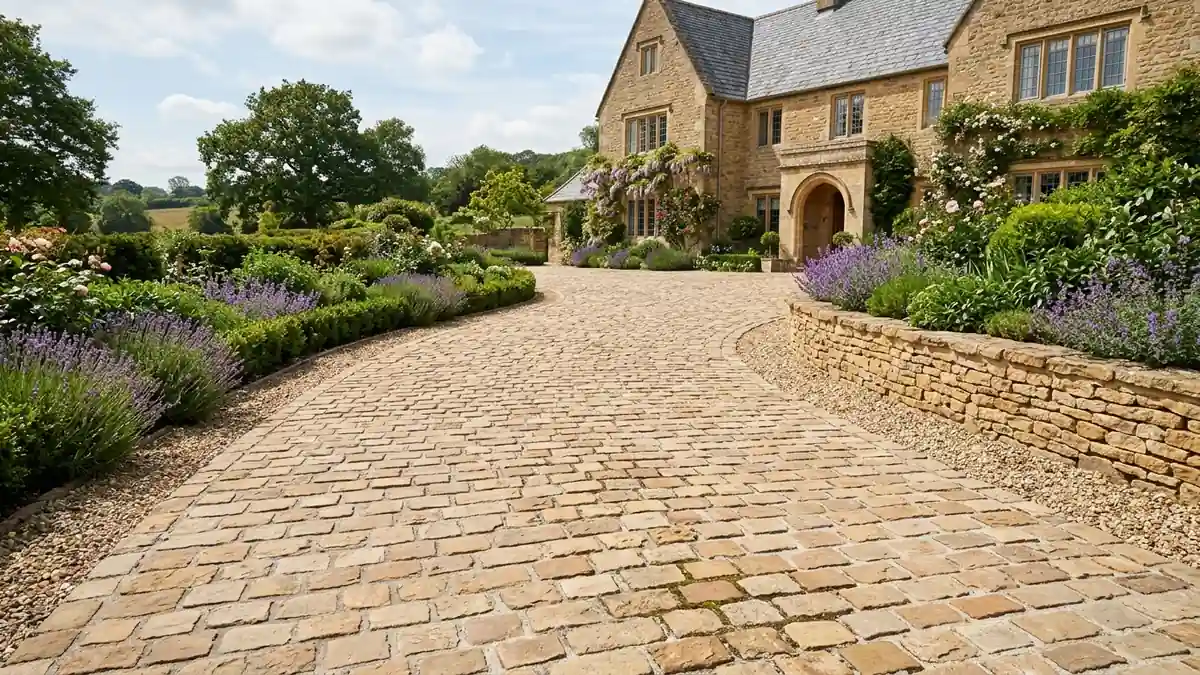
Discerning country villas and farmhouse estates benefit from the organic, aged appearance of tumbled sandstone cobbles. Natural sandstones quarried in Rajasthan, including Teakwood, Mint White and Autumn Brown, are cut into paver blocks and processed inside rotating tumbling drums with water and abrasive ceramic media. This mechanical tumbling rounds off sharp sawn edges and softens surface micro-ridges, replicating the look of centuries-old carriage roads.
When bedded over compacted aggregate with permeable sand joints, tumbled sandstone dissipates vehicle vibrations while blending into surrounding botanical gardens.
5 Split-Face Quartzite Flagstones: Maximum Traction on Steep Inclines

Driveways featuring steep approach grades, basement ramps or tight turning radii require extreme mechanical friction. Split-face quartzite flagstones deliver natural cleft ridges with a Mohs hardness of 7.0. Formed when sandstone undergoes intense metamorphic recrystallization, quartzite is rich in interlocking quartz grains that will not polish down or become slick under years of tyre friction.
The natural silver, charcoal and golden mineral banding in quartzite creates an architectural surface that disguises tyre rubber marks effortlessly.
6 Kadappa Black Stone: Deep Monolithic Contrast for Parking Bays
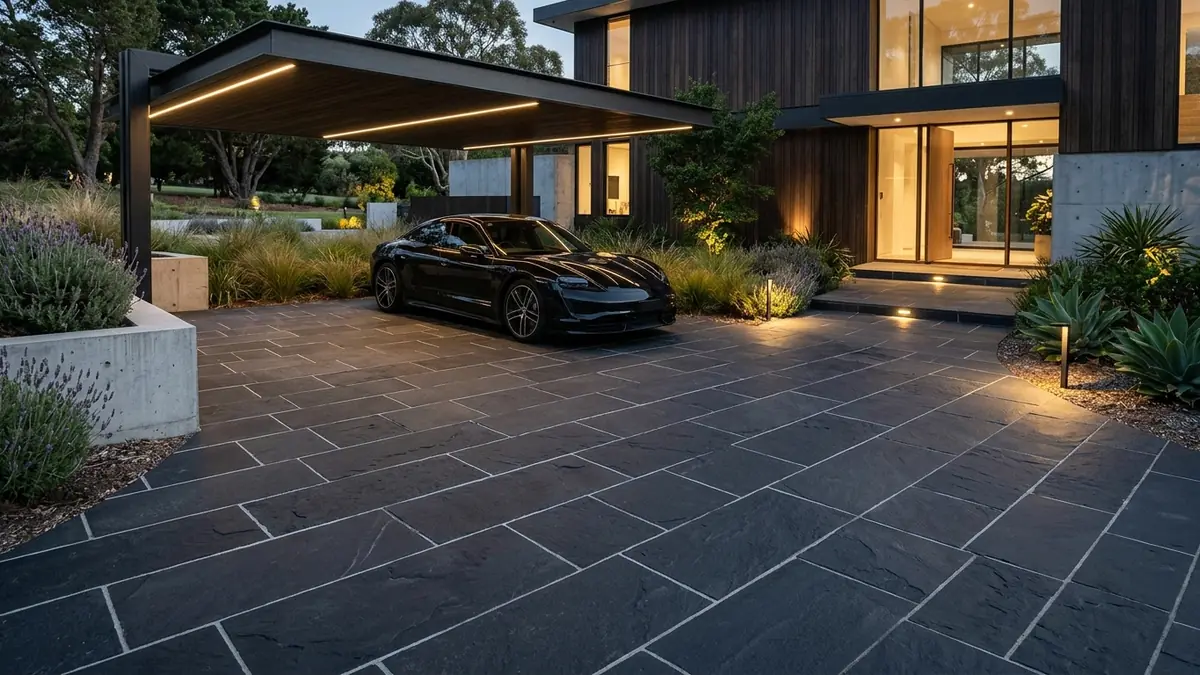
Kadappa stone, a dense black limestone quarried in Southern India, provides a deep charcoal-black aesthetic for contemporary villas. Available in calibrated 40 mm thick pavers with natural-cleft or brushed-antique finishes, Kadappa stone offers high structural density and low water permeability. Civil contractors frequently specify Kadappa slabs to delineate dedicated natural stone parking areas and vehicle stalls against lighter stone paving.
Its natural dark hue conceals occasional motor fluid drips and tyre marks, keeping executive parking bays clean between pressure-washing cycles.
7 Dholpur Beige Sandstone Pavers: Heritage Royalty and Light Reflection

Used for centuries in royal Indian palaces, Dholpur beige and red sandstones combine fine grain structures with warm buff tones. When calibrated into 50 mm thick driveway pavers with hand-chiseled or shot-blasted faces, Dholpur stone reflects harsh midday sunlight, keeping the arrival court noticeably cooler than asphalt or concrete. Its light coloration highlights night landscape illumination along residential driveways.
Because sandstone is moderately porous, applying a deep-penetrating oleophobic impregnating sealer protects the surface against vehicular oil absorption.
8 Mandana Red Stone: Acid-Resistant Heavy-Duty Paving
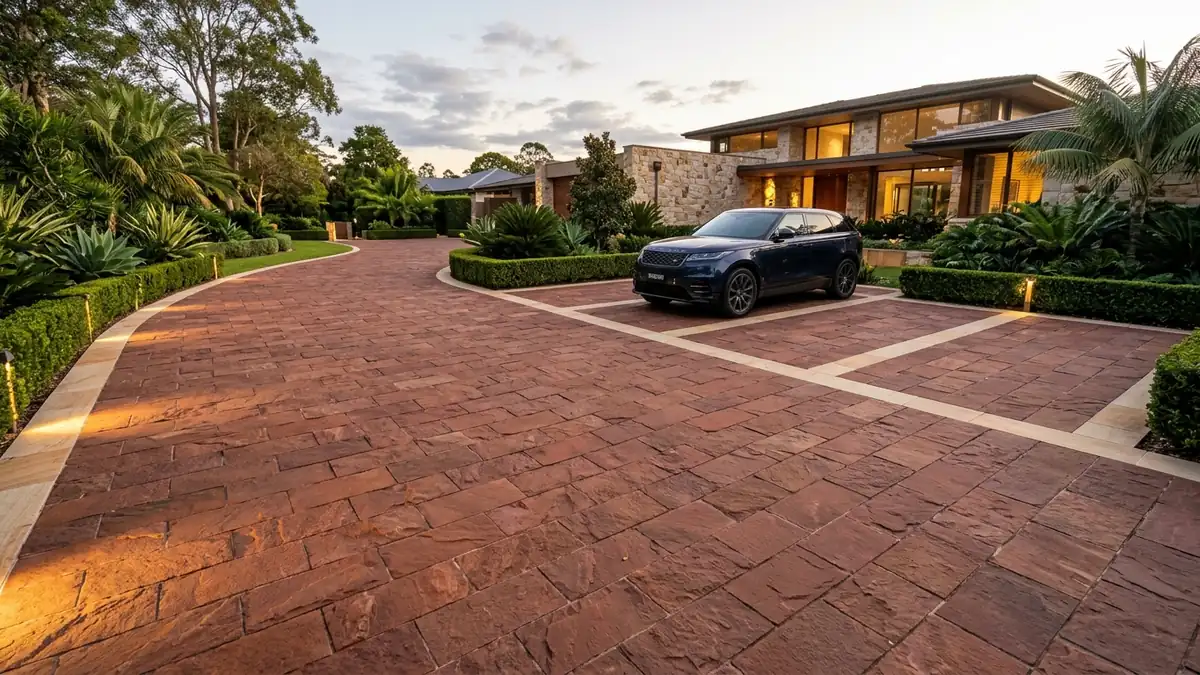
Mandana stone is an ultra-dense, chocolate-red chocolate sandstone quarried along the Rajasthan-Madhya Pradesh border. Renowned across industrial and chemical applications for its acid resistance and extreme crushing strength, 40 mm to 60 mm thick Mandana pavers make exceptional durable parking floor stones for open courtyards and wash bays. Mandana stone does not flake, pit or powder even when subjected to intense pressure washing.
To examine calibrated dimension stone slabs and custom thickness sawing, explore our curated selection of architectural granite stones crafted for demanding floor applications.
| Stone Material | Mohs Hardness | Compressive Strength | Slip Resistance (Wet) | Recommended Application Area |
|---|---|---|---|---|
| Flamed Rajasthan Granite | 6.5 - 7.0 | 180 - 240 MPa | R12 / R13 (Thermal Flamed) | Main driveway lanes, ramps and heavy SUV parking |
| Kota Stone (Limestone) | 4.0 - 4.5 | 140 - 175 MPa | R11 (Rough-Honed / Cleft) | Covered carports, residential porches and courtyards |
| Granite Cobblestones | 6.5 - 7.0 | 200 - 260 MPa | R13 (Natural Hand-Split) | Circular drop-offs, carriage drives and steep inclines |
| Tumbled Sandstone | 5.5 - 6.5 | 90 - 130 MPa | R11 (Tumbled Texture) | Country villa approaches, farmhouses and garden drives |
| Metamorphic Quartzite | 7.0 | 160 - 210 MPa | R12 (Natural Split-Face) | Basement access ramps and high-shear turning zones |
| Kadappa Basalt Stone | 5.0 - 6.0 | 150 - 190 MPa | R11 (Natural Cleft Face) | Parking bays, contrasting borders and apron bands |
Anti Skid Outdoor Stone Tiles: Textures, Grip and R-Ratings
Vehicular safety requires specialized mechanical textures meeting R11 to R13 ramp slip resistance ratings. Flamed, bush-hammered, waterjet chiseled and river-washed finishes create micro-grooves that break water surface tension, preventing tyre hydroplaning and slip hazards during monsoons.
A glossy polished stone surface has no place on an outdoor driveway. During heavy Central Indian monsoon downpours, a film of standing water trapped between smooth stone and smooth tyre rubber creates instantaneous hydroplaning risks. Specifying certified anti skid outdoor stone tiles and pavers ensures that vehicles maintain steering grip and braking traction even under wet, steep conditions.
International safety standards test slip resistance using the DIN 51130 oil-wet ramp test, classifying surfaces from R9 (lowest slip resistance) to R13 (highest traction):
- Flamed or Thermal Finish (R12 to R13 Rating): High-temperature acetylene torches pass rapidly across wet granite slabs. The rapid thermal expansion causes superficial quartz crystals to fracture, creating an aggressive, non-directional micro-cratered profile. This finish allows vehicle tyres to grip firmly while remaining easy to sweep clean of garden leaf debris.
- Bush-Hammered Finish (R12 Rating): Mechanical pneumatic heads fitted with rows of pyramidal tungsten-carbide pins hammer the face of the stone slab. This mechanical fracturing produces a uniform, pitted texture resembling natural weathered rock that disperses rainwater instantly.
- River-Washed or Leathered Finish (R11 Rating): After diamond flaming or abrasive wire brushing, rotating diamond-impregnated polymeric brushes polish the micro-peaks while preserving deep textured valleys. The resulting surface provides slip resistance while feeling smooth to bare feet when stepping out of a car.
- Natural Cleft or Hand-Split Face (R12 to R13 Rating): Produced naturally along geological cleavage planes in slate, quartzite and sandstone, hand-split faces offer organic three-dimensional character with maximum wet traction on steep entry ramps.
To inspect exterior steps and garden paths connecting vehicle courts to main villa entrances, review our dedicated guide to natural stepping stones for landscaping.
Permeable Stone Driveway Systems vs Rigid Mortar Beds
Permeable stone paving uses open-graded aggregate bedding and permeable joint sand to absorb stormwater, recharge local groundwater and eliminate surface pooling. Rigid mortar systems feature reinforced concrete slabs and bonded joints engineered for heavy axle loads and commercial turning courts.
When engineering an architectural driveway, civil contractors must select between two distinct installation philosophies: a flexible permeable stone driveway or a rigid bonded concrete mortar assembly. Each methodology serves specific site drainage conditions and vehicular load requirements.
| Engineering Feature | Flexible Permeable Stone Paving | Rigid Mortar & Concrete Base Paving |
|---|---|---|
| Bedding Layer Composition | 50 mm Open-graded 2-6 mm crushed stone grit | 30-40 mm 1:4 Polymer-modified cement sand mortar |
| Base Layer Structure | 200-300 mm Open-graded reservoir stone (no fines) | 100-150 mm M20 Reinforced concrete slab over GSB |
| Stormwater Management | 100% Infiltration; zero surface runoff | Requires 1:50 surface slope to drainage trenches |
| Joint Filling Material | Clean 2-4 mm basalt grit or polymeric sand | High-strength epoxy or polymer-modified cement grout |
| Thermal Expansion Movement | Self-accommodating via inter-stone joint shifting | Requires engineered expansion joints every 4 to 6 meters |
| Heavy Truck & Bus Tolerance | Moderate; requires 80 mm thick interlocking cobbles | Exceptional; concrete slab distributes massive axle loads |
Permeable paving systems represent an ecological solution for expansive farmhouses and sustainable estates. Stormwater filters directly between stone cobbles into the open-graded aggregate reservoir, replenishing subsoil groundwater aquifers without overloading municipal storm lines. However, for tight turning zones or car wash areas where detergents and oil are washed off vehicles, rigid bonded concrete assemblies paired with perimeter drain grates prevent hydrocarbon pollutants from seeping into subsoil layers.
Edge Restraints and Boundary Security: Stone Driveway Edging Curb Details
Heavy vehicle braking generates strong horizontal shear forces. Installing massive stone driveway edging curbs anchored by concrete haunching locks the perimeter paving in place, preventing lateral joint separation, edge chipping and sub-base washouts along garden borders.
A frequent point of structural failure on poorly built driveways is edge creeping. When a multi-ton vehicle brakes or steers sharply near the border of a driveway, lateral thrust forces push individual pavers outward into soft lawn soil. Installing a robust stone driveway edging curb creates an immovable structural boundary that locks the paving field tightly in compression.
Key civil engineering guidelines for driveway edge restraint curbs include:
- Curb Dimension and Density: Kerbstones must be fashioned from dense dimension stone such as flamed granite or thick Kota stone, measuring at least 150 mm in width, 250 mm to 300 mm in depth and 600 mm to 1000 mm in length.
- Continuous Concrete Haunching: Curbs must be bedded on a 100 mm concrete foundation with a triangular M20 concrete haunch poured behind the curb unit up to two-thirds of its total height. This haunching resists vehicular wheel impacts without tilting.
- Edge Profile Shaping: Kerb tops should feature a 15 mm to 25 mm chamfer or pencil bullnose on the traffic side to prevent tyre scuffing and reduce corner chipping when vehicles pull close to landscape beds.
- Drainage Weep Channels: Where driveways slope outward toward lawn swales, curbs must incorporate recessed slots or perforated drain spouts every three meters to prevent rainwater from damming up along the edge of the stone paving.
For ideas on tying boundary walls and entrance gate posts into your driveway paving, browse our architectural portfolio of natural stone boundary wall designs.
Cost Drivers: Understanding Driveway Stone Cost Per Sq Ft Factors
Driveway stone investment is determined by stone quarry rarity, calibrated slab thickness (40 mm to 80 mm), custom CNC edge profiling, sub-base concrete rebar thickness and permeable joint complexity rather than arbitrary square foot numbers.
When budgeting for an architectural arrival court, evaluating driveway stone cost per sq ft requires understanding the civil and structural components that govern long-term performance. Cutting corners on stone thickness or foundation concrete leads to cracked slabs and expensive reconstruction within a few monsoons.
The principal cost determinants for natural stone driveway construction encompass:
- Stone Mineral Class and Sourcing Distance: Indigenous regional stones like Kota limestone and Dholpur sandstone involve lower freight logistics across Central India, whereas ultra-dense Rajasthan black granites and silica-rich quartzites represent premium investments due to specialized extraction and diamond wire sawing costs.
- Calibrated Thickness and Block Wastage: Thin 20 mm slabs require less raw rock volume, but vehicular driveways demand thick 40 mm, 50 mm or 80 mm blocks. Producing heavy-gauge paving requires gang-sawing larger quarry boulders, which increases raw stone tonnage.
- Surface Texturing Mechanics: Standard rough-sawn stone involves basic processing, whereas controlled thermal flaming, pneumatic bush-hammering, antique tumbling or precision waterjet texturing requires automated processing lines and skilled diamond tool operators.
- Layout Geometry and Joint Complexity: Rectangular running bond patterns require standard orthogonal cuts with low cutting wastage. In contrast, radial fan cobblestone motifs, circular carriage circles, curved kerbs and diamond border highlighters require waterjet CNC cutting and precision manual tailoring on site.
- Foundation Civil Engineering: Site excavation depth, geotextile grade, crushed aggregate compaction volume and reinforced concrete slab specifications directly influence overall project scope and longevity.
| Project Specification Tier | Typical Structural Assembly | Primary Stone Specification | Key Performance Cost Drivers |
|---|---|---|---|
| Standard Residential Carport | Compacted GSB + M15 bed | 35-40 mm Rough-Honed Kota Stone | Lightweight vehicle use, manual cutting, regional quarry value |
| Architectural Villa Driveway | M20 RCC slab + semi-dry mortar | 50 mm Flamed Rajasthan Black Granite | Heavy SUV axle loads, thermal flaming, integrated curb haunching |
| Heritage Carriage Court | Permeable reservoir or rigid RCC | 80-100 mm Hand-Split Granite Cobbles | Radial fan geometry, artisan hand-dressing, polymeric jointing |
Visiting the Premier Stone Driveway Experience Center in Indore
Consulting with an architectural stone studio guarantees precision calibration, quarry-direct material integrity and trade-tested civil specifications. Stone World provides full-scale mockups, CNC edge profiling and technical engineering support across Central India.
When searching for reliable stone driveway suppliers in indore, homeowners and architects often encounter general tile dealers who offer thin interior floor slabs unsuited to vehicular axle torque. In contrast, Stone World operates a dedicated architectural stone studio and stone experience center in Indore focused exclusively on authentic indigenous Indian natural stones engineered for demanding structural roles.
Why leading architects, landscape planners and developers across Indore, Bhopal, Ujjain and Dewas collaborate with Stone World:
- Our advanced stone studio houses high-tonnage bridge saws, diamond profile routers and CNC waterjet tables capable of calibrating paving slabs to precise tolerances and shaping curved radius curbs.
- Clients can visit our stone experience center to inspect full-size driveway mockups, touch tactile flamed, bush-hammered and tumbled textures in natural sunlight and evaluate true stone coloration.
- We pre-assemble and dry-fit complex driveway components, such as circular fan cobbles, decorative compass rosettes and mitred ramp borders, right on our facility floor prior to dispatch.
- Our in-house stone specialists review subgrade conditions, drainage slope profiles and vehicle load classes to recommend tailored bedding formulations and penetrating oleophobic sealers.
Visit the Stone World Experience Center in Indore
Inspect live mockups, feel stone textures in person and discuss your upcoming architectural or villa project.
Frequently Asked Questions
Which natural stone is best for a heavy car driveway?
Flamed granite and split cobblestones are the best natural stones for heavy vehicle driveways. Their compressive strength exceeds 200 MPa, providing complete resistance to tyre scrub, braking torque, motor oil stains and cracking under multi-ton vehicle loads.
What is the minimum thickness required for natural stone driveway pavers?
For standard passenger cars and SUVs, natural stone pavers should be calibrated to a minimum thickness of 40 mm to 50 mm. For areas handling delivery trucks, commercial vans or multi-axle vehicles, specify 70 mm to 80 mm thick pavers or 100 mm cubic cobblestones.
Can Kota stone be used for outdoor parking and driveway paving?
Yes, Kota stone is an excellent and cost-effective choice for residential parking and carports when specified in 40 mm to 50 mm calibrated thicknesses. It should feature a rough-honed, river-washed or natural-cleft finish to maintain slip resistance and must be treated with a penetrating sealer to guard against oil absorption.
How do you prevent motor oil and grease stains on natural stone driveways?
Apply a breathable, deep-penetrating fluoropolymer or silane-siloxane impregnating sealer with oleophobic (oil-repellent) properties immediately after installation. This prevents petroleum hydrocarbons from penetrating the stone pores while allowing internal moisture vapor to escape harmlessly.
Are natural stone driveways slippery when wet during the monsoon?
No, provided the stone is processed with anti-skid surface textures such as thermal flaming, bush-hammering or hand-splitting. These treatments produce non-directional micro-textures that achieve international R11 to R13 slip resistance ratings, ensuring positive tyre and foot traction in heavy rain.
What is the difference between permeable and rigid stone driveway installations?
A permeable stone driveway uses open-graded aggregate bedding and permeable joint sand to allow rainwater to drain directly into the ground, eliminating standing puddles. A rigid installation beds stone on a reinforced concrete slab using polymer cement mortar, designed to carry maximum axle loads and prevent any subsoil movement.