


When the winter chill sets in, an open garden or rooftop terrace transforms from a sunny retreat into a cool evening expanse. Creating an inviting outdoor lounge requires more than outdoor heaters or temporary fire bowls. That is why architects, landscape designers and discerning villa owners specify natural stone fire pit designs to anchor their outdoor living spaces. Real stone absorbs radiant thermal energy from open flames, stores that heat deep within its dense crystalline matrix and radiates gentle warmth across the terrace long after the last ember settles.
At Stone World, our stone studio and stone experience center in Indore works directly with landscape architects, developers and homeowners across Central India to engineer bespoke natural stone hearths, courtyards and patio surrounds. This guide explores the ten most enduring fire pit concepts for winter, structural thermal mechanics, refractory masonry safety, edge coping profiles, realistic cost drivers and maintenance routines for outdoor stone.
Table of Contents
Why Natural Stone Fire Pit Designs Transform Winter Outdoor Living
Natural stone fire pit designs provide unmatched thermal mass storage, radiant perimeter heat distribution and organic architectural beauty. Unlike thin metal bowls or concrete castings, dense natural stone resists flame spalling, survives monsoon moisture cycles and gains rich character across decades of outdoor winter use.
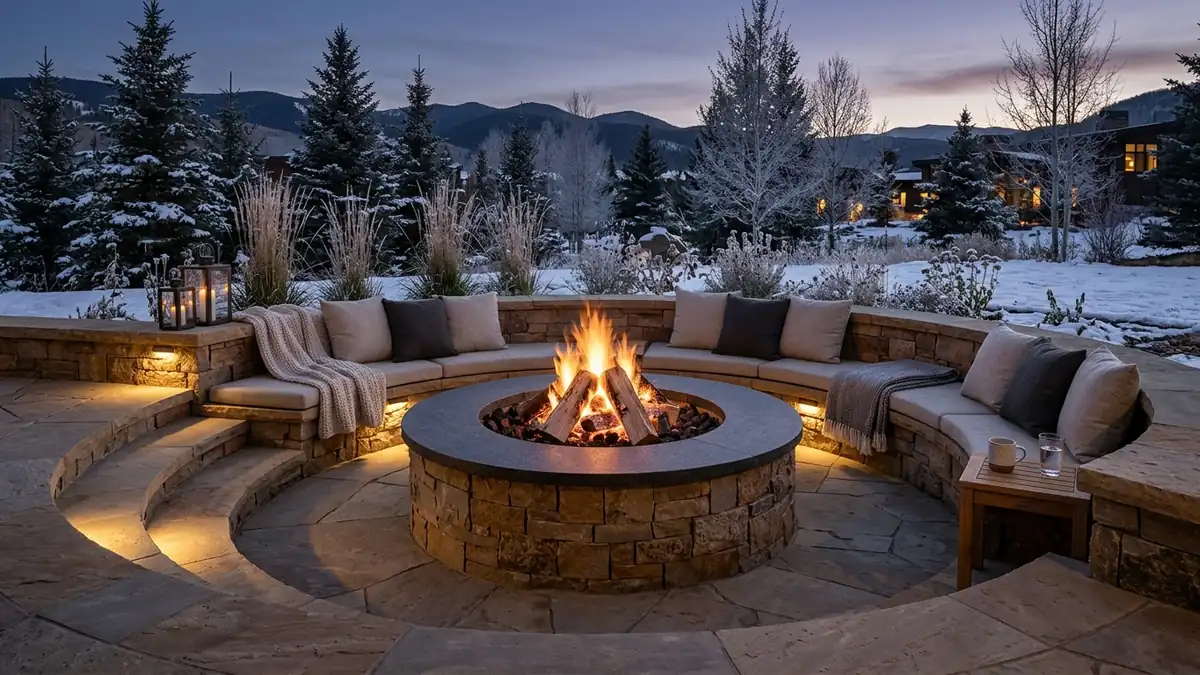
Outdoor winter gatherings center on warmth, comfort and conversation. While cast iron or sheet metal fire bowls rust when left open to the elements, dimension stone masonry creates a permanent, architectural focal point in your garden. Exploring creative outdoor stone fire pit ideas allows architects to integrate low seat walls, integrated lighting and perimeter flagstone paving into a unified landscape zone.
Dense indigenous stones like granite, quartzite and regional sandstones act as natural heat sinks. During a two-hour fire, the stone structure absorbs convective warmth. When the fire burns down to embers, the stone releases radiant infrared heat outward at seat height, keeping guests comfortable in crisp air. You can explore our dedicated portfolio of landscape natural stone installations to see how stone features anchor luxury villa grounds.
Anatomy & Engineering: Choosing Heat Resistant Stone for Fire Pit Construction
Building a safe fire pit requires dual-wall masonry engineering. An inner fire chamber built with refractory firebricks and fire clay mortar isolates intense flame heat, while an exterior envelope of dense natural stone provides structural stability, moisture protection and cool outer surfaces.
A common mistake in DIY or unguided masonry is exposing decorative stone directly to open wood fires. Trapped moisture inside natural fissures can turn to steam under direct thermal exposure, causing structural cracking or surface spalling. Choosing the right heat resistant stone for fire pit exteriors requires understanding how geology interacts with high temperatures.
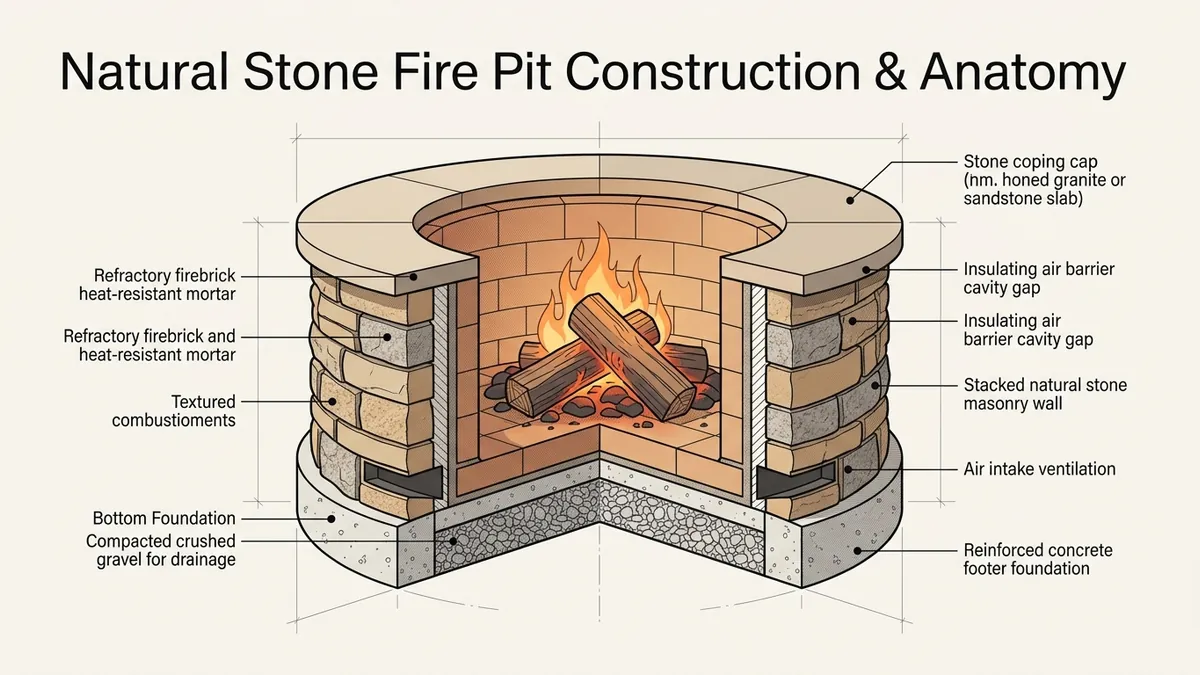
Professional fire pit construction relies on four distinct engineering layers:
- The inner burn ring must be built with ASTM C24-rated refractory firebricks set in high-temperature hydraulic refractory mortar, capable of withstanding temperatures exceeding 900 degrees Celsius without expansion stress.
- A continuous 25 mm air gap or thermal insulation blanket between the firebrick core and the decorative outer masonry prevents excessive heat transfer to the exterior stone facing.
- The outer decorative structure uses heavy dimension stone, stacked ledgestone or thick slabs bonded with polymer-modified exterior mortar and mechanical anchor ties.
- Passive base air intake vents ensure adequate oxygen supply to wood embers while functioning as bottom drainage weep holes during heavy monsoon rains.
To inspect various natural surface textures suitable for heat surrounds, review our guide to natural stone finishes designed for architectural masonry.

| Natural Stone Variety | Mohs Hardness | Thermal Shock Behavior | Porosity & Frost Tolerance | Recommended Fire Pit Component |
|---|---|---|---|---|
| Granite (Honed or Flamed) | 6.0 - 7.0 | High stability with dual-wall buffer | Very low porosity (under 0.4%) | Heavy top coping caps and outer wall cladding |
| Sandstone (Teakwood or Mint) | 5.5 - 6.5 | Gentle radial thermal expansion | Moderate porosity (needs breathable sealer) | Carved fire bowls, seat walls and patio paving |
| Quartzite (Split-Face) | 7.0 | Extreme heat and cold resistance | Virtually non-porous (under 0.2%) | Stacked stone exterior masonry and risers |
| Slate (Natural Cleft) | 4.0 - 5.0 | Requires indirect air gap buffer | Low water absorption | Exterior vertical wall tiles and decorative risers |
| Kota Stone (Limestone) | 3.5 - 4.5 | Moderate heat tolerance | Dense, fine-grained structure | Perimeter patio flooring and sunken lounge steps |
10 Best Natural Stone Fire Pit Designs for Winter
The ten best natural stone fire pit designs blend architectural form with winter comfort. Options range from rugged stacked quartzite ledgestone and sleek circular granite coping to sunken conversation pits, carved sandstone monoliths and dual-fuel linear fire tables.
Every courtyard, terrace or lawn presents unique wind patterns, sightlines and seating needs. Below are ten trade-tested design concepts crafted from indigenous Indian natural stone varieties.
1 Rustic Split-Face Quartzite and Stacked Stone Fire Pit
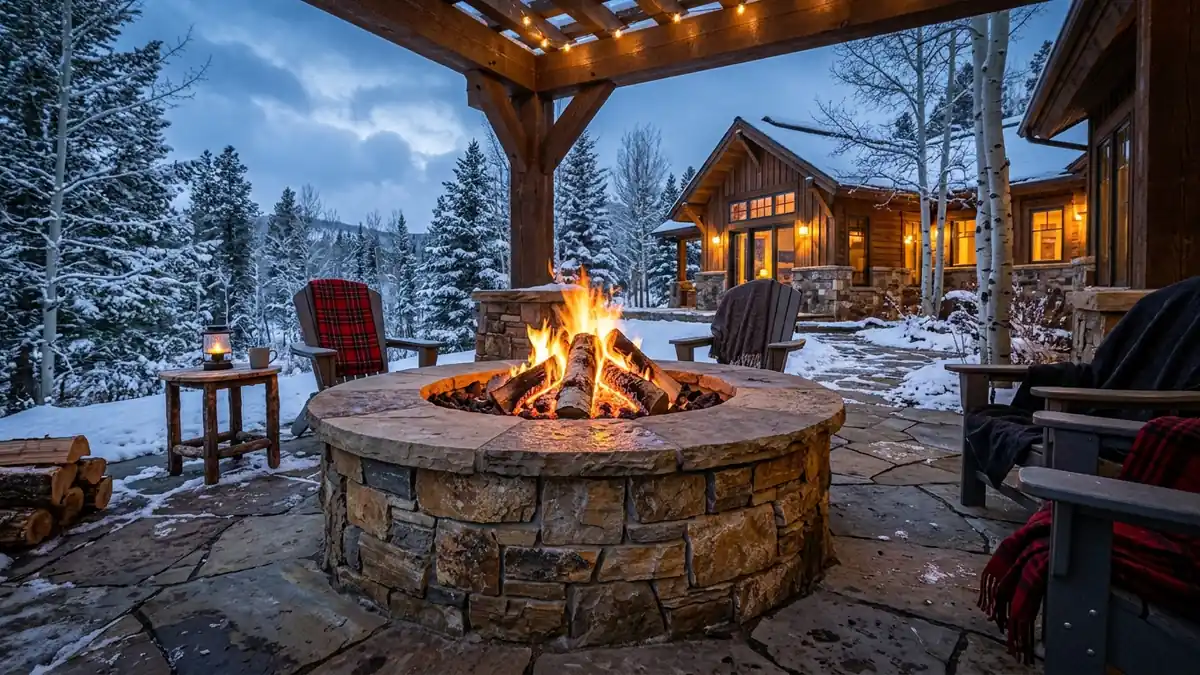
For rustic modern homes and country villas, a stacked stone fire pit built with split-face golden or grey quartzite delivers rich textural character. Masonry craftsmen lay irregular dry-stack stone courses over a reinforced cinder block core, hiding mortar joints deep within the recesses to create the look of traditional dry stone field masonry.
Quartzite's high silica content provides outstanding thermal stability, resisting both intense winter frosts and crackling firewood heat without crumbling.
2 Modern Circular Stone Fire Pit with Cantilevered Granite Rim
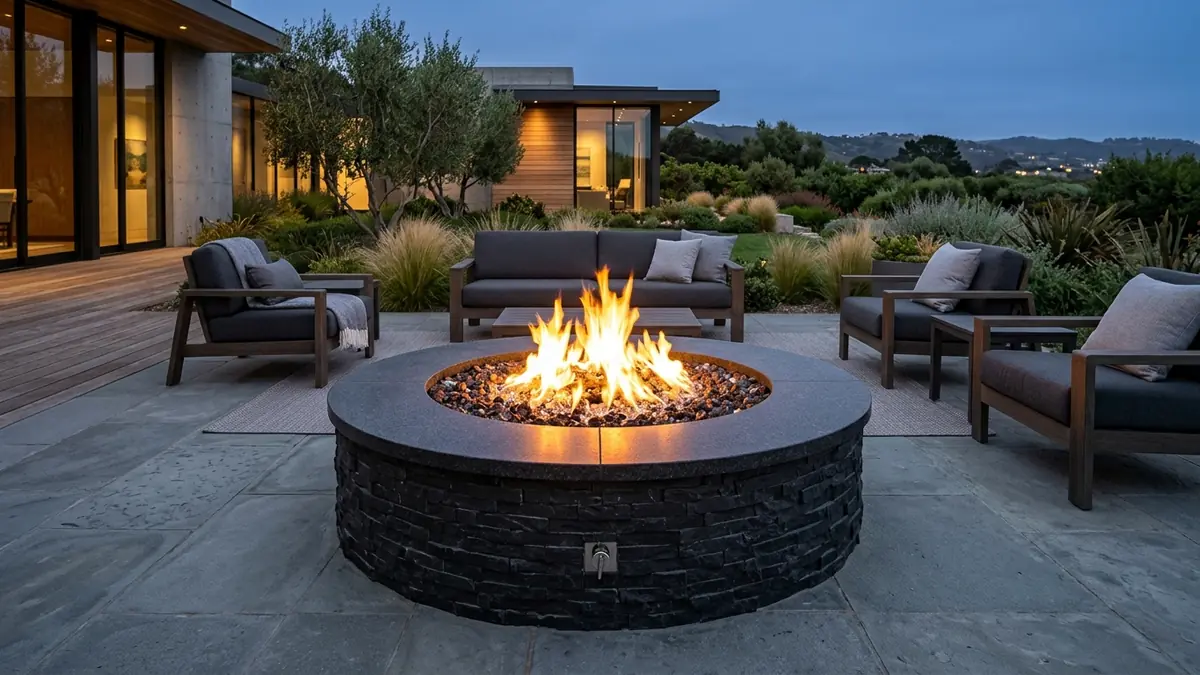
A modern circular stone fire pit creates natural 360-degree social gatherings. Its circular geometry allows equal heat distribution to everyone seated around the perimeter. Finishing the outer perimeter with honed black granite walling capped by a 50 mm thick bullnose coping creates a clean silhouette.
The dark stone retains solar heat during the afternoon and complements the warm orange glow of natural wood flames at dusk.
3 Sunken Stone Fire Pit Seating Lounge with Retaining Wall
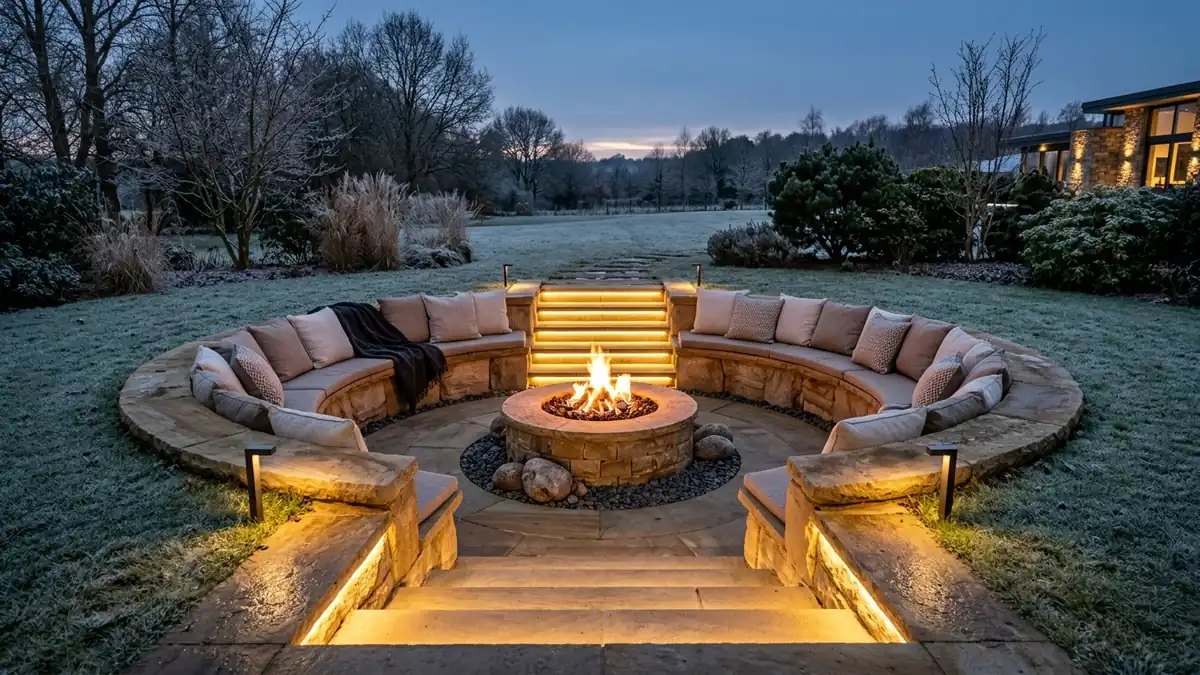
Excavating the earth to create sunken stone fire pit seating provides unmatched intimacy while shielding the open fire from cold winter crosswinds. The surrounding retaining walls serve as backrests for built-in stone benches lined with outdoor cushions.
Lining the sunken floor with natural Kota stone or sandstone pavers keeps feet dry and insulated from chilly ground dampness.
4 Hand-Carved Sandstone Fire Pit Bowl for Compact Courtyards
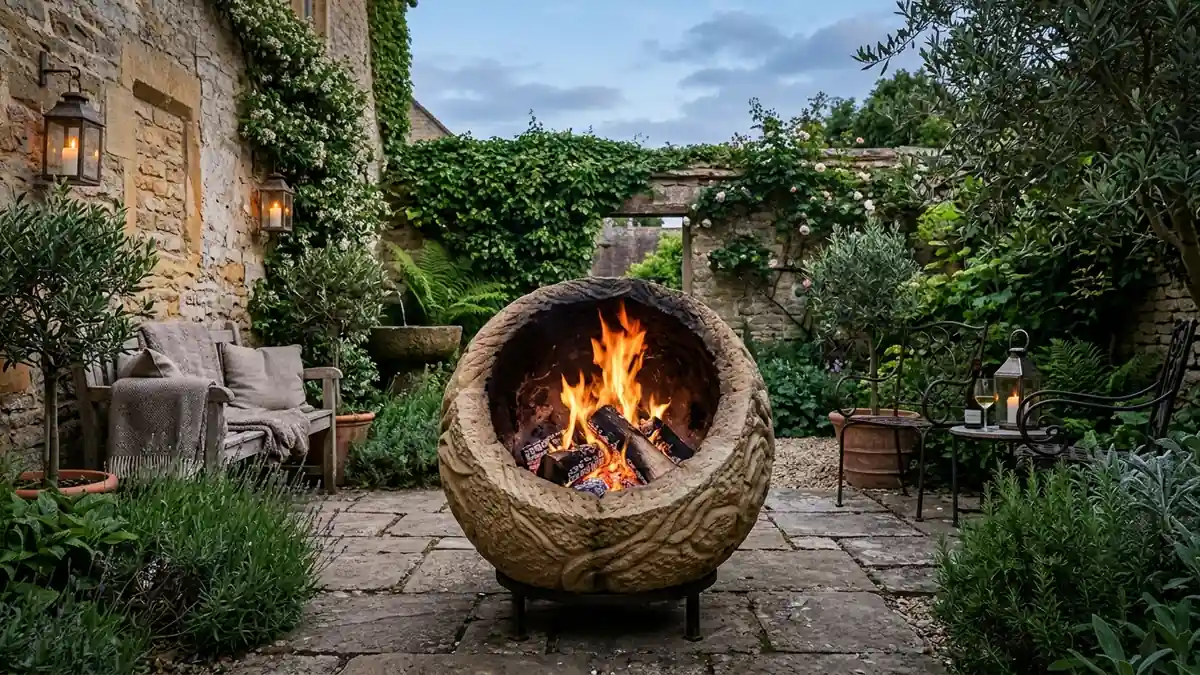
In boutique courtyards or urban rooftop gardens where slab weight is a design consideration, a sculptural sandstone fire pit bowl acts as an artistic garden centerpiece. Master stone carvers hollow out a solid block of Dholpur beige or Teakwood sandstone, creating a smooth spherical or shallow bowl form.
Fitted with a stainless steel drop-in burner pan or removable wood grate, this design combines timeless sculptural artistry with functional warmth.
5 Monolithic Flamed Granite Fire Pit Surround for Modern Terraces
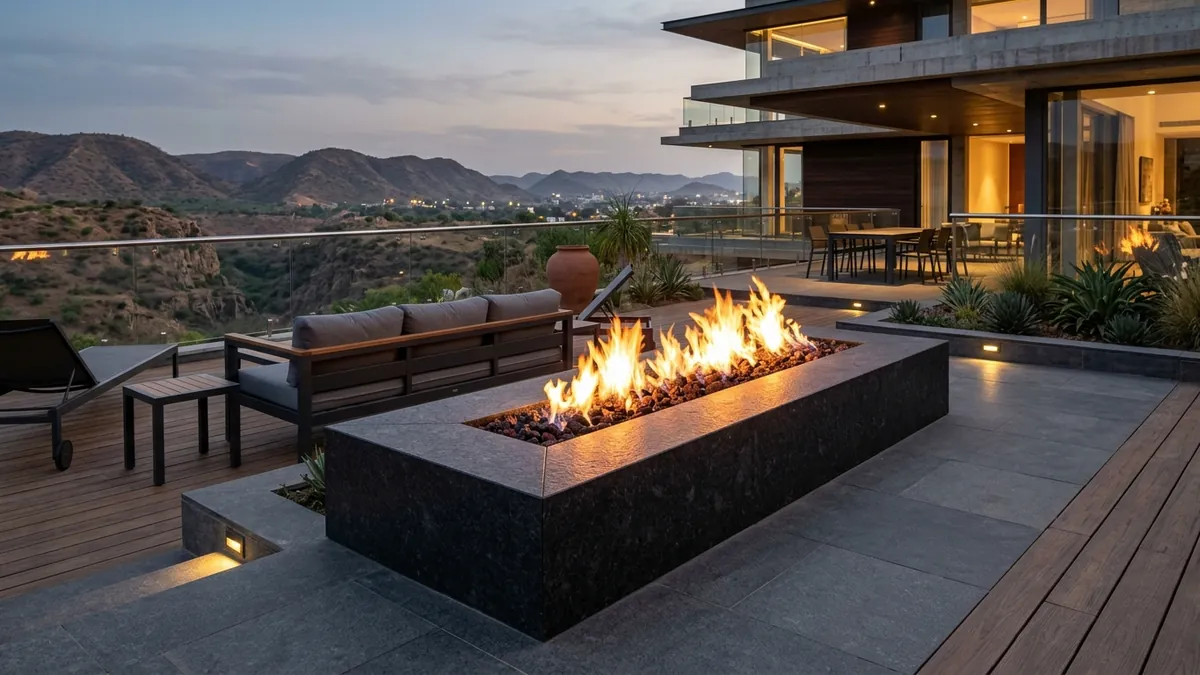
Minimalist villas benefit from clean rectilinear lines. A monolithic granite fire pit surround uses thick flamed Rajasthan Black or Jhansi Red granite slabs mitred with precision 45-degree waterjet joints. The flamed texture provides a slip-resistant, non-reflective matte finish that conceals airborne ash or wood sap marks.
Granite's dense structure ensures zero liquid absorption from spilled beverages during social gatherings.
6 Expansive Flagstone Patio with Fire Pit and Curved Benches
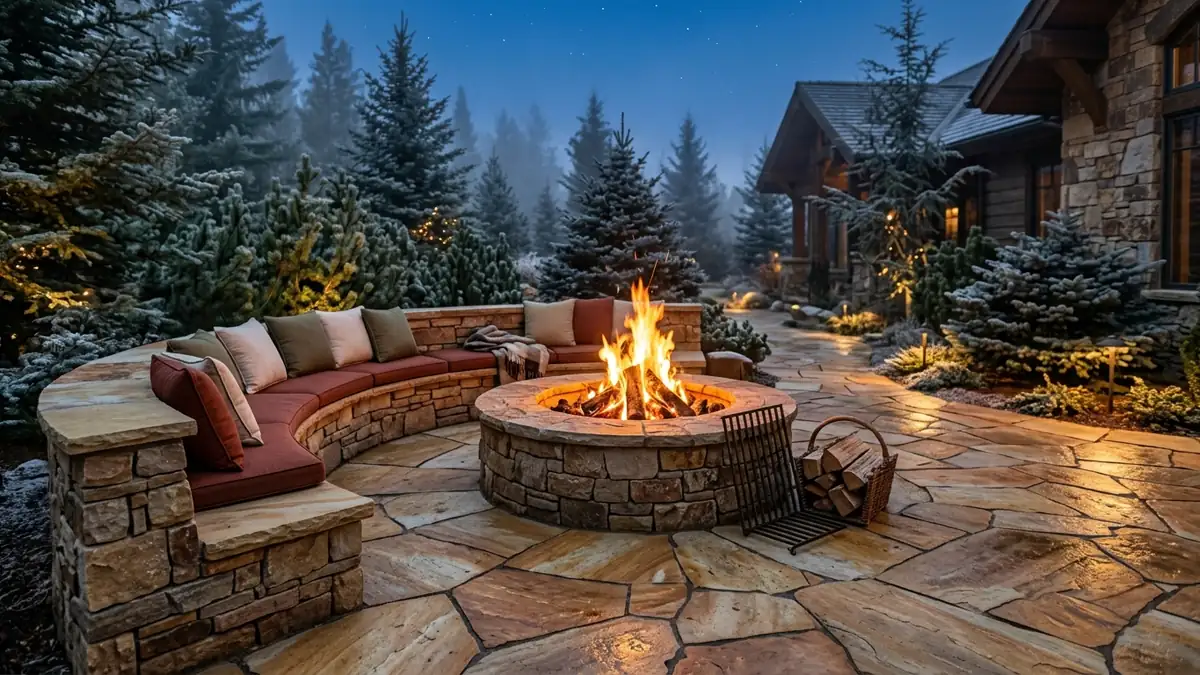
Rather than treating the fire feature as an isolated element, a cohesive flagstone patio with fire pit unifies the entire landscape terrace. Using large format irregular sandstone flagstones with tight mortar joints creates an expansive ground plane that invites movement.
Integrated semi-circular stone benches match the patio material, creating a dedicated zone for larger family celebrations and winter dinner parties.
7 Dual-Fuel Linear Stone Hearth for Modern Verandas
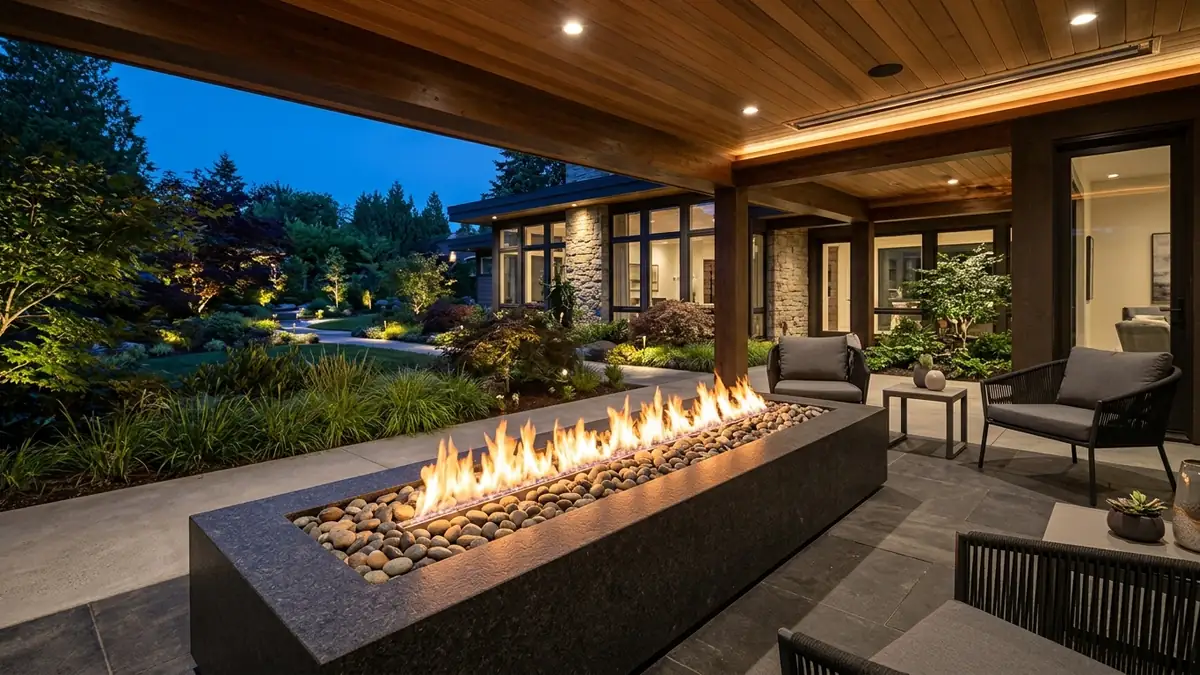
A rectangular linear fire pit measuring two meters in length provides an architectural boundary between a covered patio veranda and open garden turf. Built from honed granite side panels and topped with river-washed black pebbles over a concealed gas burner, this elongated profile produces an unbroken curtain of dancing flames.
The linear proportion allows dining chairs or daybeds to line up along either side, distributing warmth evenly across long seating arrangements.
8 Multi-Level Water and Fire Cascade with Chiseled Slate
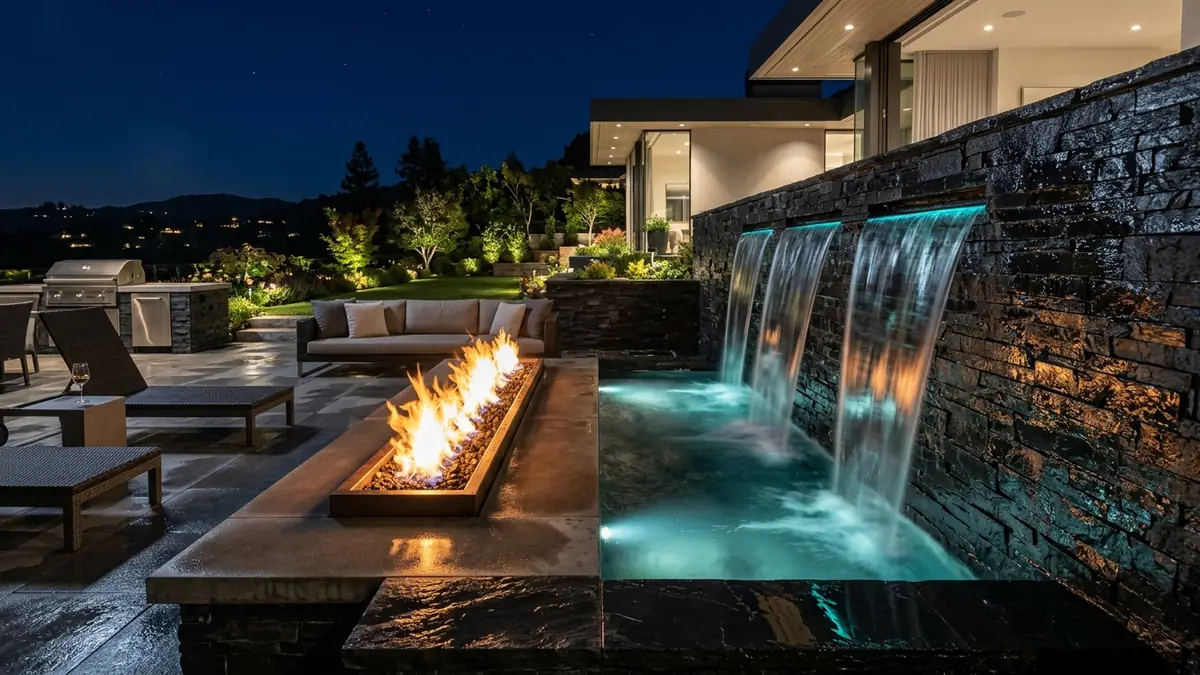
Pairing contrasting elemental forces creates hypnotic sensory drama. In this design, a raised natural stone fire pit is bordered by a gentle weeping water cascade crafted from dark natural cleft slate tiles. The sound of trickling water mixes with crackling firewood, while water reflections double the ambient glow of the fire.
Dark slate accents contrast sharply with warm sandstone coping, establishing rich visual depth across the landscape.
9 Low-Profile Kota Stone and Teak Sandstone Fire Table
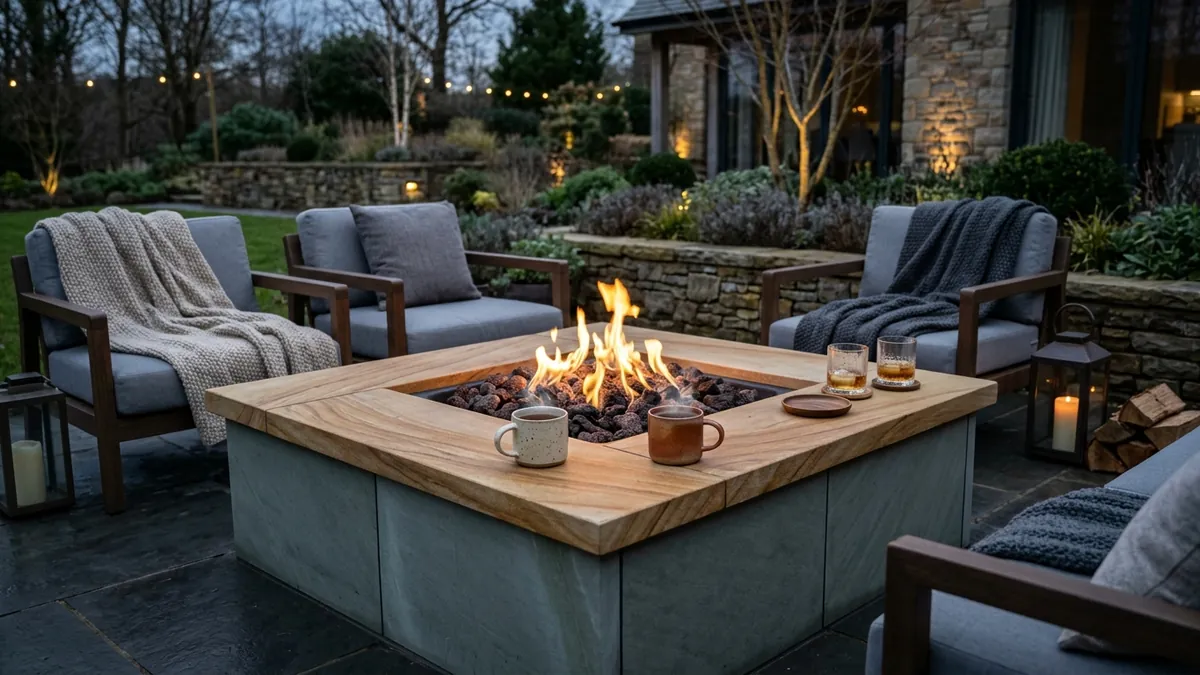
Designed at standard coffee table height (450 mm from ground level), this hybrid design features an extra-wide horizontal stone perimeter. Guests can safely rest tea mugs, wine glasses and small plates along the outer stone ring without heat transmission.
Combining greenish-blue honed Kota stone for the base with warm Teakwood sandstone coping creates an attractive two-tone organic color palette.
10 Heritage Carved Sandstone Fire Hearth with Traditional Indian Jharokha Accents
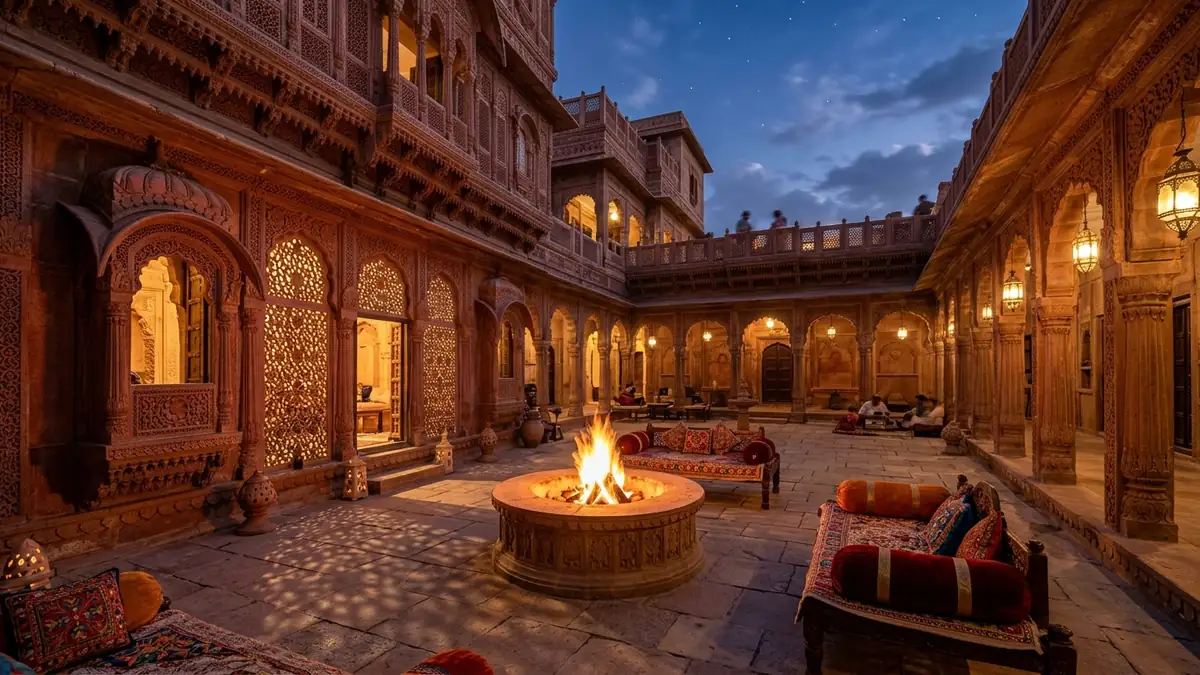
Celebrating classical Indian stone architecture, this bespoke design incorporates hand-carved floral motifs, traditional jali panels and sculpted brackets carved from pink or buff Rajasthan sandstone. The intricate stonework screens subtle low-voltage LED uplighting behind the stone panels, highlighting artisanal carvings even when the fire is unlit.
This design fits heritage farmhouses, royal courtyards and luxury estate gardens seeking deep cultural character.
To examine dense stone slabs and bespoke fabrication capabilities, browse our curated collection of granite stone varieties suitable for outdoor hearth surrounds.
Gas vs Wood Stone Fire Pit: Fuel, Masonry and Ventilation Mechanics
Choosing between gas and wood fuel impacts structural masonry dimensions, foundation utility rough-ins and cleaning routines. Wood fires deliver higher radiant temperatures, crackling acoustic ambience and authentic wood aromas, while gas systems offer instant push-button ignition, smokeless burning and pinpoint flame height control.
When planning a winter outdoor fireplace, deciding between a gas vs wood stone fire pit determines your structural masonry and utility layout from day one. Retrofitting gas lines into an existing solid stone structure after construction is costly, so specifying fuel sources early is vital.
| Engineering Feature | Authentic Wood Burning Stone Pit | Piped Natural Gas or LPG Stone Pit |
|---|---|---|
| Chamber Temperature | Exceeds 700 to 900 degrees Celsius | Consistent 400 to 600 degrees Celsius |
| Firebrick Lining Requirement | Mandatory ASTM C24 high-duty firebrick core | Standard refractory pan with ceramic insulation |
| Ventilation Requirements | Bottom intake weep holes for draft airflow | Cross-ventilation vents (minimum 36 sq inches total) |
| Ash & Soot Maintenance | Requires regular ash clearing and soot washing | Zero ash; minimal carbon cleaning on burner media |
| Site Clearances | Minimum 3.5 meters from trees and combustible roofs | Permitted under covered pergolas with proper clearance |
Wood burning systems require careful consideration of smoke drift relative to prevailing winter winds. For closed courtyards or semi-covered verandas, piped gas systems paired with ceramic stone logs or volcanic lava rock provide warmth without blowing smoke toward dinner tables.
Coping, Edge Profiles and Safety Engineering: Stone Fire Pit Coping Stones
Stone fire pit coping stones cap the vertical wall assembly, preventing rainwater ingress into masonry cores while providing a comfortable footrest and beverage ledge. Cantilevered overhangs, drip grooves and rounded bullnose edges protect guests from sharp corners and hot stone faces.
The coping ring is the most tactile element of any fire pit. Guests rest their feet on it, lean against it and set down cups or plates during fireside conversations. Specifying dedicated stone fire pit coping stones protects the structural core beneath while creating a refined architectural finish.
Key safety and architectural detailing rules for fire pit coping include:
- Coping stones should project 30 mm to 50 mm past the vertical face of the outer wall. This overhang casts a clean shadow line while shielding the vertical stone veneer from rainwater and ash wash-off.
- Underneath the overhang, a 6 mm continuous drip check groove prevents water droplets from migrating backward into vertical wall joints.
- Avoid sharp 90-degree square edges that can chip under foot impact. A full bullnose, half bullnose or 5 mm softened pencil round edge profile provides superior durability and comfortable contact.
- To keep the outer edge cool to the touch, specify coping slabs with a minimum width of 250 mm to 300 mm. The wide slab width allows thermal dissipation between the inner firebrick edge and the outer resting rim.
For ideas on matching wall veneers with complementary coping, explore our curated range of natural stone wall cladding panels designed for exterior masonry.
Site Preparation and Foundation: Building a Flagstone Patio with Fire Pit
A long-lasting stone fire pit requires a stable reinforced concrete footing below frost or disturbance depth, coupled with an aggregate drainage layer. Building an integrated flagstone patio ensures safe spark-resistant walking surfaces, proper outward water drainage and smooth outdoor circulation.
Natural stone masonry is heavy. A finished two-ring stone fire pit easily weighs between 800 kg and 1,500 kg. Building directly over soil or loose sand leads to uneven settlement, tilted walls and joint fracturing over time. Constructing a cohesive flagstone patio with fire pit demands disciplined ground engineering before laying the first stone block.
Essential ground preparation steps include:
- Excavate the fire pit footprint down to stable subsoil, removing all organic matter and turf roots.
- Lay a 150 mm base of compacted crushed gravel (WBM graded aggregate) to facilitate sub-surface drainage away from the center of the pit.
- Pour a 100 mm to 150 mm thick ring footing of M20 grade reinforced concrete, tied with 8 mm steel rebar rings matching the fire pit perimeter.
- Grade the surrounding flagstone patio with a gentle 1:50 (2 percent) slope falling away from the fire pit to ensure heavy monsoon rainwater drains smoothly toward garden swales.
To understand stepping transitions and garden paths connecting your fire pit to the main villa, review our collection of natural stepping stones for landscaping.
Cost Drivers: Understanding Stone Fire Pit Installation Cost Factors
Overall stone fire pit installation cost is shaped by material rarity, dimensional slab thickness, custom radial masonry cutting, firebrick core complexity, gas burner hardware and surrounding patio paving scope rather than a generic one-size-fits-all metric.
When budgeting for an architectural fire pit, assessing stone fire pit installation cost requires examining several key construction variables. Every project differs based on site access, custom stone shaping and fuel infrastructure requirements.
The primary cost drivers governing natural stone fire pit construction include:
- Quarry source rarity and slab thickness: Locally quarried Indian sandstones and Kota stone offer budget-friendly value, whereas rare dark granites, quartzite ledgestone and monolithic carved bowls involve specialized quarrying and transport.
- Geometry and cutting complexity: Rectangular and square layouts use standard saw-cut blocks with minimal stone wastage, whereas circular, elliptical or curved geometries demand precision CNC waterjet radius cutting and artisan edge profiling.
- Foundation depth and excavation: Level grass installations require standard footings, whereas hillside installations, sunken conversation pits or rooftop terraces demand structural retaining walls, soil shoring or crane lifting logistics.
- Fuel infrastructure: Wood burning pits require zero utility trenching, whereas piped gas systems require certified plumbing line rough-ins, push-button electronic igniters and Grade 304 stainless steel burner trays.
- Patio paving square footage: Surrounding the fire feature with hand-dressed flagstone, thermal Kota pavers or cobblestones expands the functional entertaining area while adjusting total project scale.
| Installation Tier | Structural Configuration | Primary Material Specification | Key Cost Determinants |
|---|---|---|---|
| Essential Outdoor Hearth | Above-ground circular wood-burning pit | Standard firebrick core with Dholpur sandstone veneer | Shallow concrete pad, straight saw cuts, manual assembly |
| Architectural Feature Pit | Custom circular or square fire pit with wide coping | Flamed Black Granite surround, quartzite ledgestone | CNC radius coping, bullnose profiles, integrated air vents |
| Luxury Sunken Conversation Lounge | Sunken amphitheater with dual-fuel gas hearth | Monolithic granite blocks, Kota stone floors, curved benching | Earth excavation, perimeter retaining walls, gas line piping |
Stone Fire Pit Studio and Experience Center in Indore
Partnering with a specialized stone studio ensures technical precision, authentic quarry-direct Indian dimension stones and master masonry engineering. Stone World provides live mockups, waterjet radial profiling and comprehensive project support across Indore and Central India.
When evaluating generic stone fire pit suppliers in indore, architects and homeowners often find precast cement imitations or thin synthetic tiles that crack under intense winter flame cycles. In contrast, Stone World operates an architectural stone studio and stone experience center in Indore dedicated entirely to 100 percent authentic Indian natural stones.
Why leading architects, landscape contractors and homeowners across Indore, Bhopal, Ujjain and Dewas collaborate with Stone World:
- Our state-of-the-art stone studio features CNC waterjet cutting tables, automated profile routers and calibrated bridge saws capable of shaping complex curved coping stones and custom carved sandstone bowls to millimeter accuracy.
- Clients can visit our stone experience center to inspect full-size slabs of flamed granite, split-face quartzite, hand-dressed sandstones and Kota stone under true daylight conditions before fabrication begins.
- We pre-assemble and dry-fit every fire pit ring right on our facility floor, ensuring joint tolerances, smooth coping seams and kerf anchor slots align cleanly before shipment to your villa site.
- Our technical masonry team provides comprehensive installation drawings, ventilation schematics and refractory material advice tailored specifically to Central India's climate conditions.
Visit the Stone World Experience Center in Indore
Inspect live outdoor mockups, feel natural stone textures in person and discuss your upcoming landscape, patio or villa fire pit project.
Frequently Asked Questions
Which natural stone is best for an outdoor winter fire pit?
Granite and quartzite are the best stones for fire pit exteriors and coping because their dense crystalline composition provides superior resistance to heat, rain and thermal shock. Sandstone is also excellent when protected by an internal refractory firebrick core and lined with breathable penetrating sealer.
Can I build a natural stone fire pit directly on grass or dirt?
No. Natural stone masonry requires a level, compacted gravel base and a reinforced concrete ring footing. Building directly on soil leads to uneven settlement, water pooling and cracking along stone mortar joints over time.
Why is a firebrick lining necessary inside a natural stone fire pit?
Refractory firebricks and fire clay mortar withstand combustion temperatures exceeding 900 degrees Celsius. They create an essential thermal buffer that prevents direct flame contact with the outer decorative stone, eliminating spalling risks caused by trapped moisture.
How thick should stone coping be on an outdoor fire pit?
Stone coping slabs should measure between 40 mm and 50 mm in thickness, with a width of at least 250 mm to 300 mm. This thickness ensures structural integrity when guests rest their feet or sit on the ledge while dissipating heat effectively.
Can natural stone fire pits burn both wood and gas?
Yes, dual-fuel configurations are possible by engineering an internal refractory chamber with bottom gas pipe sleeves. However, architects typically recommend dedicated systems because wood ash and soot can clog delicate electronic gas burners and pilot assemblies.
How do you clean and maintain outdoor natural stone fire pits after winter?
Clear out cold wood ash promptly to prevent acidic reactions during humid mornings. Clean soot and grime using warm water, a soft bristle brush and a pH-neutral stone cleaner. Reapply a breathable, penetrating silane-siloxane sealer to porous stones every two to three years.