

I often visit premium homes in Indore, Bhopal and other parts of Madhya Pradesh to consult on stone installations. While walking through these spaces, I notice how many homeowners spend lakhs on high-end marble floors and exquisite accents, only to feel a lingering sense of unrest or stagnant energy. When they ask me how to invite calmness and balance into their living areas, one of my first suggestions is to place a natural stone deity. But a common question always arises: which buddha is good for home, or which buddha statue is good for home and where exactly should it be positioned to invite positive energy?
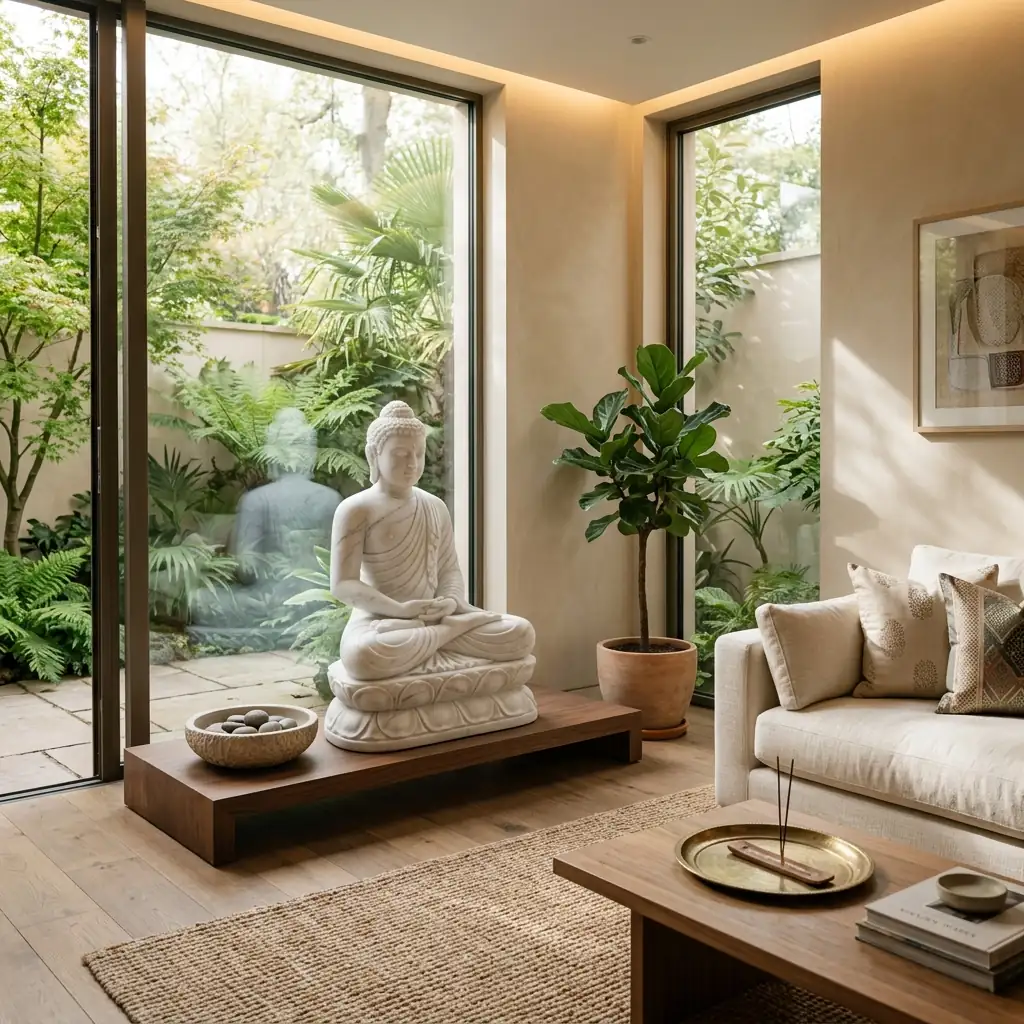
In Vastu Shastra and Feng Shui, a Buddha statue is not just an aesthetic piece of home decor. It is a powerful energetic tool that radiates specific frequencies depending on the posture (mudra) and the material from which it is carved. Placing the wrong mudra in an active area, or putting a sacred statue directly on the floor, can disrupt the natural flow of energy (chi or prana) in your household.
In this comprehensive guide, we will break down the different postures of Buddha, explain which Buddha statue is good for home vastu and share the exact placement rules to help you create a serene, prosperous living space.
Table of Content
Table of Contents
Understanding the Energy of Buddha mudras in Vastu
Buddha statues act as visual anchors that direct the flow of energy inside a home. The specific mudra (hand gesture) determines whether the statue attracts financial growth, mental clarity, physical healing, or protection from negative influences.
Every mudra of Siddharth Gautama Buddha tells a story and holds a specific energetic frequency. When you look at a statue, your mind registers its form. If the form is calm and meditative, your brain naturally mimics that feeling of stillness. If the form is active and joyful, like the Laughing Buddha, it sparks lightheartedness.
From a Vastu Shastra perspective, these forms interact directly with the five elements (Pancha Bhootas) in your home. For example, a white marble meditating Buddha placed in the Northeast zone strengthens the Water and Space elements, helping you think clearly and make better decisions. Conversely, a wooden or sandstone Buddha in the East balances the Air element, which improves your social relationships.
Choosing a Buddha is not about grabbing the prettiest statue at a local market. You must match the posture of the statue with your primary life goals - whether you want to reduce stress, improve your career, or invite financial abundance.
Which Buddha Statue is Good for Home? The 6 Key Postures
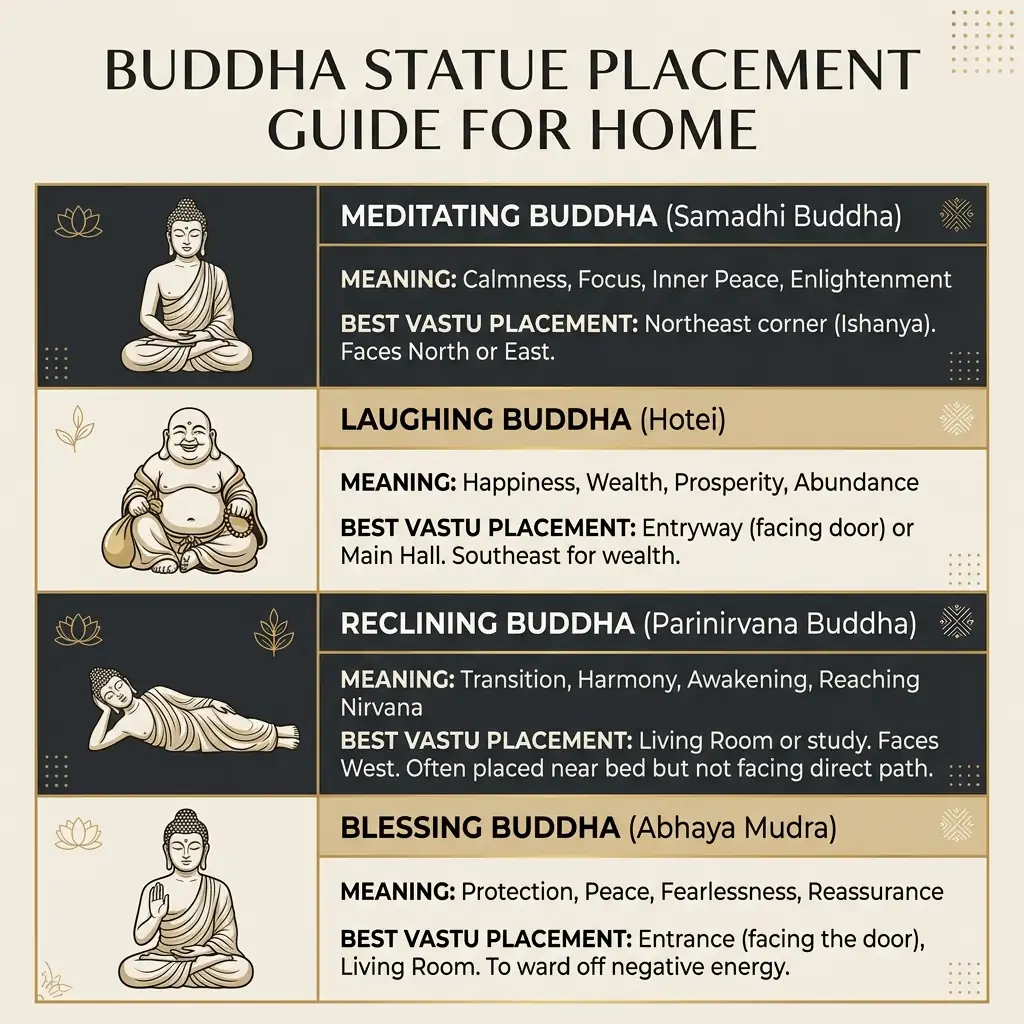
The six primary Buddha postures for homes include the Meditating Buddha for peace, the Laughing Buddha for wealth, the Reclining Buddha for calmness, the Blessing Buddha for protection, the Earth-touching Buddha for stability and the Medicine Buddha for health.
Let us look closely at the six most common Buddha postures to find the one that fits your household’s requirements.
1. The Meditating Buddha (Dhyana Mudra)
In this posture, the Buddha sits with both hands folded in his lap, palms facing upwards, with the right hand resting on top of the left. His eyes are half-closed as he is in deep contemplation.
This form represents inner peace, concentration and spiritual focus. If your home feels tense, or if family members find it hard to settle down after work, the Meditating Buddha is the right choice. It acts as a visual prompt to pause, breathe and turn your focus inward.
For the best results, you should place the Meditating Buddha in your prayer room (pooja room), a dedicated meditation corner, or a quiet study area. We recommend white marble or light-toned sandstone to highlight purity and calm.
2. The Laughing Buddha (Budai)
The Laughing Buddha is actually based on a historical Chinese monk named Budai, who was known for his generous nature and jolly spirit. He is depicted with a wide grin and a prominent belly, carrying a sack of treasures or gold ingots.
The Laughing Buddha is synonymous with wealth, prosperity and joy. He absorbs tension and converts it into happiness. If you want to improve your financial luck or lift the mood in your living room, this is the statue to select.
For proper placement, position the Laughing Buddha facing the main entrance door or in the Southeast zone of your living room. Yellow marble, aventurine stone, or gold-leafed sandstone works best for this posture to draw in abundance.
3. The Reclining Buddha (Nirvana Buddha)
This statue shows the Buddha lying on his right side, head supported by his hand, resting on a pillow. It represents the final moments of his earthly life before attaining Mahaparinirvana.
The Reclining Buddha represents ultimate release from suffering, peace of mind and complete relaxation. It is a wonderful addition to spaces where you go to unwind and rest.
It is best to place the Reclining Buddha in a large hallway or the living room, preferably facing West. Some designers suggest placing it in guest bedrooms to create a restful environment. Dark granite or warm sandstone suits this form beautifully.
4. The Blessing or Protection Buddha (Abhaya Mudra)
In this posture, the Buddha stands or sits with his right hand raised to chest level, palm facing outward, while the left hand rests at his side or in his lap.
This gesture represents protection, fearlessness and shield from negative energies. It is believed to keep anger, fear and bad intentions out of your living space. If you feel your home is exposed to envious glances or negative neighborhood vibes, the Protection Buddha is highly recommended.
Position the Protection Buddha near your main entrance, facing outward to act as an energetic shield. Heavy and grounded materials like red sandstone or grey granite are ideal for this protective form.
5. The Earth-Touching Buddha (Bhumisparsha Mudra)
This posture is one of the most famous. It depicts the Buddha sitting in meditation, with his right hand draping over his knee, fingers pointing down to touch the ground. This represents the moment he called upon the Earth to witness his enlightenment.
The Bhumisparsha Buddha represents truth, stability and unshakeable resolve. If you feel like your life lacks structure or you are constantly facing unstable situations, this mudra helps ground your home’s energy.
For Vastu alignment, the Earth-Touching Buddha is best placed in the centre of your home (Brahmasthan) or the East direction. Sandstone or beige marble complements this grounding mudra.
6. The Medicine Buddha (Bhaisajyaguru)
The Medicine Buddha holds a bowl of healing herbs in his left hand, while his right hand rests on his knee in a gesture of giving. He is associated with physical and mental health, healing and the eradication of sickness.
If a family member is dealing with chronic health issues, placing this statue in their room or in the healing zone of the home can support recovery.
Place the Medicine Buddha in the North or Northeast zone of your home to support physical healing. It is traditionally crafted from blue-toned stones or light marble to focus health energies.
Best Vastu Directions for Buddha Statue Placement
The best directions for placing a Buddha statue are Northeast for spiritual growth, East for family harmony and North for career opportunities. Always ensure the statue faces the interior of the room unless it is placed at the entrance to ward off negativity.
Directions play an important role in Vastu Shastra. Even the most beautiful stone statue will not yield positive results if it is placed in an incompatible zone. Let us examine the best directions for your Buddha statue:
The Northeast (Ishan Kona)
This is the most sacred zone of any house and is ruled by the Water element. It is the zone of wisdom, meditation and spiritual connection. A white marble Meditating Buddha or a Medicine Buddha fits perfectly here. It clears the mind, reduces anxiety and helps you make wise business decisions.
The East Direction
The East is ruled by the Sun and the Air element. It governs your social life, friendships and family harmony. Placing a Buddha statue here - especially one carved from sandstone or green aventurine - helps keep your family relationships sweet and invites positive opportunities from outside.
The North Direction
The North is governed by Lord Kubera, the deity of wealth and rules over your career, business and job opportunities. If you feel like your growth has stalled, or you are looking for a new job, place a Laughing Buddha or a Seated Buddha in the North zone of your office or living room. It keeps the financial energy active.
The Main Entrance
To guard your home against negative energy, place a Blessing or Protection Buddha at the entrance. It should be placed on a console table or in a dedicated niche, positioned at eye level, facing the entrance door to greet visitors.
Placement Mistakes: Where to Avoid Placing a Buddha
Never place a Buddha statue directly on the floor, in bathrooms, kitchens, or under staircases. Avoid placing meditating mudras in bedrooms, as they can disrupt the restful energy required for sleep.
It is just as critical to know where not to place a Buddha statue. Incorrect placement can lead to blocked energy, emotional instability, or financial losses.
- Placing the Statue Directly on the Floor: Resting a Buddha statue on the floor is considered highly disrespectful in Vastu Shastra. A sacred deity must always be elevated, placed on a sturdy wooden console, a stone pedestal, or a dedicated platform that stands at least above waist height to maintain positive energy.
- Avoid the Bedroom: Meditating or blessing postures are not suitable for primary bedrooms. The active spiritual energy of the deity can clash with the personal, relaxed vibes required for deep sleep. If you must place a Buddha in the bedroom, opt only for a small Reclining Buddha, ensuring it does not face the bed directly.
- Avoid Kitchens and Bathrooms: Keep all sacred statues away from kitchens and bathrooms. The kitchen is dominated by the fire element and the bathroom represents drainage and waste. Placing a Buddha in these areas degrades the spiritual frequency of the home and blocks positive energy.
- Under or Near Staircases: Placing a Buddha underneath a staircase is a common Vastu mistake. Staircases represent heavy movement and footsteps overhead. Positioned here, the statue's energy becomes trapped, which can lead to stagnant progress and financial blockages.
- Facing the Exit Doors: When displaying a Buddha statue inside the living room, make sure it faces inward, not directly out towards windows or exit doors. The goal is to circulate positive energy inside your living areas rather than allowing it to slip away outside.
Choosing the Best Material: Natural Stone vs. Synthetics
Natural stones like white marble, sandstone and granite are active, breathing materials that carry natural frequencies, making them superior to synthetic resin or plastic for Vastu energy flow.
When people shop for a Buddha statue, they often purchase cheap resin, plastic, or plaster of Paris options. However, Vastu Shastra emphasises that the material of the statue is critical. Synthetic materials do not hold or direct energy; they are inert.
Natural stone, on the other hand, is an active material formed deep within the earth over millions of years. It carries the grounding energy of the Earth element. When you combine this natural frequency with the sacred geometry of a Buddha mudra, the impact on your home’s energy is profound.
Let us compare the common materials used for Buddha statues:
| Material | Energy Frequency | Durability | Best Placement | Maintenance |
|---|---|---|---|---|
| White Marble | High purity, peace and mental clarity | High (lasts centuries) | Northeast / Pooja Room | Wipe with a damp cotton cloth |
| Sandstone | Grounded, warm and comforting | Medium-High (outdoors/indoors) | East / Balconies / Gardens | Gentle wash with clean water |
| Granite / Slate | Protective, stable and strong | Very High (weatherproof) | Main Entrance / Courtyards | Minimal care needed |
| Synthetic Resin | None (inert) | Low (chips easily) | Not recommended | Dust off |
At Stone World, we believe in using only genuine Indian natural stones. A white marble Buddha carved by hand in Jaipur or Indore carries a legacy of craft that plaster or plastic simply cannot match. If you want a statue that acts as a true energetic filter, natural stone is the only way to go.
Which Color Buddha Statue is Good for Home?
A white marble Buddha statue represents peace, purity and spiritual wisdom, making it best for the Northeast corner. A yellow or gold-leafed Buddha is ideal for attracting wealth, while green aventurine represents growth and emotional healing.
Apart from the posture and material, color plays an important role in Vastu energy. Homeowners often ask which color buddha statue is good for home decor.
Generally, a white color Buddha statue, carved in natural marble, represents peace, purity and wisdom, making it ideal for the Northeast zone (Ishan Kona). A gold or yellow color Buddha statue brings wealth and happiness, while a green aventurine stone Buddha represents growth and healing. If you are seeking protection, grey granite or red sandstone is suitable. Choose a shade that aligns with the specific energy you want to attract.
Integrating Buddha Statues with Water Features and Mandirs
Integrating a Buddha statue with a flowing water fountain or placing it within a stone mandir layout helps amplify the flow of positive energy, creating a serene sanctuary in your home.
To make the most of your stone Buddha, you can combine it with other natural stone elements in your house.
Pairing with a Water Fountain
Water represents Jal Tatva, which governs prosperity, career opportunities and mental flow. When you place a meditating stone Buddha next to a gentle water fountain for home vastu, you create a highly peaceful zone. The trickling sound of water over natural stone reduces stress, while the Buddha statue keeps the energy grounded. This combination is ideal for balconies, garden courtyards, or the Northeast corner of your living room.
Placing within a Stone Mandir
Many families choose to place a small marble Meditating Buddha inside their home temple. It fits beautifully alongside other deities, especially when integrated into a custom white marble mandir for home or a traditional stone temple design for home. Make sure the Buddha sits on the same level as the other deities and is kept clean.
CNC Carved Stone Backdrops
If you are planning a modern, luxury look for your entrance lobby or living room, you can install a custom Buddha statue in front of a CNC carved stone design. A fluted sandstone panel or a floral marble jaali illuminated with soft spotlighting makes the Buddha statue stand out, creating a premium focal point that feels incredibly calming.
Frequently Asked Questions
Is it bad luck to buy a Buddha statue for yourself?
This is a very common myth. Many people believe that Buddha statues should only be received as gifts. This is not true. You can certainly purchase a Buddha statue for your own home. What matters is your intention, respect for the form and ensuring correct Vastu placement.
Can I place a Buddha statue in my garden?
Yes, a stone Buddha is a beautiful addition to a garden or balcony. A large sandstone Meditating Buddha or Blessing Buddha placed under a tree, surrounded by plants, creates a peaceful outdoor sanctuary. Ensure it is placed on a raised stone platform, not directly on the soil.
How do I clean my stone Buddha statue?
To keep the energy clean, you must keep the statue free of dust. For white marble, wipe it regularly with a dry or slightly damp soft cotton cloth. For sandstone or granite outdoor statues, you can wash them with clean water. Avoid using chemical cleaners or acids on natural stone, as they can damage the finish.
Which Laughing Buddha is best for wealth?
The Laughing Buddha holding a gold ingot, a sack, or sitting on a bed of coins is considered the best for attracting wealth and financial success. Place him facing your main door so he welcomes prosperity as soon as the door opens.
Can I place a Buddha statue facing West?
Yes, placing a Reclining Buddha facing West is excellent for invoking peaceful, relaxing energy. However, for spiritual growth and meditation, the Northeast remains the primary direction.
Which Buddha is good for home for overall peace?
If you are wondering which Buddha is good for home to bring complete peace and harmony to your family, the Meditating Buddha (Dhyana Mudra) in white marble is the absolute best. It anchors the room, reduces stress and invites a quiet, spiritual energy that benefits everyone in the household.
Why Handcrafted Stone Buddha Statues from Stone World?
At Stone World, we work with skilled local artisans to hand-carve premium natural stone Buddha statues. Our custom sizing, durable weather-resistant materials and gold-leaf details ensure that your Buddha is built to last.
At Stone World, we do not mass-produce statues in factories. We work closely with skilled local artisans who have spent generations carving stone. Every statue we deliver is handcrafted from premium natural stones selected from the best quarries in Rajasthan and Central India.
At Stone World, we prioritize custom sizing to fit your specific design needs. Whether you require a small one-foot statue for a pooja shelf or a majestic five-foot statement sculpture for a garden, our team can carve it to your exact dimensions.
We also offer premium finishes tailored to your decor style. You can choose from polished marble, rustic textured sandstone, or elegant gold leafing on stones to blend the statue with your home’s aesthetic. Because we use natural stone instead of resin or ceramic, these statues possess high durability, standing strong against harsh Indian summers and heavy monsoons, while retaining their spiritual beauty for generations.
If you are ready to invite peace, positive energy and beautiful design into your home, we are here to help.
Find the Perfect Stone Buddha for Your Space
Let us help you select or custom-carve the ideal natural stone Buddha statue for your home, garden, or mandir. Reach out to our design experts today.
Contact Stone World TodayAbout the Author
Punit Tongia is the founder of Stone World, India’s premier stone design studio and manufacturer of premium natural stones and custom stone crafts. Based in Indore, Punit has spent over 15 years helping architects, interior designers and homeowners select, install and style natural stone to build beautiful, balanced living spaces.