


When temperature levels drop during the winter season, architectural stone surfaces experience unique environmental pressures that differ markedly from warm summer months. Rapid shifts between chilly night air and indoor heating, dry ambient humidity and increased tracking of gritty outdoor debris place notable stress on dense marble, granite, Kota limestone and sandstone tiles. Without timely intervention, micro-fissures can trap moisture, dulling high-gloss finishes and causing irreversible spalling across high-traffic hallways. Establishing proper winter care for natural stone floors preserves both the structural integrity and timeless visual warmth of your indigenous Indian stone investments through the coldest months of the year.
At Stone World, our stone studio and stone experience center in Indore collaborates directly with architects, interior designers and homeowners to specify and preserve authentic dimension stones. Implementing proactive winter maintenance for stone floors ensures your architectural surfaces retain their brilliant luster, slip resistance and structural soundness year after year. Explore our architectural collections of natural stone flooring options tailored for luxurious residences. This engineering guide details ten field-tested winter care tips, sub-surface porosity diagnostics, safe cleaning formulations, radiant heating protocols and professional restoration methods.
Table of Contents
Why Winter Weather Pressures Natural Stone Flooring: Porosity and Thermal Dynamics
Winter conditions subject stone flooring to sharp temperature swings, low relative humidity and abrasive grit tracking. Unsealed calcite stones absorb moisture that contracts under cold drafts, weakening crystalline bonds and accelerating micro-abrasion across high-traffic living spaces.

Every natural dimension stone is a geological composite comprising mineral crystals, microscopic capillary pores and natural fissure networks. When outdoor temperatures decline during November and December, stones experience thermal contraction. Crystalline marbles such as Makrana white marble, Ambaji marble and Banswara marble possess high concentrations of calcium carbonate, which exhibits a delicate Mohs hardness between 3 and 4. Learning how to protect marble in winter requires recognizing that cold, dry indoor air accelerates the evaporation of moisture from floor joints while pulling subgrade moisture upwards through capillary action. Architects evaluating indoor natural stone flooring options must account for these seasonal thermal shifts during material specification.
In addition, winter activities increase the volume of abrasive inorganic dust tracked into residential living rooms. Street dust, silica sand and dried garden mud cling to winter footwear. When walked upon, these hard quartz particles act like coarse sandpaper against the smooth face of polished stone, creating microscopic scratches that scatter light and make floors appear dull and chalky. Discover how architectural stone installation enhances indoor comfort by reading our overview on benefits of natural stone flooring in modern residences.
10 Essential Winter Care Tips for Natural Stone Floors
Enduring winter stone maintenance blends surface diagnostics, breathable impregnating sealers, daily microfiber mopping, pH neutral cleaners and gradual thermal heating controls. Avoiding acidic agents and rock salt preserves natural crystal luster and prevents thermal expansion cracking.
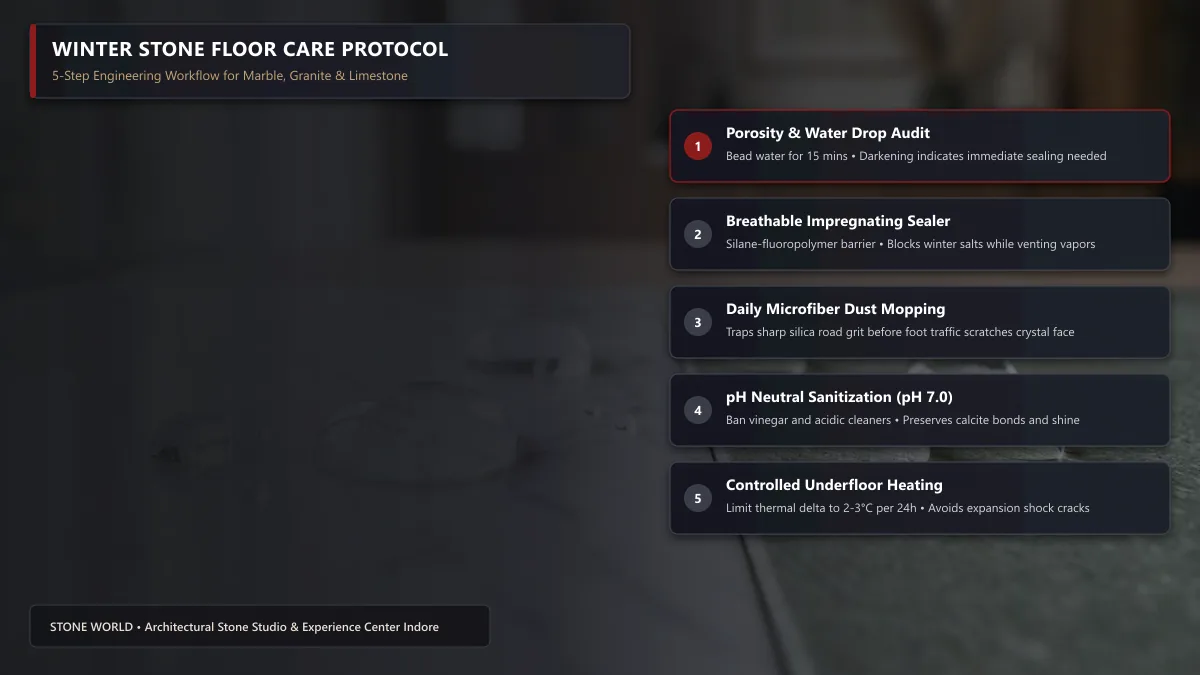
Protecting interior and exterior natural stone flooring during cold weather demands a systematic maintenance schedule. Below are ten practical, contractor-approved care strategies designed to safeguard natural stone throughout winter.
1 Perform the Porosity Audit: Conduct a Water Drop Test
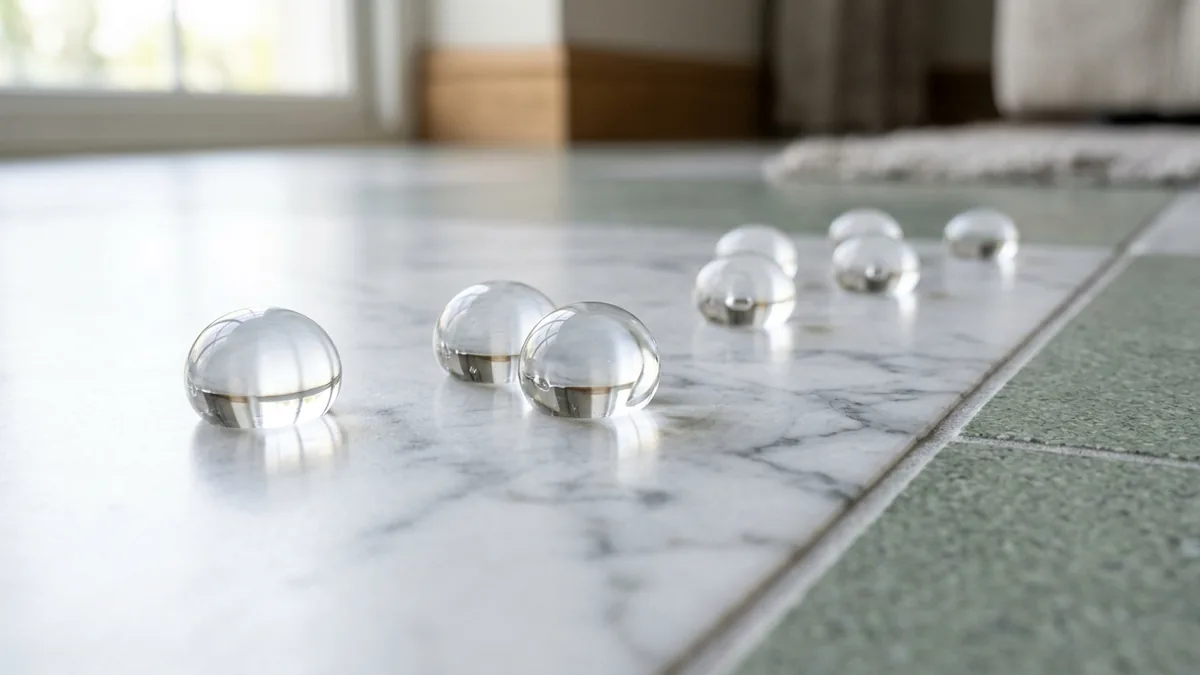
Before cold weather arrives, evaluating the condition of your floor sealant is essential. Executing a stone floor water drop test provides an immediate diagnostic assessment of surface porosity. Deposit several tablespoons of clean water onto various sections of your stone floor, especially along entryways, kitchen prep zones and dining halls. Allow the droplets to sit for fifteen minutes before inspecting the result.
If the water remains tightly beaded on the surface like droplets on glass, your impregnating sealer remains fully functional. If the stone beneath the water droplet darkens or shows a damp shadow, moisture has penetrated the pore network, signaling that immediate resealing is required before winter moisture and festive spills take hold.
2 Apply a Breathable Deep-Penetrating Impregnating Sealer
Applying the best stone sealer before winter creates an internal shield against water, winter salts and greasy stains without trapping natural vapor. Avoid cheap topical surface waxes or film-forming acrylic coatings that peel, yellow and trap moisture beneath the stone face during cold weather. Instead, specify sub-surface impregnating sealers formulated with fluoropolymers or reactive silane-siloxane oligomers.
These sub-micron molecules sink deep into stone pores, lining capillary walls without altering the natural breathability or vapor permeability of the stone. Moisture vapor can evaporate freely while liquid spills and tracked outdoor mud are repelled on contact.
3 Commit to Daily Electrostatic Microfiber Dust Mopping
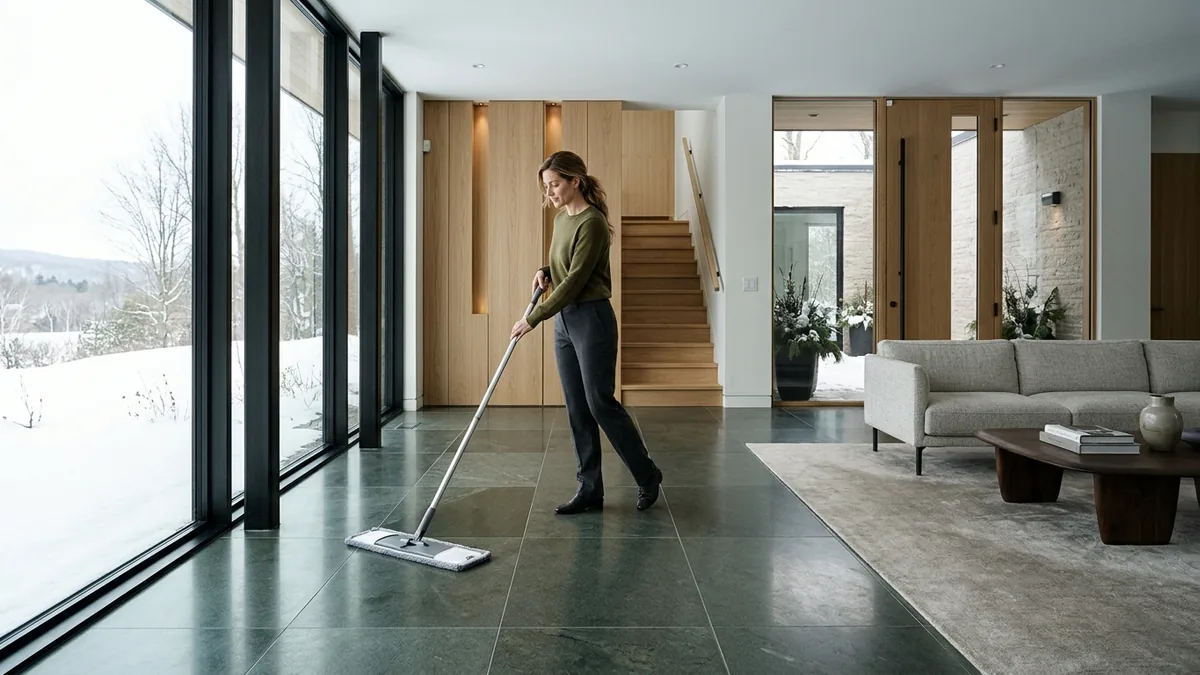
Dry winter breezes carry elevated levels of airborne dust and road grit into interior spaces. Committing to daily dust mopping stone floors using a dry, clean microfiber flat mop removes loose particles before they become embedded beneath shoe soles. Traditional straw brooms or stiff bristle sweepers push abrasive silica across the floor, scratching polished surfaces and dulling high-traffic zones like your drawing room stone flooring.
An electrostatic microfiber mop pad attracts and captures micro-grit without needing chemical dusting sprays. For optimal care, run the mop in continuous overlapping S-curves without lifting the head off the floor to prevent dropping collected grit.
4 Clean Exclusively with Certified pH Neutral Formulations
When washing stone floors during winter, the choice of cleaning agent is essential to preserving stone life. Never use household vinegar, lemon juice, bleach or bathroom floor cleaners containing hydrochloric acid or ammonia. These acidic solutions dissolve calcium carbonate crystals in marble and limestone on contact, producing permanent dull etched patches that require professional mechanical repolishing.
Always wash floors with a specialized pH neutral stone cleaner diluted in warm water according to manufacturer guidelines. A neutral surfactant lifts dirt particles and suspends grime without breaking down protective sealer molecules or leaving soapy residues that attract winter dust.
5 Regulate Radiant Underfloor Heating Gradually
Modern luxury residences frequently feature hydronic or electric underfloor radiant heating beneath natural stone floors. Natural stone possesses excellent thermal conductivity, making it an ideal companion for floor warming systems. However, practicing diligent underfloor heating stone care requires preventing abrupt temperature spikes that stress stone slabs.
Never switch radiant heating systems from completely cold to maximum temperature in a single day. Raising temperatures too quickly causes rapid expansion of the bedding screed while the stone top surface remains cold, generating high shear stresses at the adhesive interface. Increase thermostat settings gradually by no more than two to three degrees Celsius every twenty-four hours to allow the stone and mortar substrate to expand in unison.
6 Manage Movement Tolerances to Prevent Thermal Hairline Cracking
Winter temperature swings between chilly nights and heated daytime interiors cause continuous microscopic thermal contraction and expansion across floor expanses. Slabs laid tight against structural walls without movement joints will buckle or develop hairline surface fractures. Emphasizing engineered movement control is vital for preventing cracks in stone flooring across expansive living areas.
Ensure that perimeter expansion joints along skirting boards remain filled with flexible, non-staining neutral-cure silicone rather than rigid cement grout. For floor areas exceeding twenty-five square meters, incorporate intermediate expansion joints to relieve horizontal stress and protect stone tiles from shear failure.
7 Deploy Safe Deicing and Exterior Barrier Matting
Outdoor stone verandahs, porticos and walkways can become slick with frost or winter condensation. In colder microclimates, homeowners mistakenly scatter rock salt or calcium chloride deicers across natural stone surfaces. Sodium and calcium chlorides penetrate porous stone and crystallize within internal capillaries, generating sub-surface expansion pressures that cause flaking, pitting and spalling.
Opting for safe deicing for stone walkways means selecting clean coarse grit or crushed silica sand to provide mechanical foot traction without chemical degradation. Additionally, install heavy-duty dual-action walk-off scraper mats at every villa entrance. High-density bristle mats trap moisture and grit from shoes before visitors set foot onto interior stone floors. For ideas on designing weather-resilient exterior approaches, review our bespoke collection of natural stepping stones for garden paths.
8 Eradicate Winter Salt Stains and Sub-Surface Efflorescence
During cold weather, indoor floor heating draws ground moisture upward through concrete slabs, carrying soluble mineral salts toward the surface. As this moisture evaporates in dry indoor air, it leaves behind a powdery white haze known as efflorescence. Mastering proven techniques for cleaning salt stains from stone prevents these mineral deposits from permanently clouding stone colors.
Never attack efflorescence with acidic descaling chemicals or wire brushes. Instead, sweep up dry powdery salts using a stiff natural-bristle nylon brush and a vacuum. For stubborn surface deposits, wash the area with warm distilled water mixed with a neutral stone cleaner, then dry the floor immediately with clean cotton towels to prevent redepositing salts.
9 Neutralize Festive Spills and Oil Stains with Absorbent Poultices
Winter celebrations, wedding festivities and family dining gatherings frequently lead to accidental food spills. Ghee, cooking oil, mustard gravy, coffee and wine can seep into unsealed stone capillaries, creating dark organic stains. Relying on an engineered poultice is the most effective approach for removing oil stains from marble and limestone floors without damaging the finish.
To construct a poultice, combine food-grade diatomaceous earth, bentonite clay or baking soda with a splash of acetone or hydrogen peroxide (twelve percent strength) to form a thick paste with the consistency of peanut butter. Trowel this mixture over the stain in a five-millimeter layer, cover with plastic film, tape down the edges and allow it to dry for twenty-four hours. As the solvent evaporates, it draws the embedded oil out of the stone pores into the absorbent powder.
10 Schedule Periodic Diamond Honing and Restoration Polishing
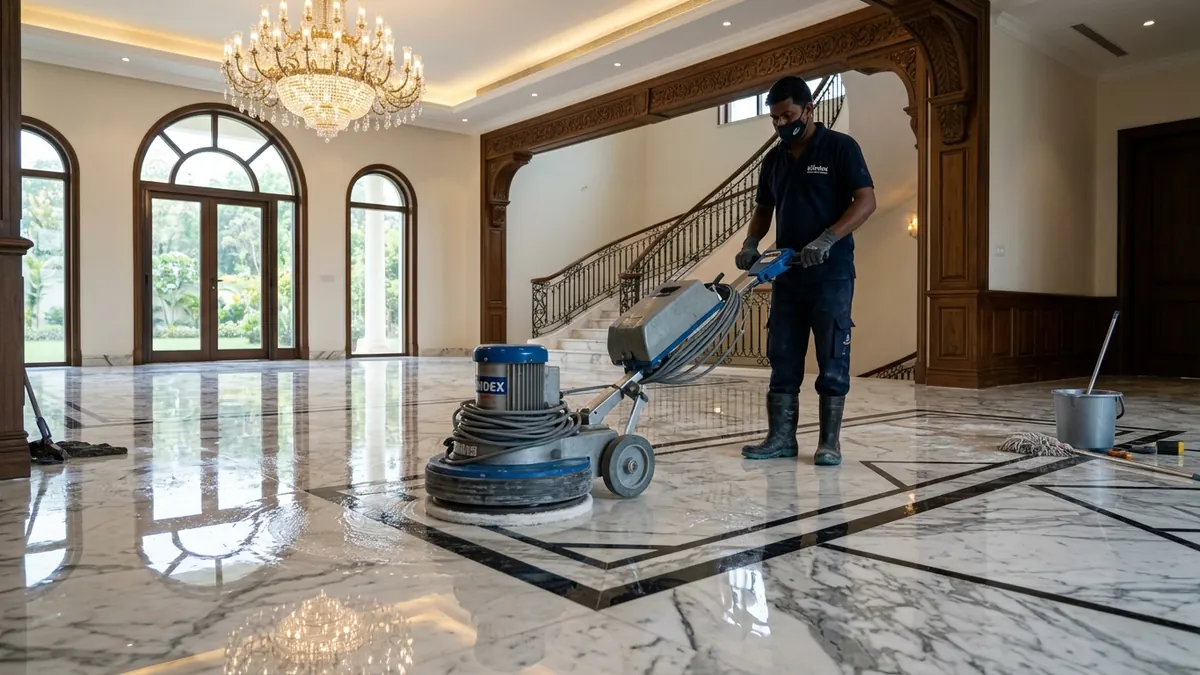
Even with rigorous daily maintenance, heavy foot traffic over years creates micro-scratches along main circulation corridors. Scheduling certified stone polishing services in indore restores original clarity, depth and optical reflectivity to worn stone surfaces before winter entertaining commences.
Professional restoration technicians employ planetary rotary floor machines fitted with wet diamond-resin pads ranging from 400 to 3000 grit. This sequential wet honing process shaves away surface damage without airborne dust, followed by mechanical stone crystallization to harden the calcium surface. Explore our diverse range of architectural granite stones crafted for enduring floor applications.
Natural Stone Winter Vulnerability Matrix: Comparing Hardness, Absorption and Care Profiles
Different natural stones react uniquely to cold-weather stressors. Calcitic marbles require acid protection, granites demand scratch defense against dry grit, dense Kota limestone needs breathable efflorescence management and sandstones require hydrophobic sealing against frost spalling.
Selecting appropriate winter maintenance tactics depends directly on the geological classification, mineral composition and physical porosity of your flooring material. The table below compares the six most popular indigenous Indian architectural stones across essential winter performance metrics.
| Natural Stone Material | Geological Class | Mohs Hardness | Water Absorption | Primary Winter Risk | Mandatory Winter Care Action |
|---|---|---|---|---|---|
| Makrana White Marble | Metamorphic Calcite | 3.5 - 4.0 | 0.12 - 0.18% | Acid etching and grit scratching | Fluoropolymer sealing and daily microfiber dust mopping |
| Rajasthan Black Granite | Igneous Plutonic | 6.5 - 7.0 | 0.05 - 0.10% | Grit dulling along entrance ways | Dual barrier entrance mats and pH neutral damp cleaning |
| Kota Stone (Limestone) | Dolomitic Sedimentary | 4.0 - 4.5 | 0.30 - 0.45% | Efflorescence white salt blooms | Breathable silane sealing and dry nylon salt brushing |
| Dholpur Beige Sandstone | Siliceous Clastic | 5.5 - 6.0 | 1.10 - 1.50% | Capillary moisture retention | Hydrophobic impregnator and non-chemical sand deicing |
| Metamorphic Quartzite | Metamorphic Sandstone | 7.0 | 0.10 - 0.25% | Joint grout shrinkage cracks | Flexible polymer joint inspection and routine washing |
| Mandana Stone | Dense Red Sandstone | 6.0 - 6.5 | 0.20 - 0.35% | Subgrade efflorescence staining | Deep siloxane coating and dry surface sweeping |
Step-by-Step Pre-Winter Floor Sealing and Protection Procedure
Effective winter sealing requires thorough surface decontamination, complete moisture drying, uniform application of breathable impregnating sealer, careful dwell time management and a full twenty-four hour polymer cure before introducing foot traffic.
To ensure maximum sealer penetration and long-lasting barrier performance, follow this technical application procedure compliant with Indian Standard IS: 13757 recommendations:
- Deep Surface Decontamination: Thoroughly scrub the entire floor using a diluted pH neutral stone cleaner and a soft white rotary nylon pad. Remove all surface grease, soil accumulation and old wax residues, followed by clean water rinsing.
- Complete Moisture Dehydration: Allow the floor to dry completely for twenty-four to forty-eight hours. Applying an impregnating sealer over damp stone traps water inside capillary channels and prevents the active polymer molecules from bonding with mineral pores.
- Uniform Impregnating Sealer Application: Pour the breathable fluoropolymer or silane impregnating sealer into a clean tray and apply an even, wet coat across the floor using a short-nap lambswool applicator or low-pressure commercial sprayer. Work in manageable sections of twenty to thirty square feet.
- Dwell Time and Residue Buffing: Allow the sealer to penetrate the stone matrix for fifteen to twenty minutes. Before the excess sealer dries on the surface, thoroughly buff off all remaining liquid using dry, lint-free microfiber towels. Leaving excess sealer to dry on polished marble leaves a hazy, uneven film.
- Polymer Cure and Water Drop Verification: Keep foot traffic off the treated floor for twelve hours and prevent any water exposure for twenty-four hours to allow the cross-linking polymer lattice to fully cure. Conduct a water drop test on day two to verify complete liquid repellency.
To examine various architectural surface textures suitable for interior and exterior flooring assemblies, read our technical overview of architectural stone finishes tailored for luxury residential architecture.
Cost Drivers: What Influences Winter Stone Floor Maintenance and Restoration
Natural stone maintenance costs vary based on stone mineral density, existing scratch depth, the active solid concentration of impregnating polymers, floor perimeter layout complexity and the diamond grit honing stages required for full clarity.
When budgeting for winter stone maintenance, property owners should evaluate the technical variables that govern lasting performance rather than seeking generic one-size-fits-all treatments. Investing in professional-grade penetrating sealers and mechanical diamond restoration protects the substantial investment of genuine architectural dimension stone.
The primary qualitative cost drivers for winter stone floor care encompass:
- Stone Mineral Density and Porosity Class: Dense granites require minimal sealer volume due to negligible porosity, whereas sedimentary Kota limestones and Dholpur sandstones absorb higher volumes of penetrating polymer liquid to achieve complete saturation.
- Surface Damage and Etch Severity: Minor surface dulling requires basic chemical cleaning and a single-stage buffing pass. In contrast, deep furniture gouges, severe acid etches or wide joint lippage demand a multi-stage sequential diamond grinding process spanning coarse 200 grit through ultra-fine 3000 grit pads.
- Sealer Chemistry and Solid Concentration: Basic water-based sealers provide brief water resistance. Premium fluorochemical oligomers and solvent-carried silanes deliver superior oleophobic oil repellency and endure for multiple winter seasons without breakdown.
- Room Layout and Architectural Obstacles: Open, continuous rectangular halls permit rapid planetary machine passes. Intricate villa layouts featuring multiple door jambs, stone baseboards, curved staircase treads and built-in cabinetry require time-intensive hand tool detail work.
| Service Specification Level | Standard Operational Scope | Ideal Stone Floor Condition | Key Performance Cost Determinants |
|---|---|---|---|
| Routine Preventive Sealing | pH neutral scrub, drying, single-coat fluoropolymer sealer | Unblemished floors with failing water drop test | Sealer active solids, floor square footage, room accessibility |
| Deep Decontamination & Crystallization | Rotary scrubbing, poultice stain extraction, chemical crystallization | Lightly dulled marble, surface oil spots, festive wear | Poultice dwell time, machine passes, chemical brand grade |
| Full Diamond Honing Restoration | Multi-stage planetary diamond honing, lippage leveling, deep seal | Deep traffic scratches, acid etching, uneven tiles | Diamond pad sequences (400-3000 grit), stone hardness, edge work |
Visiting the Stone World Experience Center in Indore for Stone Care Solutions
Consulting with dedicated stone specialists guarantees scientifically matched sealing chemistry, genuine indigenous stone selections and trade-tested restoration advice. Stone World offers full-scale architectural mockups and technical stone consultation across Central India.
When seeking reliable stone care guidance, architects, interior designers and discerning homeowners often encounter general hardware retailers who recommend harsh tile cleaners or synthetic plastic polishes unsuited to real stone. In contrast, Stone World operates a premier architectural stone studio and stone experience center in Indore dedicated entirely to authentic indigenous Indian natural stones.
Why architects, landscape designers and luxury estate owners across Indore, Bhopal, Ujjain and Dewas trust Stone World:
- Our advanced stone studio houses precision bridge saws, diamond edge-profiling equipment and calibration lines, ensuring every custom stone tile meets tight architectural tolerances.
- Visitors to our stone experience center can inspect live flooring mockups treated with various mechanical textures and protective sealers under true architectural lighting.
- We provide bespoke recommendations for floor sealing formulations, matching specific stone porosities with certified fluoropolymer and silane treatments.
- Our technical stone team assists clients in diagnosing efflorescence, sub-surface moisture migration and thermal movement tolerances across residential and commercial estates.
Visit the Stone World Experience Center in Indore
Inspect live mockups, feel stone textures in person and discuss your upcoming architectural or villa project.
Frequently Asked Questions
How often should natural stone floors be sealed before winter?
Natural stone floors should undergo a water drop test annually before the winter season commences. High-traffic living areas and dining spaces generally require resealing every one to two years with a breathable impregnating sealer, whereas dense granites in low-traffic bedrooms may remain protected for three to five years.
Can I clean marble or Kota stone floors with vinegar in winter?
No, you must never clean marble or Kota limestone floors with vinegar, lemon juice or any acidic solutions. The acid reacts chemically with the calcium carbonate crystals within the stone, causing immediate dull chemical burns known as etch marks that require mechanical diamond repolishing to remove.
Why do white powdery marks appear on stone floors during cold weather?
The white powdery residue is efflorescence, caused when subgrade moisture rises through the concrete substrate and evaporates into dry winter indoor air, depositing soluble mineral salts on the surface. Remove efflorescence by sweeping with a stiff nylon brush and washing with distilled water, avoiding acidic cleaners.
How can I remove festive oil and ghee stains from a marble floor?
Apply an absorbent poultice paste made from diatomaceous earth or baking soda blended with acetone or hydrogen peroxide. Spread the paste over the oil spot in a five-millimeter layer, cover with plastic wrap for twenty-four hours to draw the embedded oil out of the pores, then wipe clean with warm water.
Is rock salt safe to melt frost on natural stone outdoor walkways?
No, rock salt and calcium chloride deicers are harmful to natural stone. Dissolved salts enter stone capillaries and crystallize upon drying, generating internal hydraulic pressures that cause spalling, flaking and surface degradation. Use clean coarse sand to provide slip-resistant traction without chemical harm.
How do underfloor heating systems affect natural stone flooring?
Natural stone conducts and retains radiant heat exceptionally well, making it ideal for underfloor heating. However, temperature changes must be introduced gradually, adjusting by no more than two to three degrees Celsius per day to prevent thermal shock and differential expansion cracking between the stone slab and mortar bed.