


Designing a private swimming pool or a boutique resort deck demands materials that balance barefoot comfort with unyielding structural resilience. Water splashes continuously, swimmers walk with bare feet, midday tropical heat radiates off the ground and water treatment chemicals test every square inch of the paving. Standard vitrified outdoor tiles turn slick when wet, hold excessive surface heat and crack along thin grout lines under thermal expansion. That is why architects, landscape designers and discerning villa owners turn to the best natural stone for swimming pool deck paving to achieve a safe, heat-dissipating and enduring outdoor retreat that gracefully weathers decades of sun and splashing water.
At Stone World, our stone studio and stone experience center in Indore works alongside landscape architects, civil contractors and homeowners to fabricate bespoke stone coping profiles, calibrated paving slabs and water-resistant drainage surrounds. Discover our dedicated collection of architectural natural stone pool decks engineered for tropical climates. This engineering guide covers stone varieties, anti-slip surface treatments, coping geometries, infinity edge details, drainage mechanics, salt protection and preventive maintenance routines.
Table of Contents
Why Choosing the Best Natural Stone for Swimming Pool Surrounds Matters
Natural stone pool decks deliver superior slip resistance, cooler barefoot surface temperatures and resistance to chlorine or saline water. Dense igneous and sedimentary stones resist heavy splash cycles, eliminate delamination risks and provide an organic visual harmony between water and outdoor landscape architecture.
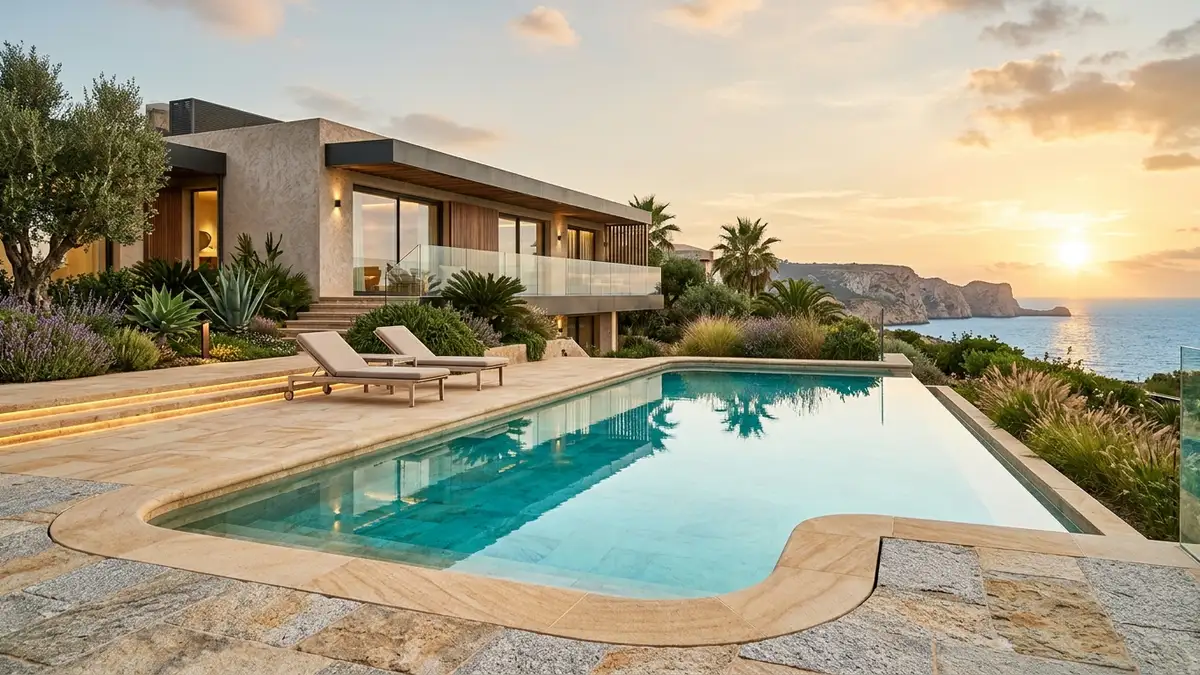
A swimming pool terrace is one of the most demanding outdoor environments in residential and commercial construction. Specifying the best natural stone for swimming pool surrounds solves three fundamental performance challenges that synthetic or factory-made tiles fail to address over time:
High Friction Mechanical Traction and Wet Slip Safety
Wet foot traffic requires exceptional friction coefficients. Polished ceramic or vitrified surfaces create an invisible film of water that drastically reduces grip, causing dangerous slips. In contrast, textured natural stones provide mechanical traction through micro-clefts and tactile surface reliefs that remain dependable even under full water submersion.
Solar Heat Reflection and Barefoot Walking Comfort
Outdoor pool paving absorbs intense solar radiation throughout midday hours. Dark synthetic pavers and concrete slabs heat up rapidly, making it painful to walk barefoot from the lounge chair to the water. Pale natural sandstones, quartzites and light granites have low thermal conductivity and high solar reflectance, keeping pool surrounds noticeably cooler under scorching summer sunshine.
Chemical Immunity Against Chlorine and Salt Water
Pool water contains dissolved chlorine, bromine, algaecides or dissolved salts in saltwater pools. These active chemicals cause synthetic glazes to peel and degrade cheap cementitious pavers through chemical etching. Dense natural stones withstand chemical exposure when treated with deep-penetrating breathable sealers. Explore our extensive portfolio of outdoor landscape stones crafted for residential gardens and resort courtyards.
Slip Resistant Stone Finishes for Wet Pool Decks: Textures and Safety Standards
Safety around pool decks requires specialized surface texturing. Flamed, bush-hammered, sandblasted and river-washed finishes create controlled micro-textures meeting international R11 and R12 slip resistance ratings. These specialized textures ensure firm barefoot grip without feeling abrasive against wet skin.
Achieving the right texture on wet stones is an exact science. A surface that is too smooth turns dangerous when wet, while a surface that is overly coarse will graze sensitive wet feet. Selecting appropriate slip resistant stone finishes for wet pool decks ensures optimal traction underfoot without sacrificing tactile comfort.
In architectural stone fabrication, surface texturing alters the face of the stone slab mechanically or thermally without altering its internal mineral strength:
- Flamed or Thermal Finish: High-temperature blowtorches are run across wet granite slabs. The thermal shock causes quartz crystals to burst, leaving a rough, non-directional texture with exceptional wet traction meeting R11 to R12 safety standards.
- Bush-Hammered Finish: Pneumatic heads with rows of pointed carbide tips strike the stone surface repeatedly. This mechanical pulverizing creates a uniform, cratered relief that disperses standing water films cleanly.
- Sandblasted or Shot-Blasted Finish: A high-velocity stream of abrasive silica or steel grit bombards the stone, creating a soft, velvet-matte texture that feels comfortable under bare feet while ensuring firm grip.
- Leathered or River-Washed Finish: Following flaming or wire brushing, abrasive diamond-impregnated brushes smooth down sharp micro-peaks. This produces an antique pebbled texture that is easy to sweep yet remarkably slip-resistant.
To examine how surface mechanics influence outdoor longevity, read our detailed technical review on natural stone surface finishes across architectural applications.
Bullnose Pool Coping Stone Designs and Dimensions: Safety and Edge Profiles
Pool coping caps the structural shell, protects pool beam edges and provides a smooth handhold for swimmers. Full bullnose, half bullnose and drop-face profiles manufactured from 30 mm to 50 mm stone slabs prevent cuts, deflect back-splash and tie the pool rim cleanly into surrounding paving.
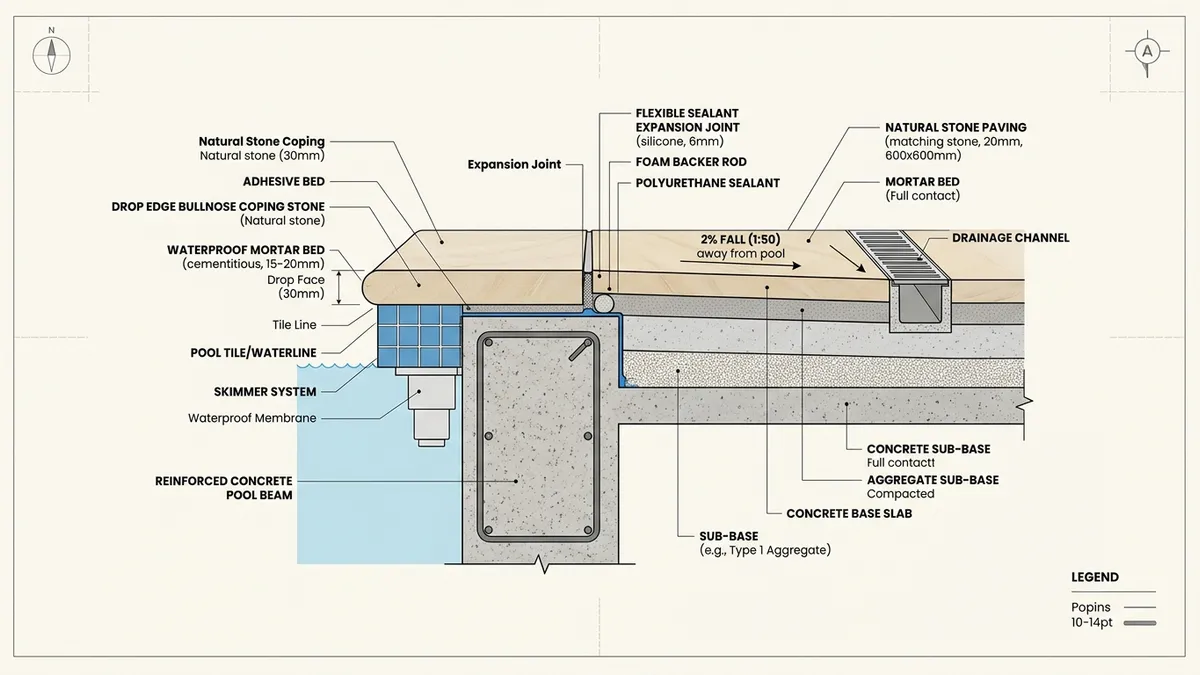
Pool coping serves as both the functional cap of the reinforced concrete pool shell and the visual picture frame of the entire water body. Swimmers grab this edge when resting, kicking off or climbing out of the pool. Choosing the right bullnose pool coping stone designs and dimensions prevents painful scrapes while directing splashing water away from the shell foundation.
Architects typically select from four primary coping edge profiles based on the design language of the property:
- Full Bullnose Edge: A completely rounded, semi-circular edge profile with a 15 mm to 20 mm radius. This profile provides the softest, most ergonomic handhold for children and elderly swimmers, eliminating sharp corners along the waterline.
- Half Bullnose Edge: Rounded along the top edge while remaining flat with a crisp bevel along the bottom. This profile offers a contemporary profile while preventing water from clinging to the underside of the stone.
- Drop-Face or Apron Coping: An L-shaped profile created by mitring a 50 mm to 100 mm drop down over the pool beam. Drop-face coping conceals the pool waterline tile joints, giving modern pools a bold, monolithic rim.
- Pencil Round or Chamfered Edge: A minimalist, rectilinear edge with a subtle 3 mm to 5 mm radius curve. It suits clean architectural residences where crisp geometric lines define the landscape.
Standard coping stone dimensions require a minimum thickness of 30 mm to withstand the cantilevered point load of a swimmer climbing out of the water. Coping units are typically cut in lengths of 600 mm, 900 mm or 1200 mm with widths ranging between 300 mm and 450 mm. A continuous drip groove cut 10 mm behind the pool rim prevents splash water from tracking backward into the mortar bed.
Heat Resistant Natural Stones for Outdoor Pool Pavers in Tropical Climates
In high-temperature climates, dark or dense pavers retain searing heat that burns bare feet. Light-toned Indian sandstones like Mint and Teakwood, along with pale grey granites, possess high Solar Reflectance Index values that keep walking surfaces comfortable throughout peak afternoon sunshine.
During Indian summers, ground surface temperatures on dark outdoor paving can climb beyond fifty-five degrees Celsius. Walking barefoot across an overheated deck quickly ruins the poolside experience. Choosing proven heat resistant natural stones for outdoor pool pavers ensures that pool surrounds remain touch-friendly and comfortable at all hours of the day.
Thermal absorption in stone depends primarily on mineral density, crystalline structure and surface pigmentation. Light-colored sedimentary sandstones, such as Rajasthan Mint White, Teakwood Sandstone, Dholpur Beige and Mandana Stone, exhibit natural porosity that slows heat conduction. Because these stones do not store thermal mass as rapidly as dense basalt or dark granite, they dissipate radiant heat into the atmosphere more efficiently.
Architectural testing indicates that pale sandstone pavers achieve a high Solar Reflectance Index (SRI) above 75, reflecting the majority of infrared solar rays. When combined with light textured finishes, these pale natural stones keep ground temperatures up to fifteen degrees cooler than dark vitrified porcelain tiles. Villa owners can step comfortably from the shade onto the pool coping without burning the soles of their feet.
Kota Stone vs Flamed Granite for Swimming Pool Flooring: Material Comparison
Kota limestone provides classic cool-toned greenish-blue charm and affordable durability for regional projects. Flamed granite delivers virtually zero porosity, extreme hardness and chemical immunity to pool salts. Both stones offer proven slip resistance when processed with tactile anti-skid finishes.
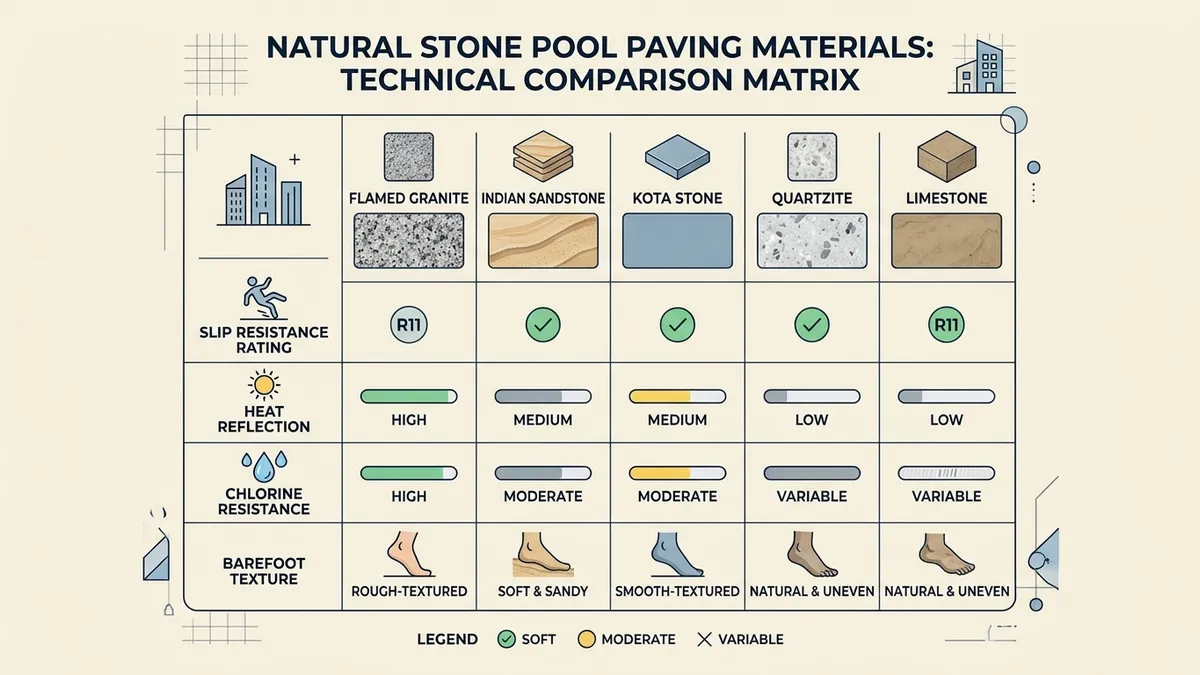
Two of the most widely specified indigenous Indian stones for outdoor paving are Kota limestone and flamed granite. Comparing Kota stone vs flamed granite for swimming pool flooring helps architects and homeowners balance aesthetic character against long-term maintenance requirements.
Kota stone is a fine-grained, high-density dolomitic limestone quarried in Rajasthan. Its natural cool blue-grey and greenish-brown tones harmonize naturally with tropical greenery and blue pool water. When finished with a rough-honed, river-washed or hand-cleft face, Kota stone remains naturally non-slip and stays comfortably cool. However, because Kota stone is a calcium-bearing limestone, it reacts to acidic pool chemicals and concentrated chlorine splashes if left unsealed. It requires periodic application of deep-penetrating impregnating sealers to prevent surface bleaching.
Flamed granite represents the pinnacle of structural durability. Composed of quartz, feldspar and mica, granite boasts a Mohs hardness rating of 6 to 7. It is completely acid-resistant, chemically inert to saltwater chlorinators and virtually impervious to water absorption (below 0.2 percent). While flamed granite requires precision diamond tooling to fabricate and calibrate, its resilience makes it virtually indestructible. View our curated selection of dense architectural granite stone collections suitable for heavy-duty outdoor flooring.
| Performance Parameter | Flamed Indian Granite | Kota Stone (Limestone) | Indian Sandstone (Mint/Teak) |
|---|---|---|---|
| Mohs Hardness | 6.5 to 7.0 (Extreme) | 3.5 to 4.0 (Medium) | 5.5 to 6.5 (High) |
| Water Absorption Rate | Under 0.2% | 0.5% to 1.2% | 1.0% to 2.5% |
| Slip Resistance Rating | R11 to R12 (High wet grip) | R10 to R11 (Honed/Rough) | R11 to R12 (Shot-blasted/Cleft) |
| Barefoot Heat Retention | Moderate (Select light shades) | Low to Moderate | Very Low (Remains cool) |
| Chlorine and Salt Tolerance | Complete immunity | Requires regular sealing | Requires breathable silane sealer |
| Sealing Maintenance Cycle | Every 3 to 5 years | Every 1 to 2 years | Every 2 to 3 years |
Sandstone and Limestone Pool Patio Combination Ideas
Combining sedimentary sandstone with fine-grained limestone produces rich textural layering. Architects pair soft golden-beige sandstone coping with cool grey limestone patio layouts, defining wet splash zones, dry sunbathing decks and covered cabana lounges with understated sophistication.
Monolithic, single-stone patios can appear sterile across expansive outdoor plots. Blending complementary natural stones introduces subtle zoning and architectural depth. Exploring innovative sandstone and limestone pool patio combination ideas allows designers to transition gracefully from the pool coping to the surrounding lawn and outdoor kitchen.
A proven design approach uses a 40 mm thick drop-face coping slab of Teakwood Sandstone around the pool rim, paired with large-format 600x900 mm brushed Kota limestone pavers across the sunbathing lounge. The warm golden wood-grain veining of the sandstone highlights the water line, while the cool, muted green-blue tones of the limestone frame the pool loungers in calm elegance.
Another popular layout incorporates multi-size French Opus patterns combining four distinct slab dimensions. Mixing cleft-finish sandstone in traffic corridors with smooth sandblasted limestone beneath dining pergolas establishes clear functional zones without building physical barriers. The natural variations in fossil markings and mineral ribbons ensure that no two patio slabs look identical.
Modern Infinity Pool Edge Natural Stone Details and Waterline Engineering
Infinity pools require microscopic leveling and chamfered weir stone details. Precision-cut granite or quartzite weir caps guide a continuous sheet of water into concealed catchment troughs. Mitred drop fascias and submerged stone grates create a seamless mirror horizon over surrounding scenery.
Vanishing-edge and perimeter-overflow pools represent the highest tier of aquatic luxury architecture. The water appears to flow endlessly toward the horizon or drop cleanly into a hidden perimeter slot. Perfecting modern infinity pool edge natural stone details requires precision CNC milling, tight tolerances and specialized masonry anchoring.
On an infinity weir wall, the top weir stone must be set with microscopic levelness across its entire run, often within a 1 mm tolerance over twenty metres. If the stone edge deviates by even a fraction of a millimetre, water sheets unevenly, leaving dry patches across the weir face. Architects specify dense Black Granite or Grey Quartzite with a calibrated 45-degree chamfer along the outer top lip to promote smooth laminar water flow without hydraulic turbulence.
The vertical face of the weir wall drops into a lower catch basin. Cladding this vertical drop with flamed or split-face stone creates a soothing acoustic cascade as overflowing water glides down the textured masonry. In slot-overflow pools, bespoke natural stone grates with CNC-machined drainage slots replace plastic drain covers, creating a continuous stone floor right up to the water plane. Explore our custom masonry work for stone water body features designed for luxury estates.
Slope Drainage and Installation Tips for Pool Stone Pavers
Pool decks require a minimum 1:50 to 1:40 outward drainage slope to divert dirty surface runoff away from clean pool water. Laying stone pavers on a reinforced screed bed with full mortar contact and elastomeric perimeter expansion joints prevents slab tenting and ponding.
A flawless pool deck begins with the subterranean engineering that sits beneath the stone pavers. Overlooking drainage gradients or adhesive coverage leads to standing puddle stains, efflorescence and cracked joints. Following proven slope drainage and installation tips for pool stone pavers ensures that your outdoor stone deck remains stable and dry under heavy monsoon downpours.
The primary rule of poolside civil engineering is directing surface water away from the pool shell. Decks must be graded with an outward fall of 1.5 percent to 2.0 percent (equivalent to a 15 mm to 20 mm drop per linear metre) leading toward concealed trench drains or perimeter gravel soakaways. This outward gradient prevents dirty garden runoff, sunscreen residue and rainwater from washing back into treated pool water.
During installation, masons must avoid spot-bonding (dot-and-dab) techniques entirely. Voids beneath poolside stones collect trapped water, leading to hollow sounds, loose pavers and efflorescence blooming. Pavers must be set on a continuous 30 mm to 40 mm semi-dry mortar bed (1:3 cement to coarse sand mix) with a polymer-modified bonding slurry combed onto the back of each stone slab. Flexible polyurethane expansion joints must be installed every four metres and at the junction between the pool beam and the deck slab to accommodate structural movement without shearing stone tiles.
How to Seal Pool Deck Stones Against Chlorine and Saltwater
Pool water treated with chlorine or salt generates subsurface crystallisation pressure that fractures unsealed stone pores. Applying deep-penetrating breathable silane-siloxane or fluoropolymer sealers lines internal capillaries, repelling saline moisture while letting water vapor evaporate freely.
Chlorine and saltwater pool systems create a harsh microclimate for natural stone. When chlorinated splash water lands on porous stone, water evaporates under the sun, leaving concentrated salt crystals trapped inside microscopic pores. As these salt crystals rehydrate and expand during subsequent splash cycles (subflorescence), they exert immense hydraulic pressure that can cause surface flaking and spalling. Understanding how to seal pool deck stones against chlorine and saltwater is essential to preserve the structural integrity of your paving.
Never apply cheap film-forming topical sealers or acrylic gloss coatings around a swimming pool. Topical lacquers trap moisture rising from the sub-base, turning cloudy white, peeling in sheets and creating a dangerously slick plastic barrier. Instead, specify deep-penetrating, breathable impregnating sealers formulated with silane, siloxane or fluoropolymer active ingredients.
Impregnating sealers penetrate 5 mm to 10 mm into the stone's crystalline matrix, chemically bonding to the pore walls. This alters the surface tension of the stone, repelling liquid water and dissolved salts while maintaining an open capillary pathway for subsurface moisture vapor to escape harmlessly. For optimal protection, apply two saturation coats to completely dry stone slabs prior to grouting, followed by a final protective seal across the cured grout joints.
How to Prevent Algae and Efflorescence on Pool Stones
Algae and efflorescence flourish where water ponds and moisture evaporates through cementitious bedding. Installing vapor barriers, applying breathable penetrating sealers and conducting routine seasonal washes with pH-neutral stone detergents keep pool surrounds clean and free of green biofilm.
The combination of continuous moisture, warmth and shade creates an ideal breeding ground for microscopic algae, black mildew and unsightly white efflorescence crusts. Learning how to prevent algae and efflorescence on pool stones ensures your deck looks pristine and remains safe to walk on year-round.
Efflorescence occurs when water dissolves soluble calcium hydroxide salts from the concrete substrate or mortar bed. As moisture migrates upward through the porous stone and evaporates on the surface, it reacts with atmospheric carbon dioxide to form insoluble calcium carbonate, leaving stubborn chalky white patches. Preventing efflorescence requires installing a continuous polythene damp-proof membrane beneath the sub-base and using low-alkali, efflorescence-resistant setting mortars.
Algae spores settle in microscopic surface crevices that stay damp for extended periods. To eliminate slippery green and black patches without damaging the natural stone:
- Maintain active surface drainage so no puddles linger for more than thirty minutes following a swim or heavy rain.
- Avoid using harsh acidic cleaners, hydrochloric acid or muriatic acid washes, which permanently pit limestone, burn sandstone matrices and strip protective sealers.
- Clean the pool deck every month using a dedicated pH-neutral outdoor stone cleaner and a medium-stiff nylon bristle deck brush.
- Apply an eco-friendly biocide algaecide treatment prior to the monsoon season to prevent spore germination in stone micro-fissures.
Cost Drivers of Natural Stone Pool Deck Installation per Sq Ft in India
Pool deck stone costs depend on slab thickness calibration, edge profiling complexity, surface flame or shot-blast texturing, substrate waterproofing and specialized chemical sealing. High-grade custom drop-face coping and radial cuts require skilled artisan masons and precision workshop machinery.
When budgeting for a luxury outdoor swimming pool project, assessing the cost of natural stone pool deck installation per sq ft requires understanding key structural and fabrication variables rather than looking at basic raw material rates alone.
The primary cost driver is stone selection and slab calibration. Standard commercial outdoor tiles vary in thickness by several millimetres, demanding tedious bed packing on site. Architectural-grade pool paving requires calibrated slabs with uniform 20 mm, 30 mm or 40 mm thickness, ensuring perfectly flush walking surfaces that prevent toe-stubbing trips. Dense crystalline granites and fine-veined sandstones quarried from deep geological layers command a premium over softer surface strata.
Edge profiling and radial masonry represent another major factor. Rectilinear pool copings with standard chamfers require standard machine runs, whereas freeform pools with curved radii demand computerized CNC waterjet template cutting and hand-honed drop-face aprons. In addition, site preparation factors, including reinforced concrete raft foundation slabs, dual-component elastomeric waterproofing membranes, polymer-modified adhesives and multi-year fluoropolymer impregnating sealers, dictate the ultimate investment required for an enduring poolside sanctuary.
Consulting Swimming Pool Deck Stone Suppliers and Contractors in Indore
Sourcing natural stone for swimming pool decks requires inspecting live mockups, testing wet barefoot textures and consulting with seasoned stone technicians. Visiting our specialized stone studio ensures proper stone selection, custom edge fabrication and engineering guidance for Central Indian climates.
When consulting with landscape architects, developers or generic swimming pool deck stone suppliers and contractors in indore, clients often encounter standard pre-cut tile stocks that lack specialized anti-slip certifications or custom coping profiles. Designing an exceptional pool deck demands direct collaboration with technical stone fabricators who understand masonry load tolerances and chemical resistance.
At Stone World, our dedicated stone studio and stone experience center provides architects, luxury builders and homeowners with access to an extensive library of indigenous Indian stones. Clients can physically inspect wet-surface textures, review CNC-machined bullnose and drop-face mockups and evaluate bespoke combinations of sandstones, granites and limestones under natural daylight before ordering.
Visit the Stone World Experience Center in Indore
Inspect live mockups, feel stone textures in person and discuss your upcoming architectural or villa project.
Frequently Asked Questions
Which natural stone is best for swimming pool deck paving?
Flamed granite and textured Indian sandstone represent the best choices for swimming pool deck paving. Flamed granite provides complete immunity to chlorine, salt and heavy foot traffic, while light-toned sandstones like Mint or Teakwood stay exceptionally cool under bare feet during hot summer afternoons.
How thick should natural stone pool coping and deck pavers be?
Pool coping stones should have a minimum thickness of 30 mm to 50 mm to withstand cantilevered weight as swimmers pull themselves out of the pool. Surrounding deck pavers laid over a concrete screed bed perform best at 20 mm to 30 mm calibrated thickness.
Can saltwater swimming pools damage natural stone pavers?
Yes, unsealed porous stones can suffer from salt attack and subsurface spalling when saltwater evaporates inside microscopic stone pores. Applying a deep-penetrating, breathable silane-siloxane impregnating sealer lines stone capillaries, neutralizing salt damage while letting moisture vapor escape.
What is the safest anti-slip finish for wet pool surroundings?
Flamed, bush-hammered, sandblasted and rough river-washed finishes provide the safest grip around wet pool decks. These mechanical and thermal treatments create micro-textured surfaces meeting international R11 and R12 slip resistance ratings without hurting bare feet.
Why is pool deck drainage slope essential during installation?
A continuous slope gradient of 1:50 to 1:40 away from the pool shell prevents dirty patio water, sunscreen oils and garden runoff from washing back into clean pool water. It also stops puddle ponding, which prevents algae formation and efflorescence stains.
How often should outdoor pool deck stones be resealed?
High-quality penetrating fluoropolymer and silane-siloxane sealers typically protect pool deck stones for 2 to 4 years depending on sun exposure and splash frequency. Conducting a simple water droplet test indicates when water stops beading and resealing is required.