


You spend months designing the perfect home elevation. You select the best exterior paints, source expensive lighting and yet, the facade often ends up feeling like just another modern concrete block. It lacks character. It lacks a story. That is the exact problem a traditional Rajasthani window element solves. But here is where most homeowners hit a wall. Figuring out how to buy heritage jharokha stone is not like picking out living room tiles. It involves understanding natural stone densities, structural load capacities, fine carving grades and safe installation methods.
If you get the material wrong, the stone might stain or crack during the first heavy monsoon. If the installation anchors fail, you are looking at a serious structural hazard. I have seen homeowners completely overwhelmed by the conflicting advice they receive from local civil contractors who have never handled heavy carved stones. At Stone World, we carve and supply architectural stones across India and this guide exists to cut through that noise. By the time you finish reading this, you will know exactly how to evaluate materials, estimate costs and talk to your architect about securing these beautiful structures.
Table of Contents
What Exactly Is a Jharokha Stone?
A heritage jharokha stone is an ornate, projecting overhanging balcony or window frame carved from natural sandstone or marble. Rooted in traditional Rajasthani palace architecture, it typically features a domed canopy, detailed jaali screens and heavy supporting brackets. Today, it acts as a central design feature for modern home facades.
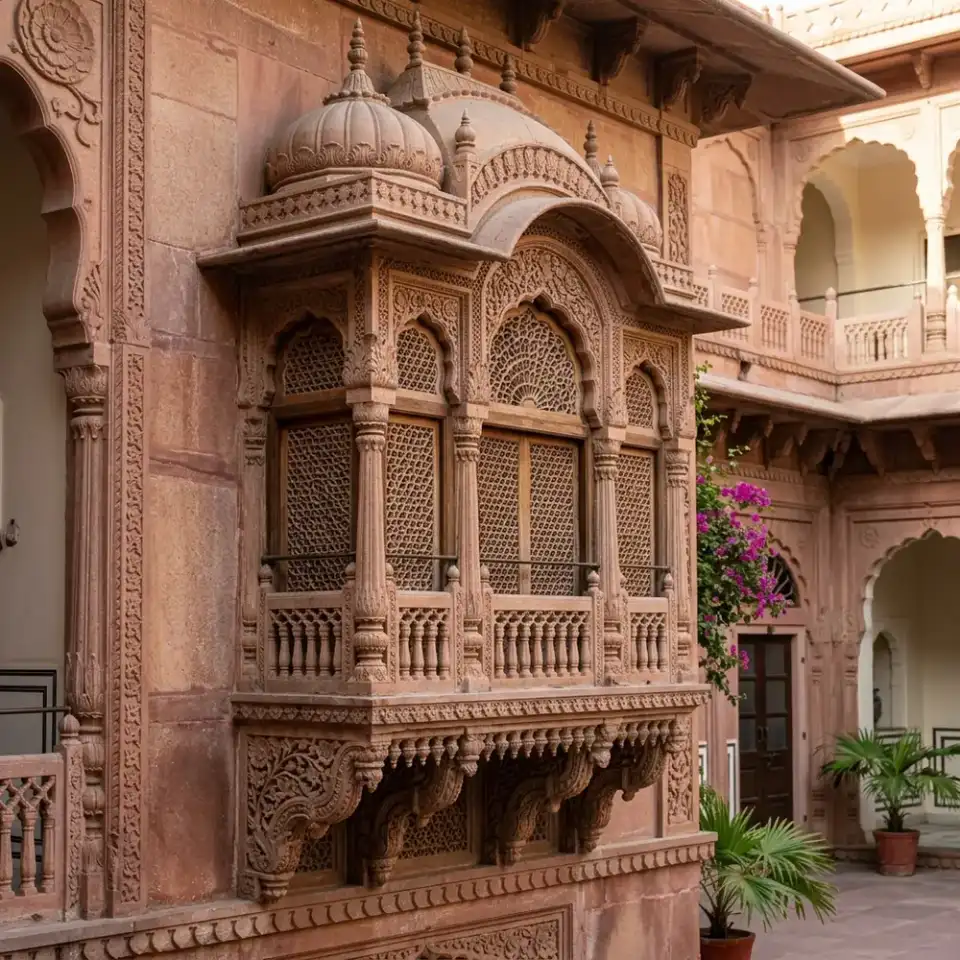
To truly understand what is a jharokha stone, you have to look back at the historic forts of Jodhpur, Jaisalmer and Jaipur. Traditionally, these projecting windows allowed royal women to look out at street processions without being seen from the ground below. The detailed stone lattice panels, known as jaalis, allowed cool breezes to circulate while filtering out the harsh Indian sunlight.
These architectural elements were never just decorative add-ons; they were functional climate-control devices. Today, home builders and architects use them differently. While they still offer shade and ventilation, they are primarily installed to give flat, uninspired building elevations a strong sense of identity. You see them mounted on boundary walls, flanking main entrance doors or serving as main attractions on the second floor of a luxury villa.
Which Stone Is Best for Jharokha Design?
The best stone for jharokha design depends entirely on placement. Agra Red and Jodhpur Pink sandstone are the top choices for exterior elevations because of their excellent weather resistance. For interior spaces and home temples, white Makrana or Banswara marble is preferred due to its capacity for fine floral detailing.
When clients walk into our studio, their very first question is usually which stone is best for jharokha design. It is a completely fair question. Natural stone behaves differently depending on how much rain, UV exposure and pollution it faces. Let us break down the primary options.
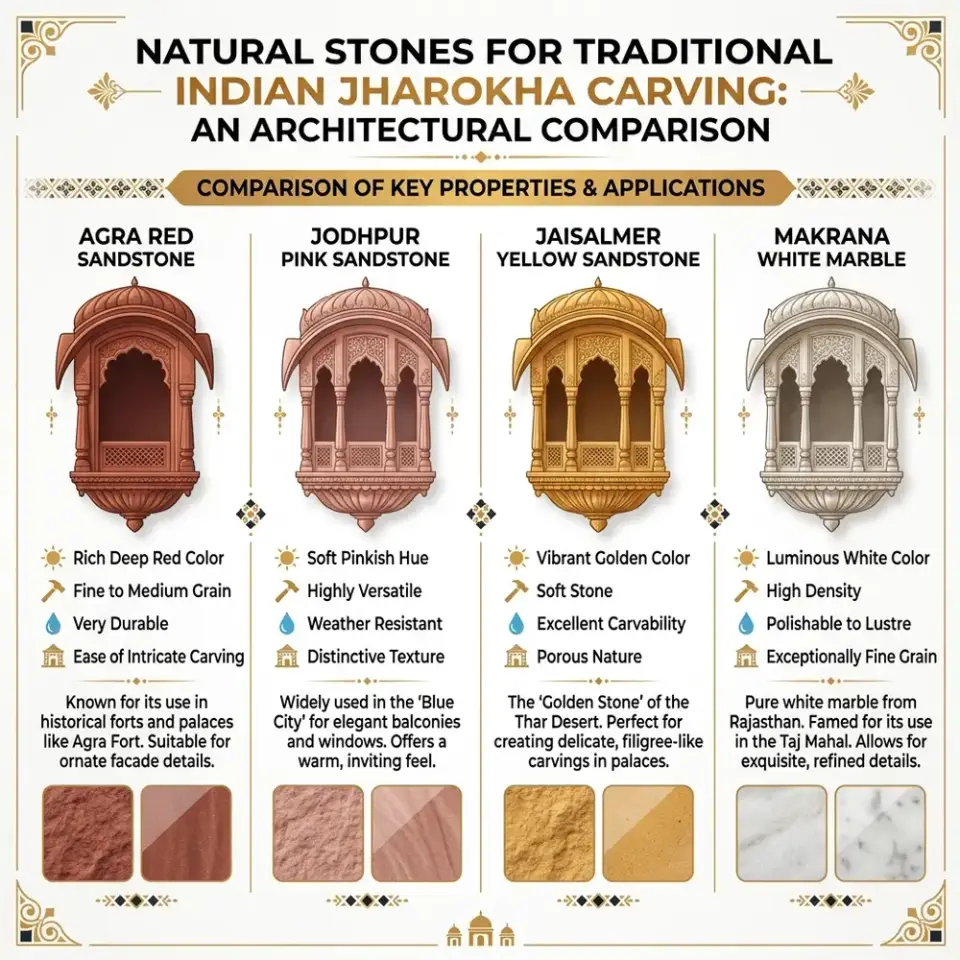
1. Jodhpur Pink & Agra Red Sandstone (For Exteriors)
Sandstone has literally been the bedrock of Rajasthani architectural history for centuries. It resists monsoon moisture and extreme summer heat without spalling or cracking. Pink Jodhpur sandstone offers a subtle rose tint that pairs beautifully with off-white paint, while Agra Red provides that royal look seen in the Red Fort. If you are building an exterior facade, this is your safest, most durable bet.
2. Jaisalmer Yellow Sandstone (Warm Golden Look)
Famous for its warm golden honey hue, Jaisalmer stone creates an immediate rich look. The catch? Yellow sandstone is slightly softer and more porous than its pink counterpart. If you use it for an exterior balcony in a heavy rainfall region, you absolutely must apply high-performance hydrophobic stone sealers to prevent water staining.
3. White Marble (For Interiors & Mandirs)
White marble offers crisp contrast and permits microscopic relief carving that sandstone simply cannot hold. But direct exposure to heavy rain and industrial smog will dull marble surfaces quickly. We strongly recommend reserving white marble for indoor courtyard walls, covered balconies and dedicated home temples.
If you are debating between red sandstone vs marble jharokha options, the rule of thumb is simple: sandstone goes outside, marble stays inside. Sandstone embraces the weather and builds character over time. Marble demands protection to stay looking new.
Need Expert Help Choosing the Right Stone?
Stop guessing which material works best for your local climate. Speak directly with our architectural stone experts to get tailored advice for your villa's elevation.
Consult With Stone WorldWeight Limits and Balcony Installation Safety
A fully carved stone jharokha weighs between 180 kg and 600 kg. Safe installation requires heavy-duty stainless steel anchor bolts, chemical fasteners and robust stone brackets that anchor directly into the building's reinforced concrete (RCC) beams, rather than standard brickwork.
One important technical aspect buyers routinely overlook is understanding how heavy is a stone jharokha. Natural stone is incredibly dense. A standard 4-foot by 3-foot projecting sandstone jharokha with 50mm thick carved slabs carries a massive dead load. You cannot glue this to a wall with standard tile adhesive and call it a day.
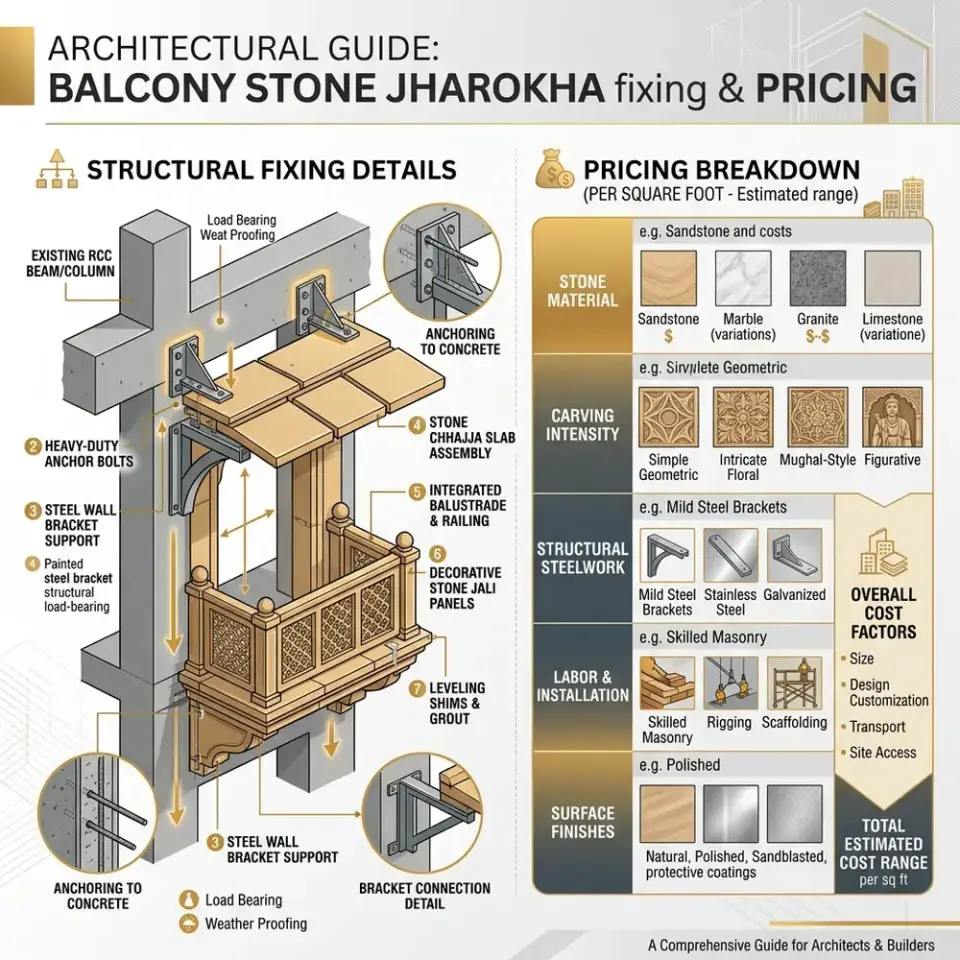
Clients frequently ask us: can we fix stone jharokha on balcony rails or existing apartment walls? The answer is yes, but only if the structural anchoring methods are mathematically sound. When figuring out how to install sandstone jharokha safely, the installation team must bypass the soft outer brickwork and drill directly into the structural RCC columns or lintel beams. We use heavy-duty stainless steel (SS 304) anchor bolts and epoxy chemical fasteners to ensure the cantilevered brackets (khuntis) can support the overhanging stone roof without sagging over the decades.
If you are planning an exterior facade that features heavy stone projections, review our architectural wall cladding guide to ensure your base wall preparations are up to code.
Breaking Down the Cost of Rajasthani Stone Jharokha
The cost of a Rajasthani stone jharokha varies significantly based on whether you choose standard CNC-machined designs or premium custom hand-carved architectural pieces. Pricing is determined by the total cubic volume of stone, the complexity of the 3D carving and the specific material grade selected.
Let's talk numbers. The cost of rajasthani stone jharokha is rarely fixed because every piece is essentially a custom sculpture. When you request a quote, the price you receive factors in three distinct elements:
- Material Grade: Basic Dholpur beige sandstone costs less per cubic foot than premium, unblemished Makrana white marble. The thicker the stone slab required for the structural pillars, the higher the raw material cost.
- Carving Method: A fully CNC-machined jharokha with shallow 2D relief work is economical because machines handle the bulk of the labor. True 3D hand-carving by master artisans, which yields deep undercuts and organic floral shapes, takes weeks of manual labor and significantly raises the price.
- Logistics and Assembly: A massive 8-foot balcony structure ships in multiple heavy pieces requiring specialized wooden crating. Installation on a third-story facade requires scaffolding, chemical anchors and skilled labor.
For a standard mid-sized exterior sandstone jharokha, you should expect to set aside a moderate home improvement budget, which will scale up based on site location, transport and installation requirements. Want to see how these fine patterns are made? Explore our CNC carved stones collection.
Cleaning and Polishing Sandstone Jharokhas
To polish and maintain a sandstone jharokha, regularly dry-brush the carved crevices to remove dust. Apply a penetrating natural stone sealer every two years to block moisture and prevent algae growth. Avoid acidic bathroom cleaners, as they will degrade the sandstone surface.
Once your piece is installed, you need to know how to polish sandstone jharokha elements without ruining the finish. The reality is that exterior sandstone does not require a high-gloss polish like interior marble flooring does. The rough, matte texture is part of the charm.
However, the deep carvings act as dust traps. Every few months, use a soft, dry bristle brush to sweep out the crevices. Never use harsh chemical acids or wire brushes, as they will scar the stone permanently. After a heavy monsoon, a gentle pressure wash (on a wide, low-pressure setting) removes accumulated grime. Applying a high-quality penetrating stone sealer every two to three years is the best investment you can make to stop water absorption and keep the stone looking fresh.
Finding Custom Makers and Traditional Designs
When searching for custom stone jharokha makers, evaluate their previous architectural projects and factory capabilities. Ensure they offer detailed CAD drawings before carving begins and use proper crating methods for safe nationwide transport of heavy stone components.
Sourcing these pieces requires careful research. Searching for custom stone jharokha makers near me might yield a few local monument carvers, but building an architectural balcony requires specialized engineering knowledge, not just carving skills.
You need a supplier who understands traditional window jharokha designs but operates with modern precision. At Stone World, our workflow bridges this gap. We start with precise CAD drawings so you and your architect can verify dimensions and load bearings before a single chisel hits the stone. We combine the accuracy of CNC machinery for perfect symmetry with the soul of hand-finishing by generationally trained artisans.
Ready to Upgrade Your Home Facade?
From conceptual CAD drawings to final crated delivery, we handle the entire process. Share your elevation plans with us and we will craft a jharokha that lasts generations.
Request a Custom QuoteFrequently Asked Questions
A collection of direct answers addressing the most common concerns homeowners and architects have regarding the selection, weight limits, material durability and maintenance of traditional natural stone jharokhas.
What is the standard turnaround time for a custom stone jharokha order?
A custom hand-carved or CNC-machined sandstone jharokha typically takes 3 to 5 weeks from approved CAD drawings to completed factory assembly and crated dispatch.
Can a stone jharokha be installed on a brick wall facade without concrete beams?
Small accent jharokhas weighing under 50 kg can be fixed to solid brick walls using chemical anchors. However, heavy 3D balconies over 150 kg require direct mechanical anchoring into RCC columns or lintel beams to prevent structural failure.
Is hand carving better than CNC machine carving for stone jharokhas?
CNC machine carving provides exact symmetry and lowers production costs, while hand carving adds organic depth and sharper undercuts. Combining both methods yields the best balance of structural precision and traditional relief detail.
Can an outdoor sandstone jharokha handle heavy monsoon rains?
Yes. High-grade Indian sandstones like Agra Red and Jodhpur Pink have proven weather resistance spanning centuries. Applying a breathable stone sealer after installation protects the stone from absorbing excess rain and developing algae.