


Walk into any luxury villa or penthouse and your eyes immediately lock onto that glowing, vein-matched stone wall behind the couch or television console. There is something effortless about white marble. It brightens up a room, reflects ambient light and gives your living space an open, breathable vibe. But when you start shortlisting materials for your own home, you quickly realise that determining which white marble is best for walls is surprisingly tricky. One contractor recommends Indian Statuario for dramatic veining, another suggests pristine Vietnam White, while stone artisans advise Makrana White, Agaria White or Banswara Purple.
Pick the wrong slab or skip structural wall waterproofing and you risk yellowing, moisture patches or hairline cracks within a couple of monsoons. Even worse, fixing heavy marble slabs incorrectly on high walls creates a genuine safety risk. At Stone World, we work with architects, builders and interior designers across India every day to select, cut and install architectural stones. This detailed guide cuts through the sales pitches to give you practical stone comparisons, real-world pricing in Indian Rupees, safe installation methods and maintenance secrets so your marble walls stay flawless for decades.
Table of Contents
Which White Marble Is Best for Walls? Top 5 Varieties
Indian Statuario and Banswara marble lead for artistic bookmatched living room feature walls, while Makrana and Vietnam White provide ultra-dense, non-porous surfaces for pooja rooms and master bathrooms. Agaria White delivers superior scratch resistance and geometric linear patterns for high-traffic hallways and staircase wall panelling.
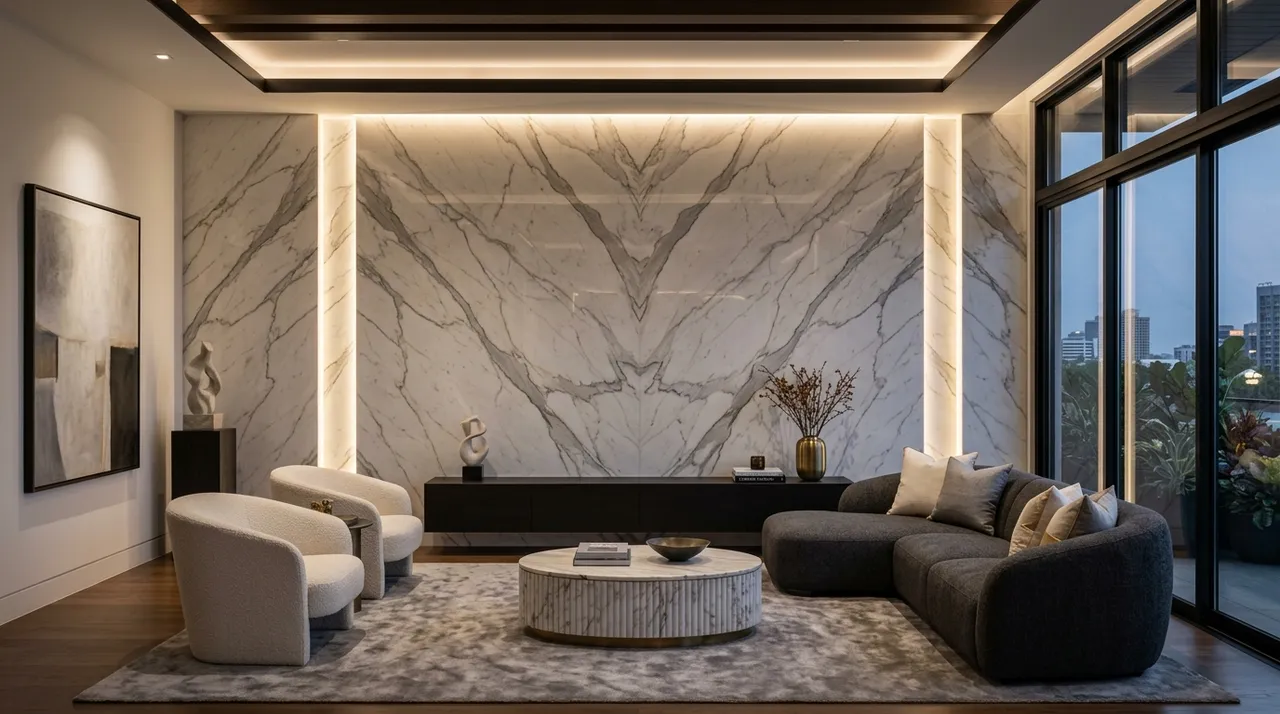
Every marble variety has its own mineral structure, grain density and porosity. A stone that looks magnificent behind your living room couch might fail inside a steam shower if it has high iron content or open pores. Indigenous Indian stones from Rajasthan alongside high-density Vietnam calcite offer exceptional durability, distinct vein patterns and effortless maintenance under Indian climate conditions. Here are the top five white marble varieties for interior walls today.
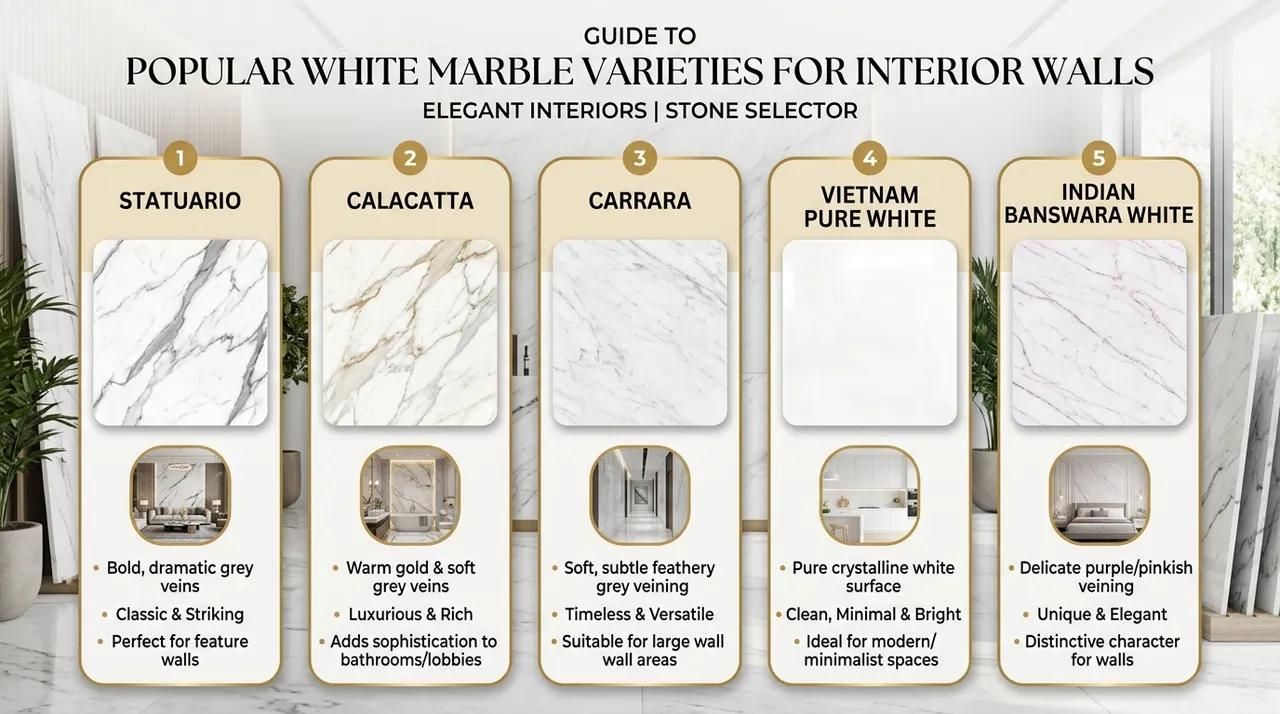
1. Indian Statuario Marble (The Dramatic Bookmatched Feature Wall Choice)
Quarried from the rich marble belts of Rajasthan, Indian Statuario is the premier choice for homeowners seeking bold visual drama without exorbitant costs. It features a bright white to light-pearl ground accented by bold, expressive diagonal grey and dark charcoal veins. When cut in sequence and bookmatched, Indian Statuario produces dramatic symmetrical centrepieces for drawing room feature walls, TV consoles and foyer panels. Its dense crystal matrix makes it sturdy during cutting and vertical wall mounting.
2. Makrana White Marble (98% Pure Calcite Heritage Benchmark)
Mined in Makrana, Rajasthan, this is the legendary stone used to construct the Taj Mahal and Victoria Memorial. Composed of over 98% pure calcium carbonate, Makrana marble has almost zero porosity (under 0.08%) and contains virtually no iron minerals. As a result, it will never leach rust spots, absorb moisture or turn yellow over decades. Unlike softer stones that require synthetic chemical resin and back netting for reinforcement, Makrana is 100% natural, solid and grows more lustrous with time. It is the premier choice for mandir backdrops, pooja rooms and luxury bathroom wet walls.
3. Vietnam White Marble (Pristine Pure Crystal Calcite)
Vietnam Crystal White is world-renowned for its spotless, solid milk-white surface free of heavy veining. Composed of dense, uniform calcite micro-crystals that catch ambient light like fine sugar granules, it delivers a sleek, minimalist backdrop. Its ultra-low porosity makes it exceptionally resistant to moisture, soap residue and surface staining. Vietnam White is ideal for modern minimalist living room backdrop walls, master bathroom vanities and backlit pooja room panels.
4. Agaria White Marble (Dynamic Zig-Zag Veins & Structural Hardness)
Sourced from the Agaria quarry cluster in Rajsamand, Rajasthan, Agaria White is celebrated for its distinctive geometric veining. The stone pairs a milky white crystalline background with dynamic zig-zag, linear and criss-cross veins in shades of slate grey, olive green and golden brown. Agaria marble is exceptionally hard, highly compact and takes a high-gloss mirror finish that resists surface scratches and humidity. It is an excellent choice for accent walls, staircase cladding, lift lobbies and contemporary fluted wall panelling.
5. Banswara Marble (Exotic Violet Waves & Artistic Character)
Quarried in Banswara, Rajasthan, banswara white marble for wall cladding is celebrated for its unique purple, violet and lavender-grey ribbon patterns flowing across an off-white canvas. This natural colouration creates an organic tapestry effect that feels warm and artistic. Highly economical yet structurally dense, Banswara marble is ideal for dining room accent walls, bedroom headboard panelling and large corridor walls that need rich character on a practical budget.
| Marble Variety | Origin & Quarry Belt | Background & Vein Pattern | Calcite Content & Porosity | Ideal Wall Application | Recommended Surface Finish |
|---|---|---|---|---|---|
| Indian Statuario | Rajasthan, India | Pearl white ground with bold diagonal grey & dark charcoal waves | High Calcite (0.10% - 0.16% porosity) | Drawing room TV units, living room bookmatched walls | High-gloss mirror polish (Bookmatched) |
| Makrana White Marble | Makrana, Rajasthan | Pure crystalline white with subtle grey linear ribbons | 98%+ Pure Calcite (<0.08% porosity) | Mandir backdrops, pooja rooms, shower wet walls | Traditional fine diamond polish / Hand-buffed |
| Vietnam White Marble | Luc Yen, Vietnam | Pristine solid white with uniform calcite micro-crystals | 99% Calcite Density (0.08% - 0.12% porosity) | Minimalist backdrop walls, bathroom vanity surrounds | High-gloss or honed matte finish |
| Agaria White Marble | Rajsamand, Rajasthan | Milky white with dynamic zig-zag green, grey & bronze veins | Dense Matrix (0.08% - 0.12% porosity) | Corridors, staircase walls, lift lobbies, CNC fluting | Mirror polish or fine fluted texture |
| Banswara Marble | Banswara, Rajasthan | Off-white ground with distinct purple, violet & lavender bands | Moderate Density (0.10% - 0.15% porosity) | Dining room feature walls, bedroom panelling, long corridors | High-gloss polish or CNC relief patterns |
Book Match Marble Wall Design Ideas and Feature Walls
Book matching pairs consecutive marble slabs sliced from the same block, mirror-imaging their natural veining to create symmetrical diamond, butterfly or abstract geometric patterns. It transforms a standard wall into an organic art installation without requiring artificial wall panelling.
When you cut a block of marble, consecutive slabs are mirror opposites of one another. When installed side by side, their veins meet at the seam, creating stunning patterns. Indian Statuario, Agaria White and Banswara Purple slabs from Rajasthan produce magnificent vein reflections that rival any luxury wall installation. Exploring book match marble wall design ideas is one of the most exciting parts of residential interior planning. You can explore several distinct layouts:
- Two-Slab Butterfly Match: Two tall vertical slabs meet at the centre seam. Perfect for TV consoles and standard 10-foot ceiling drawing room feature walls using Indian Statuario.
- Four-Slab Diamond Match: Four consecutive slabs (2x2 grid) join at a central focal point, forming an expanding geometric diamond. This creates an unforgettable statement in double-height entrance foyers.
- Continuous Vein Flow (Slip Matching): Rather than mirroring, the slabs are laid side-by-side to let the veins travel horizontally across long corridor or dining room walls with Agaria White or Banswara slabs.
- Backlit Marble Panels: Pairing translucent high-calcite slabs like Vietnam White with LED diffusers behind the wall creates a warm evening ambient glow.
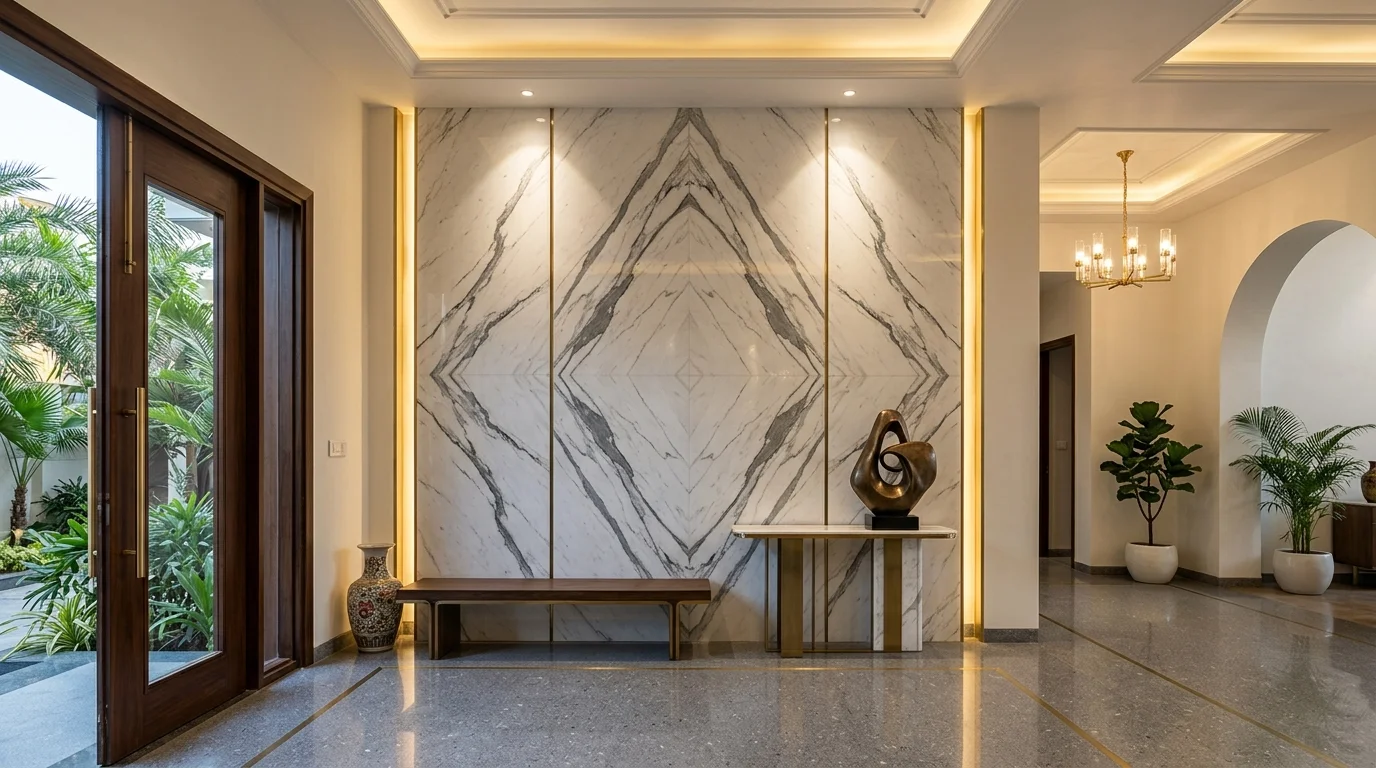
For more inspiration on pairing bookmatched stone panels with modern lighting schemes, explore our curated luxury feature wall collection.
Looking for Bespoke Bookmatched Marble Slabs?
Finding slabs with matching consecutive veins requires curated sourcing. Visit our Stone Experience Center or connect with our stone consultants to view live lots with 3D slab dry-lay mockups.
Consult With Stone WorldMarble Slab Thickness and Safe Wall Fixing Methods
Standard marble wall cladding thickness ranges between 16mm and 18mm for natural slabs and 3mm to 6mm for slim porcelain-backed veneers. High-wall installations require mechanical dry cladding with grade 304 stainless steel clamps and chemical fasteners rather than traditional cement-sand mortar beds.
One of the biggest mistakes contractors make is treating wall marble like floor tiles. Standard natural marble wall cladding thickness in India is 16mm to 18mm. A single 8x4 foot slab at 18mm thickness weighs over 130 kilograms. If you rely solely on regular cement mortar to stick that weight to a vertical wall, temperature fluctuations and structural vibration can cause the adhesive bond to fail.

When planning how to fix marble on walls safely, there are two primary installation systems:
1. Mechanical Dry Cladding (Recommended for Heights Above 8 Feet)
In dry cladding, stainless steel (SS 304 or SS 316) brackets and anchor fasteners are drilled into the structural masonry or RCC wall. Kerf slots are precision-cut into the top and bottom edges of the marble slabs, allowing the metal brackets to hold the stone mechanically. This creates an air cavity behind the slab, eliminating efflorescence and dampness transfer while ensuring total seismic and vibration safety.
2. High-Performance Polymer Wet Cladding (For Low Heights)
For internal walls under 8 feet, you can use specialized high-polymer, two-component epoxy or C2TE-grade tile adhesives (such as Laticrete or MYK Arment). Never use pure grey cement. Grey cement leaches moisture and dark minerals through white marble pores, leaving permanent grey water stains on the front face.
For large format marble slab installation, applying a two-coat breathable epoxy sealer on the back and four edges of each slab before installation is essential. This prevents alkaline moisture from seeping into the marble face. To understand mechanical fixing standards in detail, read our practical guide on dry vs wet cladding methods.
Can We Use White Marble in Bathrooms and Wet Areas?
Yes, white marble can be used safely in bathrooms, provided the slabs are sealed with penetrating hydrophobic sealers on all six sides and joints are filled with non-staining epoxy grout. Denser marbles like Makrana White and Vietnam Crystal White perform best in wet shower enclosures due to near-zero water absorption.
Homeowners constantly ask us: can we use white marble in bathrooms without risking ugly water stains or yellow patches? The short answer is yes, but wet room installations demand strict discipline. Bathrooms introduce constant humidity, soap scum, acidic shampoo spills and mineral-heavy hard water.
To keep your white bathroom marble immaculate, follow these four rules:
- Choose Dense Marbles: In the direct shower enclosure, opt for Makrana White or Vietnam Crystal White. Their tight calcite crystal structure resists water ingress and prevents oxidation.
- Six-Side Hydrophobic Impregnation: Before fixing, coat the front, back and all four side edges with an impregnating sealer (such as Tenax Proseal or Akemi Nano-Seal). This blocks water absorption from grout lines and rear condensation.
- Use 100% Epoxy Grout: Standard cementitious grout absorbs moisture and fosters black mold. Always specify two-component epoxy grout (in matching white or translucent frost) for marble wall joints.
- Ensure Proper Ventilation: Install a powerful exhaust fan to prevent standing steam from condensing on cold marble surfaces for extended hours.
Explore our dedicated luxury bathroom stone collection to discover vanity counters, stone washbasins and waterproof wall concepts.
Cost of White Marble Wall Design and Polishing in India
The overall investment for white marble wall cladding depends on stone rarity, block lot symmetry, mechanical dry cladding hardware, six-side hydrophobic sealant protection and multi-stage handheld diamond pad on-site polishing.
Budgeting for a marble feature wall involves more than just selecting raw slabs. Homeowners are often surprised when overall project estimates vary widely from initial stone inquiries. Slab grading, vein continuity across consecutive cuts and structural framework requirements determine the total budget. Here is a clear breakdown of pricing across the top five varieties:
| Marble Variety | Material Characteristics | Recommended Fixing System | Sealing Protection | Approximate Price Range (INR) |
|---|---|---|---|---|
| Banswara Purple / White Marble | Flowing violet-grey ribbons, artistic appeal | Polymer adhesive bed or SS dry clamps | Breathable penetrating sealer | ₹75 – ₹180 / sq ft |
| Agaria White Marble | Dynamic zig-zag green-grey veins, high hardness | SS 304 dry brackets or C2TE polymer mortar | Standard hydrophobic moisture barrier | ₹90 – ₹220 / sq ft |
| Indian Statuario Marble | Bold diagonal grey waves, master bookmatching | SS 304 mechanical dry cladding framework | Six-side hydrophobic impregnation | ₹180 – ₹450 / sq ft |
| Vietnam Crystal White | Spotless pure solid white calcite crystals | SS 304 dry anchors or polymer adhesive | Rear breathable epoxy barrier | ₹200 – ₹550 / sq ft |
| Makrana White Marble | 98%+ pure calcite heritage stone, lifetime durability | Engineered SS 304 framework or polymer bed | Naturally impervious (<0.08% porosity) | ₹250 – ₹650+ / sq ft |
When evaluating the cost of white marble wall polishing, keep in mind that vertical wall polishing requires specialized lightweight handheld machinery fitted with sequential diamond abrasive pads (grit 50 through 3000) followed by chemical crystallization (such as Klindex or 5-Extra). Because artisans work vertically against gravity and must carefully mask adjacent flooring and ceilings, finishing wall panels requires greater craftsmanship and dedicated setup time than standard floor polishing.
How to Clean and Remove Stains From White Marble Walls
Clean white marble walls using microfibre cloths dampened with pH-neutral stone cleaners and lukewarm water. Remove stubborn deep-set organic or oil stains by applying a paste poultice of baking soda or powdered talc mixed with 6% hydrogen peroxide, leaving it taped over the stain for 24 hours.
Because marble is composed primarily of calcium carbonate, it reacts instantly with acids. Knowing how to clean white marble walls safely will prevent irreversible surface etching. Follow these simple maintenance rules:
- Routine Dusting: Wipe down vertical wall panels once a week with a dry or lightly damp microfibre duster. Vertical walls collect less debris than floors, so gentle wiping is usually all that is needed.
- Use pH-Neutral Cleaners: For monthly washes, use specialized stone cleaners like Fila Cleaner or Taski R7. Never use vinegar, lemon juice, Colin, bleach or toilet acid (Harpic) on marble.
- Reseal Every Two Years: In high-touch zones like dining walls or bathroom surrounds, reapply a breathable stone impregnator every 24 months to maintain water repellency.
If you already have a spot, here is how to remove stains from white marble wall surfaces without stripping the polish:
The DIY Hydrogen Peroxide Poultice for Stubborn Stains
Mix baking soda or chalk powder with 6% hydrogen peroxide (available at any chemist) to form a thick, peanut-butter consistency paste. Wet the stained marble area with clean water, spread a 5mm layer of the paste over the mark, cover it with plastic cling wrap and tape the edges with painter's tape. Leave it for 24 hours to draw the deep stain out into the powder. Remove the wrap, wipe away the dry powder with a damp cloth and the stain will be gone.
For more detailed restoration techniques, explore our guide on how to clean natural stone wall panels.
Ready to Upgrade Your Home With White Marble?
From Indian Statuario lots to custom CNC wall murals and dry cladding engineering, Stone World provides end-to-end architectural stone solutions tailored to your floor plans.
Request a ConsultationFrequently Asked Questions
Direct answers to the most common questions regarding white marble selection, structural dry cladding, bathroom safety, polishing costs and long-term maintenance for Indian homes.
Which white marble is best for living room TV unit feature walls?
Indian Statuario and Banswara Purple marble are the top choices for TV unit backdrops. Their bold, expressive veining allows for dramatic two-slab butterfly or four-slab diamond bookmatched patterns that form a natural focal point in the drawing room.
Why is Makrana white marble recommended for pooja rooms and mandir backdrops?
Makrana marble contains over 98% pure calcium carbonate with near-zero porosity (<0.08%). It does not absorb water, never oxidizes or turns yellow, and needs no chemical resin treatment, making it the most sacred and durable stone for mandir backdrops and pooja rooms.
What is the difference between Vietnam White and Makrana White marble?
Vietnam White offers a solid, spotless milk-white crystalline base with virtually no veins, making it ideal for modern minimalist walls. Makrana White has subtle linear grey waves, a heritage crystalline sheen, and superior non-yellowing durability over multiple generations.
Is Agaria white marble durable enough for high-traffic corridors and staircase walls?
Yes. Agaria White is one of the densest and hardest marbles quarried in Rajasthan. Its distinctive zig-zag green and grey veining hides minor surface wear, and its high mineral density resists impact scratches and humidity along busy hallways and staircases.
How do Banswara purple-wave marble slabs look when bookmatched?
Banswara slabs produce an exquisite tapestry-like pattern with flowing purple, violet and grey swirls. When two consecutive slabs are mirror-matched, the veins form organic, feather-like geometric designs that provide an artistic accent for dining areas and bedrooms.
Can heavy marble slabs fall off interior walls over time?
Marble slabs fixed with improper grey cement mortar on high walls can delaminate due to structural shifting and moisture. Using mechanical dry cladding with grade 304 stainless steel clamps or specialized C2TE polymer epoxy adhesives eliminates this risk entirely.
Does natural white marble turn yellow on interior walls?
White marble can turn yellow if iron minerals inside the stone oxidize from rear moisture seepage, or if acidic cleaners strip the stone. Applying a breathable epoxy back-coating and sealing the stone every two years prevents yellowing.