


There is an unmistakable, grounded character that genuine fieldstone brings to a home. Whether it wraps around a grand exterior boundary wall, frames an outdoor patio fireplace or creates a rugged double-height facade, natural stone brings a timeless, solid presence. But turning raw, irregularly shaped quarry stones into a stable, weatherproof wall requires serious structural planning. Homeowners and contractors frequently ask us how to install natural fieldstone cladding correctly without dealing with future moisture leaks, cracked joints or heavy stones detaching from the substrate.
Working with fieldstone is fundamentally different from sticking standard vitrified wall tiles or lightweight ceramic panels. You are handling natural mineral slabs with varying weights, organic contours and specific mortar adhesion requirements. If you skip water-resistive barriers or use an incorrect cement mix, monsoon rains can seep behind the stones and cause structural wall failure. At Stone World, we quarry, craft and supply architectural stones across India. This guide gives you the practical technical details: substrate preparation, mortar formulations, corner detailing, cost estimates in Indian Rupees and long-term stone maintenance.
Table of Contents
What Is Natural Fieldstone Cladding and Where Is It Used?
Natural fieldstone cladding is made from quarried or naturally weathered riverbed rocks and hillside stones split into thin or full-bed profiles for wall surfacing. It features irregular geometric shapes, rough earthy textures and diverse mineral tones ranging from golden ochre to deep charcoal, making it popular for rustic facades and boundary walls.
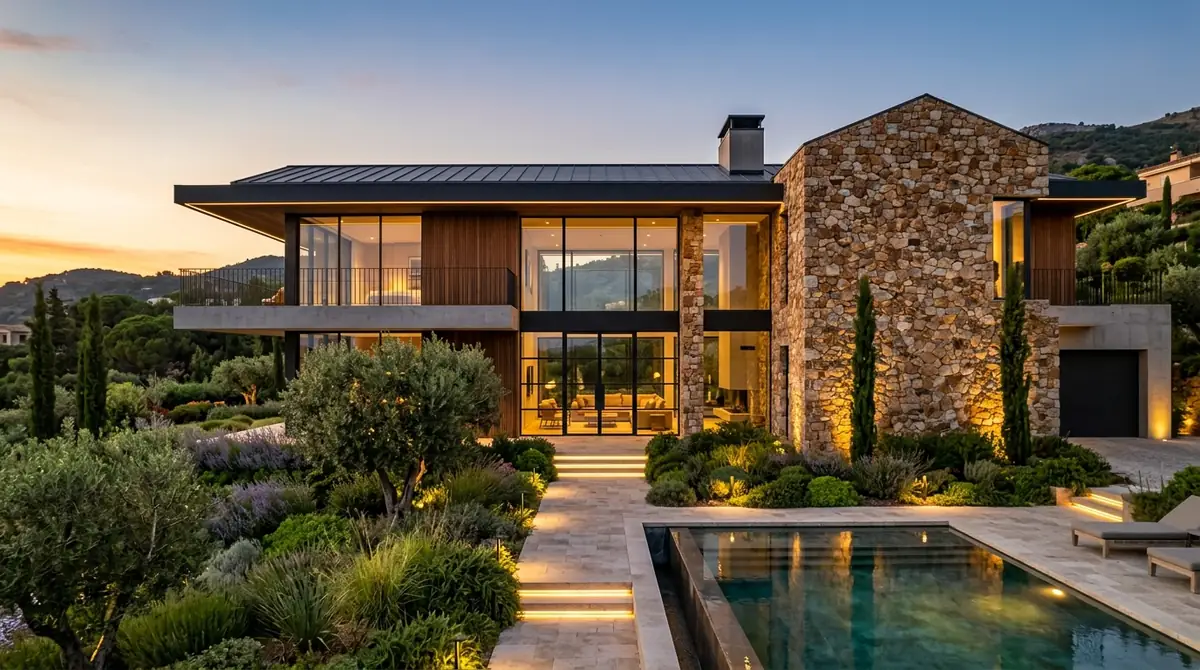
Fieldstone gets its name from stones collected from the surface of fields, riverbeds and hillsides where natural weathering has rounded their edges and softened their textures over decades. Unlike precision-cut granite or polished marble tiles, fieldstone showcases organic irregularity. Each piece has subtle variations in grain, iron oxide pigmentation and tactile depth.
In modern Indian architecture, fieldstone cladding is widely specified for villa boundary walls, exterior entry gates, living room accent pillars, courtyard water features and landscape retaining walls. It creates an authentic connection between built architecture and surrounding garden landscapes. If you are comparing stone types for outdoor elevations, read our guide on architectural stones for wall cladding to see how fieldstone compares with sandstone and slate.
Natural Fieldstone vs Manufactured Veneer: Key Differences
Natural fieldstone is 100% genuine quarried stone with mineral richness that never fades under intense sunlight and can last centuries. Manufactured stone veneer is a cast mixture of Portland cement, lightweight aggregates and iron oxide dyes that is lighter in weight but prone to surface chipping and UV fading over time.
When selecting materials for an elevation project, builders often weigh natural fieldstone vs manufactured veneer. While manufactured fake stone is lighter and easier for untrained masons to install, it cannot match the structural integrity and lifetime durability of real stone.
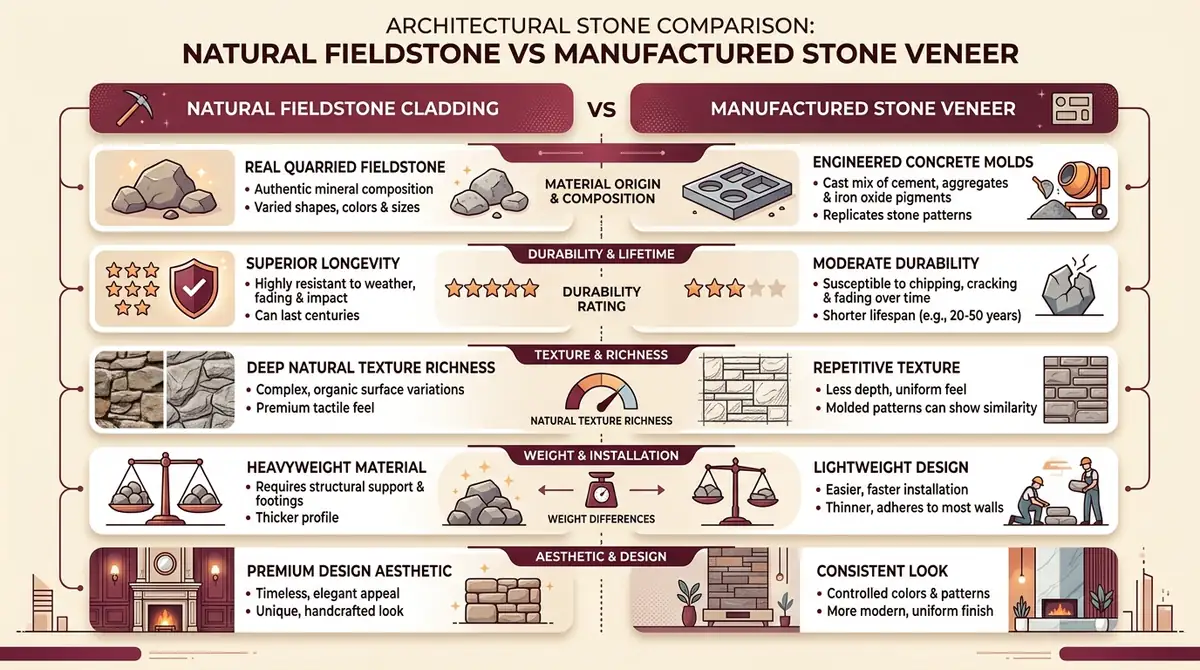
| Feature | Natural Fieldstone Cladding | Manufactured Stone Veneer |
|---|---|---|
| Composition | 100% genuine quarried granite, quartzite or sandstone | Moulded Portland cement, fly ash and chemical pigments |
| Colour Longevity | Permanent natural minerals; never fades under extreme UV | Surface pigments fade and bleach over 7-12 years |
| Weather Resistance | Withstands heavy monsoons, heatwaves and winter chills | Porous concrete matrix absorbs moisture; risk of efflorescence |
| Chipping & Damage | Exposes identical natural stone beneath; chips blend in | Chips reveal raw grey concrete core beneath thin colour coat |
| Lifespan | 75 to 100+ years with minimal wear | 15 to 25 years before noticeable surface wear |
For long-lasting residential builds and luxury bungalows, natural fieldstone is the clear winner. The authentic tactile feel and natural mineral sparkle cannot be replicated by concrete casting.
How Thick Is Fieldstone Wall Cladding?
Natural fieldstone wall cladding is available in two primary formats: thin stone veneer measuring 25 mm to 38 mm (1 to 1.5 inches) thick and traditional full-bed stone cladding measuring 75 mm to 150 mm (3 to 6 inches) thick requiring dedicated structural ledge foundations.
A crucial technical question every structural engineer asks is how thick is fieldstone wall cladding. The thickness directly dictates the dead weight loaded onto your walls and determines whether you need a dedicated RCC foundation ledge.
1. Natural Thin Fieldstone Veneer (25 mm to 38 mm)
Thin fieldstone veneer is sawn flat on the back using industrial diamond saws while leaving the front face naturally rugged. It weighs approximately 45 kg to 65 kg per square metre. Because of its lighter weight, thin veneer adheres directly to masonry, concrete or metal lath walls without requiring structural stone shelf angles or concrete floor ledges.
2. Full-Bed Architectural Fieldstone (75 mm to 150 mm)
Full-bed fieldstone consists of solid, heavy stone blocks used in load-bearing stone masonry or thick anchored cladding. These stones weigh upwards of 180 kg to 250 kg per square metre. They require a reinforced concrete foundation ledge, heavy-duty wall ties and seismic anchoring to hold the mass safely against the building frame.
For 90% of modern residential home renovations and exterior cladding projects, natural thin fieldstone veneer is the preferred choice. It offers the authentic appearance of full stone walls without overwhelming the building's structural load capacity.
Looking for Premium Natural Fieldstone Cladding?
Explore Stone World's curated selection of hand-sorted quartzite, sandstone and granite fieldstones, precision-cut for effortless wall installation.
View Cladding CollectionsDry Stack vs Mortar Fieldstone Wall: Which Style Fits Your Home?
Dry stack fieldstone walls fit stones tightly together with hidden mortar behind the pieces, creating a sleek, shadow-rich contemporary look. Mortared fieldstone walls leave visible 10 mm to 20 mm recessed or flush joints between stones, offering a classic European farmhouse aesthetic and higher weatherproofing.
When planning your layout, deciding between a dry stack vs mortar fieldstone wall alters both the visual personality of your space and the installation technique required.
- Dry Stack Aesthetics: In a dry stack finish, masons chisel and trim stones so they fit snugly against each other. Mortar is applied only to the back of the stone to bond it to the wall, leaving the front joints empty. This casts dramatic shadows under outdoor spotlights and gives modern facades a crisp, architectural look. However, dry stacking requires careful stone dressing and takes longer to install.
- Mortared / Grouted Joints: In a traditional mortared installation, stones are spaced roughly 12 mm to 18 mm apart. After setting the stones, masons fill the gaps with a grout bag and strike the joints smooth. This creates strong mechanical interlocking and seals the entire wall surface against rainwater penetration, making it ideal for high-rainfall regions.
For more insights on mechanical vs adhesive wall fixing, explore our breakdown on dry vs wet cladding methods.
How to Install Natural Fieldstone Cladding Step-by-Step
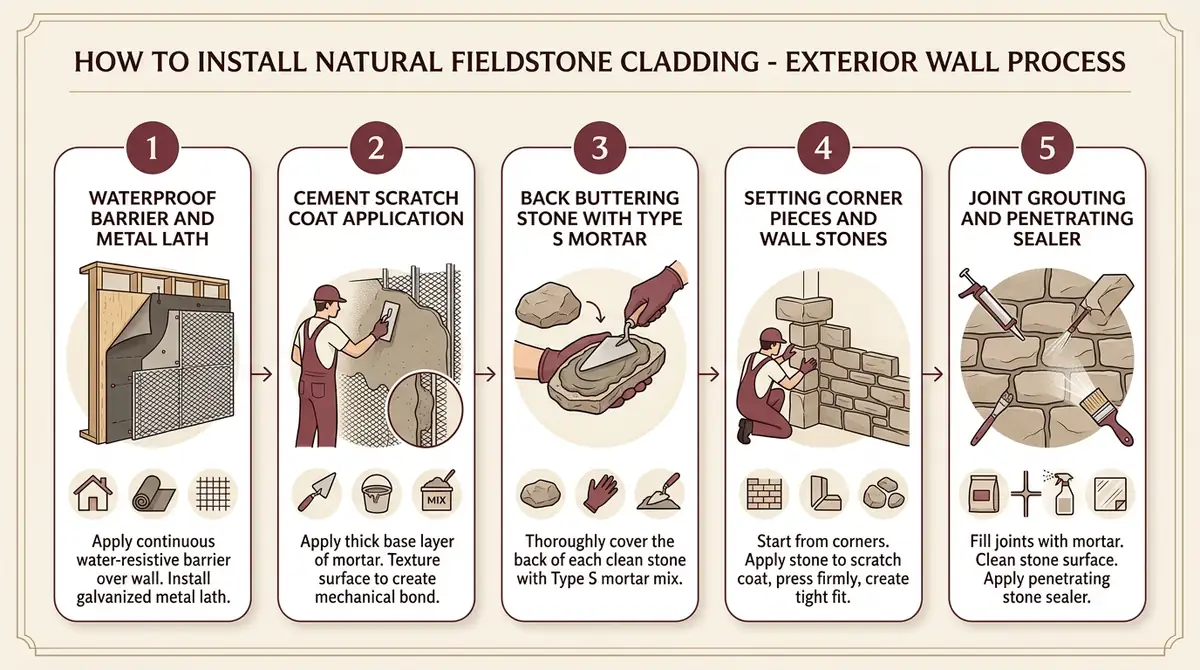
To install natural fieldstone cladding, prepare a sound substrate, apply a water-resistive barrier with expanded metal lath, apply a rough 10 mm cement scratch coat, back-butter each clean stone with Type S modified mortar, set L-shaped corner pieces first, lay wall fieldstones firmly and finish with joint grouting and sealing.
Let us walk through the exact professional procedure for how to install natural fieldstone cladding on exterior or interior walls. Following these 5 essential steps ensures your stone installation remains rock-solid for decades.
Step 1: Substrate Preparation & Moisture Barrier
Inspect the backing wall. It must be structurally sound and free of loose plaster, paint, grease or dust. On plywood or cement backerboard walls, fasten a continuous layer of breathable weather-resistant barrier (WRB) followed by hot-dipped galvanised diamond metal lath (minimum 1.4 kg/m²). Secure the lath using corrosion-resistant fasteners spaced 150 mm on centre.
Step 2: Apply the Cement Scratch Coat
Trowel a 10 mm to 12 mm thick layer of Type S mortar over the metal lath, pressing firmly so the mortar keys completely through the mesh openings. Before the mortar sets, run a notched trowel or plasterer's scarifier horizontally across the wet surface to create horizontal grooves. Allow this scratch coat to cure for at least 24 to 48 hours, dampening it occasionally with water mist.
Step 3: Wash and Back-Butter the Stone
Unpack the natural fieldstones and scrub the back of each piece with a stiff bristle brush and clean water to remove quarry dust. A dusty stone will not bond with mortar. Using your trowel, apply a generous 12 mm layer of polymer-modified mortar directly across the entire rear surface of each stone (back-buttering).
Step 4: Set Corner Pieces First and Fill the Field
Always install fieldstone cladding corner pieces first, starting from the base of the wall and working upward. Alternate the long and short returns of the 90-degree corner stones to prevent continuous vertical joint lines. Once corners are secured, set the flat fieldstones, pressing each stone firmly into the scratch coat with a slight twisting motion until mortar squeezes out around the edges.
Step 5: Grout Joints and Apply Protective Sealer
For mortared designs, load a masonry grout bag with matching mortar and inject it deeply into joint voids. When the mortar reaches thumbprint hardness, tool the joints with a wooden dowel or joint striker. Brush away excess crumbs. After 14 days of curing, wash the wall and apply a breathable siloxane stone sealer.
Waterproofing, Mortar Mixes and Fieldstone Corner Pieces
Exterior fieldstone waterproofing requires a continuous moisture barrier behind the lath, adequate drip flashings along top coping stones and Type S high-strength masonry mortar. Dedicated 90-degree corner pieces wrap cleanly around pillars and edges, giving the cladding the genuine depth of a solid stone wall.
Several technical factors make or break an exterior stone installation. Let us address the three most critical components: waterproofing, mortar selection and masonry corner detailing.
1. How to Waterproof Exterior Fieldstone Walls
Understanding how to waterproof exterior fieldstone walls is essential across Indian weather conditions with heavy monsoons. Natural stone and mortar joints are naturally breathable and will absorb moisture during continuous downpours. To prevent water from reaching your interior brickwork, implement a three-tier drainage system: install a heavy-duty vapour-permeable membrane over the base wall, install stainless steel weep screeds at the wall base so trapped moisture escapes freely and cap top horizontal wall sections with sloped natural stone coping.
2. Which Mortar to Use for Fieldstone Cladding
Selecting which mortar to use for fieldstone cladding depends on wall height and stone weight. Never use standard non-structural lime mortar or cheap tile adhesive. We recommend an ASTM C270 Type S mortar mix, formulated with 1 part Portland cement, 1/2 part hydrated lime and 3 1/2 to 4 1/2 parts clean masonry sand. For added bond strength, mix in liquid polymer bonding admixtures. Type S mortar delivers a compressive strength of over 12.4 MPa (1800 PSI) and high flexural tensile bond resistance.
3. Fixing Fieldstone Over Existing Brickwork
Homeowners often ask: can i put fieldstone cladding over brick? Yes, provided the brickwork is structurally solid and unpainted. If the brick surface is bare, clean and porous, you can dampen the brick and apply the scratch coat directly without metal lath. However, if the brick is painted, crumbling or glazed, you must mechanically anchor galvanised wire lath with concrete masonry anchors before applying mortar.
Cost of Fieldstone Veneer Per Square Foot in India
In India, natural thin fieldstone veneer material costs between ₹120 and ₹320 per square foot depending on the stone variety. Structural installation, including metal lath, polymer mortar, skilled stone mason labour and hydrophobic sealing, adds ₹80 to ₹180 per square foot, bringing total costs to ₹200 to ₹500 per sq ft.
When budgeting for your home elevation or landscaping boundary wall, calculating the total cost of fieldstone veneer per square foot helps you plan accurately. Here is a clear cost breakdown across material grades and installation components:
| Cost Component | Standard Quartzite Fieldstone | Premium Granite / Sandstone Fieldstone |
|---|---|---|
| Raw Thin Stone Flats (per sq ft) | ₹120 - ₹190 | ₹220 - ₹320 |
| L-Shaped Corner Pieces (per linear ft) | ₹180 - ₹260 | ₹280 - ₹420 |
| Lath, Fasteners & Type S Mortar | ₹40 - ₹65 | ₹45 - ₹75 |
| Skilled Mason Labour & Grouting | ₹45 - ₹80 | ₹60 - ₹110 |
| Penetrating Hydrophobic Sealer | ₹15 - ₹25 | ₹20 - ₹35 |
| Estimated Total Finished Cost | ₹220 - ₹360 / sq ft | ₹345 - ₹540 / sq ft |
For an average 500 sq ft exterior villa elevation wall, expect an all-inclusive budget of approximately ₹1.25 lakh to ₹2.25 lakh, delivering a maintenance-free natural facade that outlasts conventional exterior paints by decades.
Sealing, Moss Removal and Long-Term Fieldstone Care
Fieldstone cladding requires periodic sealing with penetrating silane-siloxane sealers every 3 to 5 years to resist moisture and organic staining. Remove moss and algae by spraying a 1:4 dilution of oxygen bleach or mild pH-neutral stone cleaner and scrubbing with a soft nylon brush.
Proper long-term care preserves the rustic beauty of your natural stone facade without altering its earthy texture.
1. Does Fieldstone Cladding Need Sealing?
Clients often wonder: does fieldstone cladding need sealing? While natural fieldstone is extremely durable, applying a high-grade penetrating sealer is strongly recommended for exterior walls. Avoid high-gloss topical acrylic sealers that create a plastic film and trap moisture inside the stone. Instead, use a breathable, impregnating silane-siloxane sealer. It penetrates 3 mm to 5 mm into the stone pores, repelling liquid water while allowing internal moisture vapour to escape safely.
2. How to Clean Moss From Fieldstone Walls
If your exterior walls are shaded by trees, knowing how to clean moss from fieldstone walls after heavy monsoons is essential. Never use concentrated muriatic acid or harsh wire brushes, as acid corrodes mortar joints and bleaches iron minerals in the stone. Instead, mix warm water with oxygen bleach or a dedicated biological stone cleaner, spray the affected patches, let it sit for 15 minutes to break down moss roots and scrub gently with a stiff nylon bristle brush before rinsing with clean water. For more panel care techniques, check our guide on how to clean natural stone wall panels.
Plan Your Elevation with Stone World
From estimating exact square footage and corner pieces to supplying hand-dressed fieldstone cladding across India, our stone consultants are ready to assist you.
Get in Touch TodayFrequently Asked Questions
Direct answers addressing the most common structural, material and maintenance questions regarding natural fieldstone wall cladding installation and long-term durability.
How to install natural fieldstone cladding on an exterior concrete wall?
To install natural fieldstone cladding on concrete, ensure the surface is clean and scarified, apply a polymer-modified Type S cement scratch coat, back-butter each cleaned stone slab with mortar, set corner pieces first, press fieldstones firmly into position with a twisting motion and fill joints with matching grout before sealing.
What is the difference between natural fieldstone vs manufactured veneer?
Natural fieldstone is authentic quarried stone that never fades, resists extreme weather and lasts over a century. Manufactured stone veneer is cast dyed concrete that is lighter in weight but prone to fading, chipping and water absorption over 15 to 20 years.
How thick is fieldstone wall cladding for residential elevations?
Thin natural fieldstone veneer is typically 25 mm to 38 mm (1 to 1.5 inches) thick, making it lightweight enough to adhere directly to masonry walls. Traditional full-bed fieldstone is 75 mm to 150 mm thick and requires a dedicated concrete foundation ledge.
Which mortar to use for fieldstone cladding installations?
Use an ASTM C270 Type S masonry mortar mix (1 part cement, 1/2 part lime, 4 parts sand) enhanced with liquid polymer bonding agents. Type S mortar delivers over 1800 PSI compressive strength and high adhesive suction for heavy natural stones.
Can I put fieldstone cladding over brick walls directly?
Yes. If the brick wall is structurally sound, unpainted and porous, you can apply a scratch coat and mortar stones directly. If the brick is painted or deteriorating, install corrosion-resistant metal lath with mechanical masonry anchors first.
Does fieldstone cladding need sealing after installation?
Yes. Exterior fieldstone should be sealed with a penetrating, breathable silane-siloxane stone sealer. This blocks water and oil stains while allowing internal moisture vapour to escape, preventing efflorescence and moss growth.