


Architects, interior designers and homeowners in India love natural stone for its raw beauty, earthy feel and rich organic textures. But traditional stone slabs are very heavy, difficult to handle and completely rigid. You cannot bend a solid stone slab around a curved wall or round pillar, while fixing heavy slabs on high-rise walls or gypsum partitions demands heavy steel framing, mechanical brackets and weeks of messy civil work. The arrival of flexible natural stone veneer sheets for interior and exterior walls solves this problem completely. By peeling paper-thin layers of genuine metamorphic stone and bonding them with a strong fiberglass backing, this modern material brings the authentic texture of real stone to curved walls, round columns, false ceilings, wardrobe doors and glowing backlit panels without the burden of heavy quarry slabs.
At Stone World, our stone studio and stone experience center in Indore works closely with architects, interior contractors and homeowners across Central India to deliver bespoke stone installations. This practical guide explains how flexible stone sheets are made, weight advantages over solid slabs, curved wall installation steps, the right adhesives, bathroom waterproofing, backlit design ideas, simple cutting methods and realistic cost factors in clear Indian English.
Table of Contents
Understanding Flexible Natural Stone Veneer Sheets for Interior and Exterior Walls: How They Are Made
Flexible natural stone veneer is real metamorphic stone sliced into ultra-thin sheets between 1.0 mm and 2.0 mm thick. Reinforced with a flexible fiberglass-polyester backing, it preserves natural 3D stone texture while bending around curved walls and round columns without cracking.
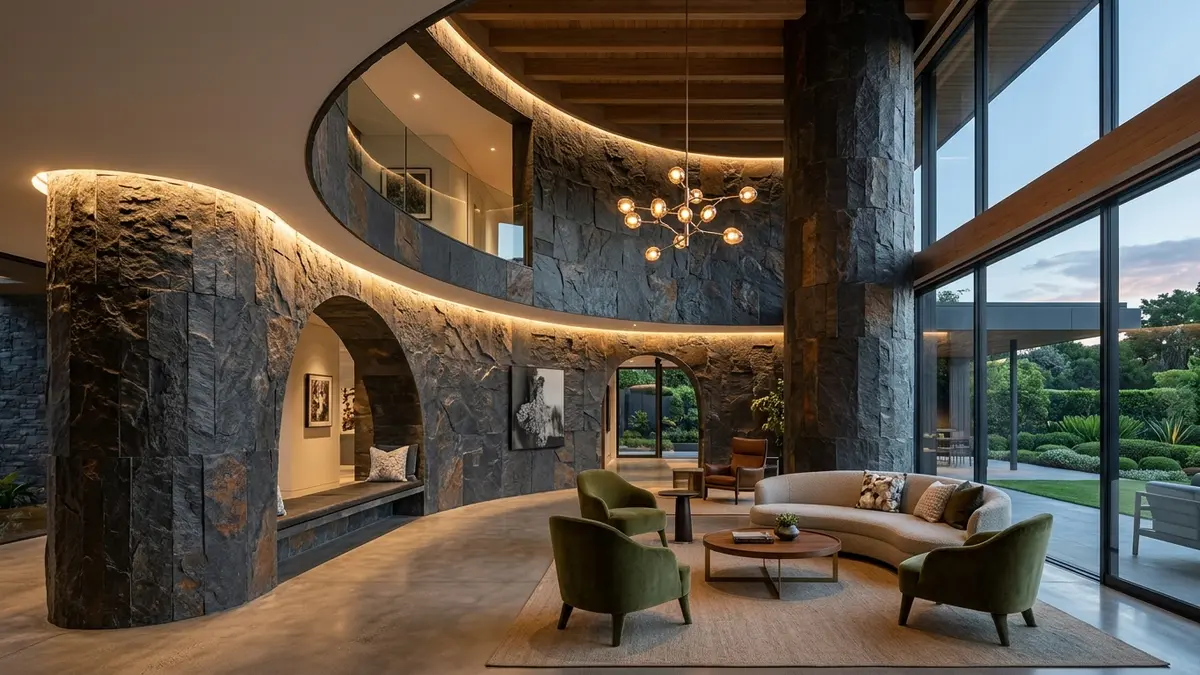
To understand why this material has become so popular in modern architecture, let us examine what is ultra thin flexible stone veneer and how is it made. Unlike artificial plastic sheets, printed laminates or porcelain tiles, every single sheet of flexible stone veneer comes from real natural stone. The fabrication process takes advantage of the natural splitting properties of metamorphic rocks, specifically layered slate, mica schist and fine-grained quartzite found in Indian quarries.
The manufacturing process begins by selecting raw stone blocks at the quarry. Technicians coat the raw surface of the stone with a specially formulated liquid polymer resin reinforced with a tight woven fiberglass mesh. As the resin sets and cures into a tough flexible sheet, it locks directly onto the tiny ridges and crystals of the top stone layer. Once fully cured, workers carefully peel the fiberglass sheet away from the master stone block using controlled mechanical pull. This peeling action splits the natural layers of the rock, pulling off a thin, continuous skin of real stone measuring roughly 0.5 mm to 1.5 mm thick.
The finished sheet has a total thickness of only 1.5 mm to 2.0 mm and consists of three unified layers:
- Top Real Stone Face: Real raw cleft stone showing natural surface relief, earthy textures, mica sparkle and organic color variations that plastic laminates can never copy.
- Core Bonding Layer: High-strength structural resin that firmly holds individual stone mineral particles together, stopping peeling and absorbing stress during bending.
- Composite Backing Layer: Woven fiberglass cloth or soft fleece fabric that provides high tensile strength, prevents tears and creates an ideal grip for common building adhesives.
Because each pull strips a fresh micro-layer from the stone block, every sheet shares consecutive tonal characteristics with adjacent sheets while maintaining unique natural markings. At Stone World, our team provides architectural natural stone veneers crafted from genuine Indian rock beds, enabling architects to achieve continuous vein patterns across extensive elevations.
Weight and Structural Efficiency: Flexible Slate Veneer vs Solid Stone Slabs
Flexible stone veneer sheets weigh between 1.5 and 2.0 kg per square meter, representing an astonishing 95 percent weight reduction compared to conventional 20 mm solid stone slabs that weigh 55 to 65 kg per square meter. This radical lightness eliminates structural load calculations and mechanical anchors.
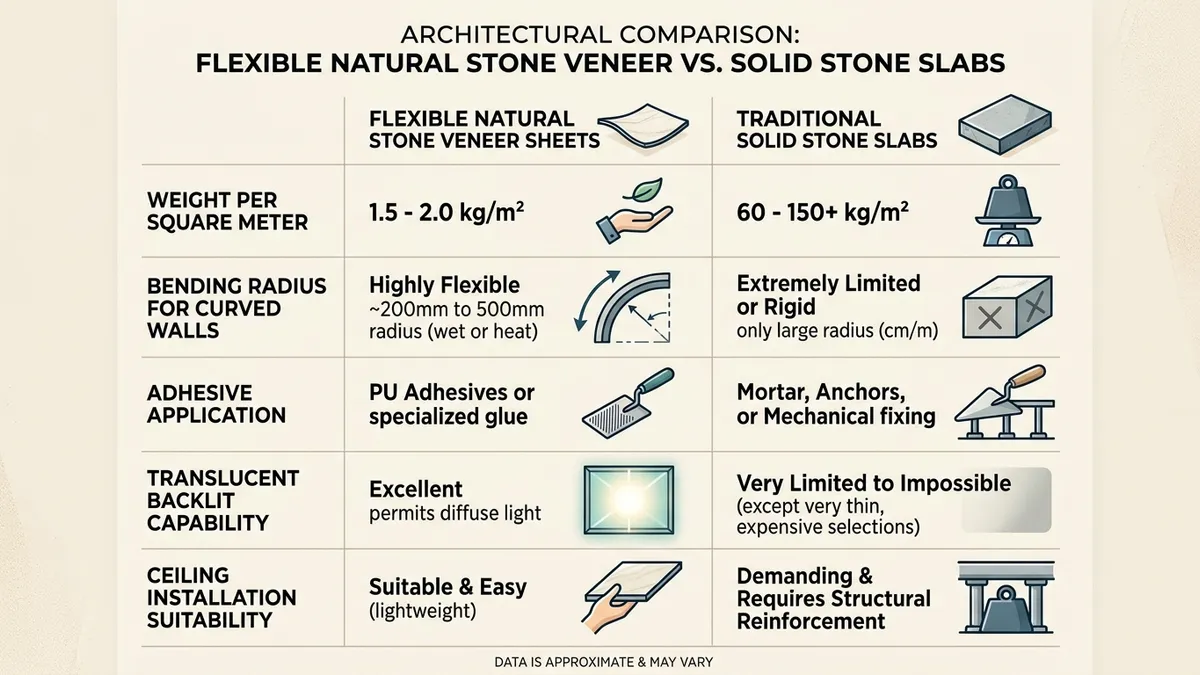
Weight is usually the biggest hurdle stopping architects from using natural stone on tall buildings, drywall partitions and false ceilings. Conducting a flexible slate veneer vs solid stone slab weight comparison reveals huge structural and practical differences between traditional stone masonry and flexible stone technology.
| Performance Criterion | Flexible Stone Veneer (1.5mm - 2mm) | Solid Natural Stone Slab (20mm) |
|---|---|---|
| Dead Load per Square Meter | 1.5 kg to 2.2 kg / m² | 55 kg to 65 kg / m² |
| Structural Anchor Requirement | Zero mechanical anchors; direct adhesive bond | SS 304 brackets, tie-backs and heavy sub-framing |
| Substrate Compatibility | Plywood, MDF, gypsum drywall, concrete and glass | Reinforced concrete or solid brickwork only |
| Flexibility and Bending Radius | Bends up to 200 mm radius with mild heat assistance | Completely rigid; requires costly segmented facets |
| Handling and Freight Volume | Can be packed in flat pallets or rolled into tubes | Heavy gantry cranes, flatbeds and risk of breakage |
| Site Installation Pace | Rapid single-person installation using hand tools | Multiple masons, wet mortar beds and slow curing |
When cladding interior drywall partitions in commercial towers or high-rise luxury apartments, the structural frame cannot tolerate the cumulative load of heavy masonry slabs. Flexible veneer eliminates dead-weight concerns entirely, allowing designers to install genuine stone on existing plasterboard without adding steel channels. To explore how mechanical framing compares in outdoor contexts, read our review of dry cladding and wet cladding techniques for architectural elevations.
Curved Surfaces and Cylindrical Architectural Elements
Flexible stone veneer bends effortlessly across concave and convex surfaces, enabling uninterrupted stone wraps around round columns, sweeping arches and serpentine walls. Gentle heat gun warming relaxes the polymer backing, allowing tight radial wraps without surface micro-fractures.
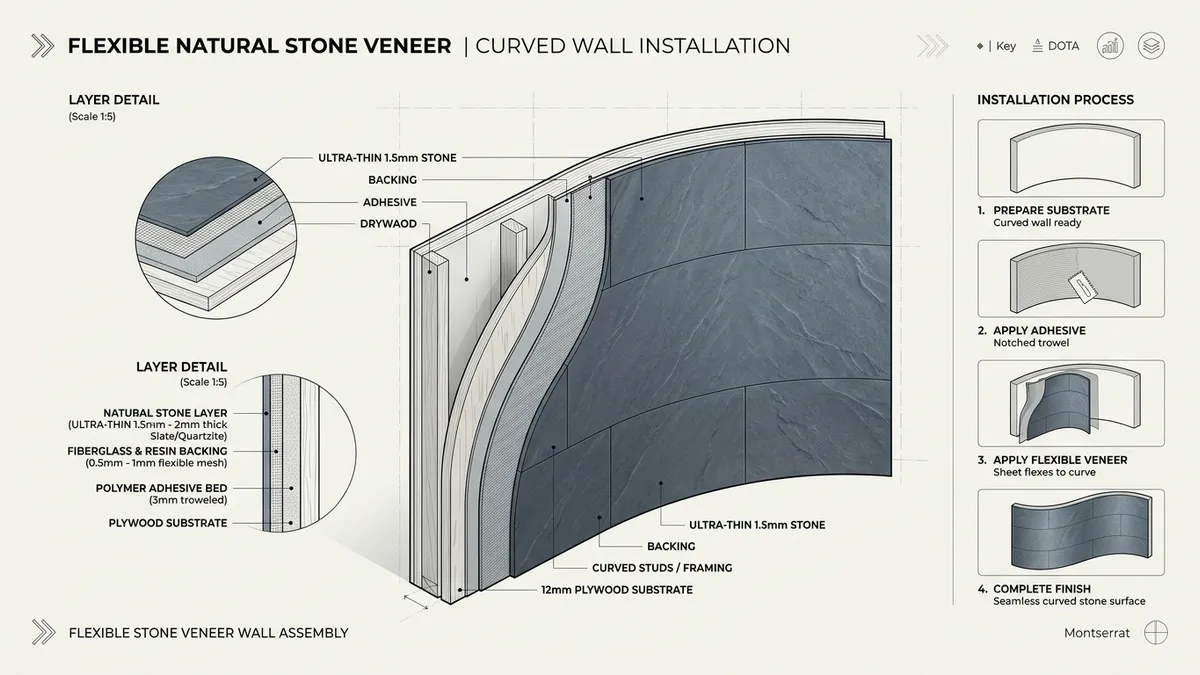
One of the most striking architectural capabilities of flexible stone sheets is their ability to conform smoothly to three-dimensional curves. Mastering how to install flexible stone veneer on curved walls and columns requires an understanding of the polymer backing and its thermal behavior during application.
Solid stone slabs can only curve through expensive CNC hollow milling or by cutting thin vertical strips that create jagged faceted joints. Flexible stone sheets, however, curve naturally in both directions:
Substrate Calibrating and Radial Template Checking
Ensure the curved substrate, whether constructed from flexi-ply, curved metal framing or precast concrete, has a smooth, continuous radius without abrupt bumps or sharp fastener heads. Any uneven step on the substrate will telegraph through the thin stone sheet under lateral adhesive pressure.
Controlled Thermal Softening of the Resin Matrix
For standard curved walls with a radius exceeding 500 mm, the sheet bends comfortably at ambient room temperature. For tight columns with a radius between 150 mm and 350 mm, technicians apply gentle warm air using an industrial heat gun across the reverse fiberglass face. Waving the heat gun evenly at fifty to sixty degrees Celsius softens the polyester polymer, making the stone supple enough to wrap tight cylinders without stress marks.
Progressive Rolling and Temporary Strap Clamping
Apply adhesive using a fine V-notch trowel to both the substrate and sheet backing. Begin wrapping from one vertical plumb line, pressing progressively around the circumference with a firm rubber hand roller to evacuate air pockets. Secure the wrapped column with adjustable ratchet web straps over protective foam blocks until the adhesive reaches full cure.
By wrapping large diameter lobby pillars in a single continuous vertical run, corporate foyers and private villas achieve the grand visual presence of solid stone columns at a fraction of the structural engineering cost. Explore our extensive portfolio of architectural feature wall designs crafted for luxury residences and hotels.
Substrate Preparation and Bonding Chemistry
Bonding flexible stone sheets requires elastomeric adhesives that accommodate differential thermal movement between stone and underlying substrates. One-component polyurethane and hybrid MS-polymers provide exceptional shear resistance, waterproof bonds and clean adhesion to wood, drywall and masonry.
The long-term integrity of a thin stone cladding installation depends entirely on adhesive chemistry. Identifying the best adhesive for applying stone veneer sheets on plywood and drywall ensures that seasonal temperature fluctuations or structural vibrations do not cause hollow sounding spots or edge peeling.
Construction adhesives fall into distinct categories, each suited to specific substrates and site conditions:
- Polyurethane (PU) Construction Adhesives: One-part polyurethane pastes provide outstanding initial grab and high tensile shear strength. They bond tenaciously to commercial plywood, marine flexi-ply, MDF and cement fiber boards while remaining slightly flexible to absorb thermal expansion.
- Modified Silane (MS) Polymers: Solvent-free and odor-free hybrid adhesives that combine the strength of polyurethanes with the environmental resistance of silicones. MS polymers bond exceptionally well to painted drywall, metal studs, aluminum composite panels and glass partitions without requiring aggressive chemical primers.
- Polymer-Modified Epoxy Systems: Two-component epoxy adhesives offer maximum rigid bond strength and chemical resistance. They are preferred when cladding steel elevator surrounds or high-temperature fireplace hearth backdrops.
- High-Performance C2TE Cementitious Mortars: For direct application over raw cured concrete or cement sand plaster, flexible polymer-modified thin-set tile adhesives meeting C2TE standards provide reliable mechanical grip into the fiberglass backing.
Before applying adhesive, substrates must be thoroughly degreased, dust-free and primed with an acrylic bonding primer. Adhesive should always be combed out using a 3 mm to 4 mm V-notched trowel in parallel ridges, avoiding spot-dabbing methods that trap hollow air cavities behind the panel face.
Wet Areas and Moisture Management in Bathrooms and Showers
The fiberglass-resin backing of flexible stone veneer forms an impermeable moisture barrier that blocks water passage. When paired with continuous joint sealing and penetrating fluoropolymer surface sealers, flexible stone delivers dramatic spa-style bathrooms free from moldy grout lines.
Traditional tile bathrooms rely on hundreds of grout joints that gradually absorb soapy residue, crack under thermal movement and harbor unsightly black mold. Utilizing waterproof flexible stone veneer for bathroom and shower walls creates an expansive, monolithic natural stone shower surround that is both hygienic and visually captivating.
Because the cured polyester resin on the back of each veneer sheet is naturally non-porous and waterproof, water splashing against the face of the stone cannot penetrate into the drywall substrate. However, comprehensive moisture detailing requires three protective layers:
First, the drywall or cement backer board must receive a continuous liquid-applied elastomeric waterproofing membrane before stone installation. Second, panel butt-joints must be filled with a matching color-coordinated neutral-cure silicone or polyurethane sealant to prevent moisture capillary action along sheet edges. Third, the exposed raw stone surface must be treated with two saturation coats of an impregnating oleophobic and hydrophobic sealer. This breathable sealer prevents soap scum, hard water minerals and shower gels from penetrating the natural slate pores while letting moisture vapor breathe naturally. Discover our custom designs for natural stone bathroom cladding engineered for spa-grade longevity.
Millwork, Joinery and Bespoke Cabinetry Cladding
Weighing less than 2 kg per square meter, flexible stone veneer transforms standard cabinetry, wardrobe doors, reception desks and kitchen islands into monolithic stone pieces without overloading hinges, drawer runners or sliding hardware mechanisms.
Furniture designers historically avoided genuine stone for operable doors and drawers because a solid 20 mm marble or granite door would weigh sixty kilograms, shearing hinges off cabinet carcasses. Specifying flexible stone veneer for luxury furniture doors and wardrobe cladding has opened exciting design frontiers in high-end joinery and custom casework.
Using flexible stone veneer in bespoke millwork delivers distinct practical advantages for interior projects:
- Standard Hardware Compatibility: Because a typical wardrobe door clad in flexible stone adds only three to four kilograms of dead weight, cabinetmakers can use standard 110-degree soft-close concealed European hinges and heavy-duty sliding track systems without costly custom hardware.
- Edge Banding and Mitred Profiles: Veneer sheets cut cleanly along sharp 45-degree chamfers, enabling fabricators to wrap stone continuously around the edge of an 18 mm marine-ply shutter, creating the realistic illusion of a solid stone block.
- Integrated Metal Accents: Flexible stone sheets integrate cleanly with brass, copper and matte black PVD titanium T-profiles, creating geometric modern panel compositions across credenzas, TV consoles and executive desks.
- Impact Resilience: The fiberglass-reinforced backing cushions the stone against blunt frontal impact, offering greater crack resistance than fragile, brittle ceramic laminates.
For bespoke interior furniture, fabricators often select warm rustic slates, copper quartzites or silvery mica schists to harmonize with rich walnut, smoked oak and fluted wall paneling.
Luminous Feature Walls and Illumination Dynamics
Translucent flexible stone veneer combines micro-thin natural quartzite or slate with a crystal-clear resin backing. When backlit with dimmable LED light sheets, the natural mineral veining, crystalline fissures and amber layers illuminate with breathtaking radiant warmth.
While solid onyx slabs remain the historical standard for illuminated stone walls, they suffer from extreme fragility, astronomical square-foot expense and massive weight requiring welded steel cradle frames. Exploring modern translucent backlit flexible stone veneer design ideas provides architects with an accessible, lightweight alternative that produces mesmerizing ambient illumination.
In translucent stone veneer sheets, fabricators substitute the standard opaque black or grey backing with an optically clear transparent polyester resin and clear glass matrix. Because the natural stone face is only a fraction of a millimeter thick, light passes through translucent quartz crystals, mica veins and golden iron oxide fissures while dense mineral areas block the light, creating dramatic chiaroscuro contrast.
To achieve flawless backlighting without hot spots or dark shadowing, follow these lighting best practices:
- Diffused LED Light Panels: Install ultra-slim, edge-lit acrylic light guide plates or flexible LED light sheets with a minimum color rendering index (CRI) of 90 to 95. This reveals true, vibrant mineral tones.
- Color Temperature Tuning: Use tunable white LEDs ranging from 2700K warm amber to 4500K neutral daylight. Warm illumination emphasizes rich golden slate veins, while cooler white light highlights shimmering white quartzite crystals.
- Diffuser Acrylic Substrate: Mount the translucent veneer onto a 4 mm to 6 mm frosted acrylic or polycarbonate sheet using optically clear UV-stable adhesives, maintaining a 30 mm to 50 mm cavity between the LED matrix and the stone for uniform glow.
Translucent stone feature walls serve as showstopping centerpieces in hotel reception backdrops, cocktail bar fronts, powder room highlighters and luxury media lounges. To compare illuminated stone materials, view our technical guide on how architectural lighting transforms stone color.
Overhead Installations and Weight-Critical Surfaces
Installing natural stone on ceilings was once considered structurally hazardous. With flexible stone veneer weighing less than 2 kg per square meter, designers can safely clad coffered ceilings, cantilevered porch soffits and elevator car ceilings using standard drywall grids.
Carrying the organic texture of natural stone overhead creates an enveloping, cocoon-like atmosphere in luxury penthouses and boutique hospitality venues. Implementing interior ceiling cladding with lightweight stone veneers allows design teams to introduce authentic earthy textures into overhead soffits that would otherwise remain sterile white gypsum boards.
Because suspended ceiling grids are engineered to carry only light loads, solid stone cladding requires massive secondary structural steel trusses and complex through-bolt anchoring systems. In contrast, flexible stone veneer is so light that it adheres directly to standard 12 mm moisture-resistant gypsum plasterboard or calcium silicate ceiling boards.
Installation overhead begins by mapping out joint grids that align with recessed downlights, linear magnetic track lights and air conditioning return slots. Installers use high-grab polyurethane contact adhesives or fast-curing MS-polymers applied to both surfaces. Temporary pneumatic T-props or expanding ceiling support poles hold the sheet firmly against the ceiling plane for fifteen minutes while the initial bond locks. Once set, the stone ceiling remains stable indefinitely, unaffected by building vibration or seasonal humidity swings. Review our specialized concepts for natural stone ceiling designs across residential and commercial spaces.
Weathering Performance and Exterior Facades
Engineered with UV-stabilized resins and authentic metamorphic rock, flexible stone veneer withstands intense solar heat, monsoon downpours and freeze-thaw cycles on exterior facades. Proper substrate expansion joints and breathable nano-sealers prevent thermal buckling and moisture trapping.
Exterior elevations in tropical and semi-arid climates endure extreme environmental stresses: scorching summer surface temperatures reaching fifty-five degrees Celsius, torrential monsoon deluges and high ultraviolet solar radiation. Evaluating exterior flexible stone cladding UV and weather resistance confirms that high-grade flexible stone sheets deliver dependable performance when installed with appropriate exterior detailing.
The durability of exterior flexible stone cladding rests on three engineered factors:
- UV-Stabilized Resin Matrix: Premium exterior veneer sheets use specialized cross-linked polyester or polyurethane resins formulated with ultraviolet absorbers. This prevents resin yellowing, embrittlement or micro-cracking even under decades of harsh tropical sun exposure.
- Thermal Movement Tolerances: Flexible stone veneer expands and contracts at rates comparable to modern cement fiber substrates. By incorporating 4 mm to 6 mm elastomeric expansion joints every 3 to 4 meters, the facade accommodates building settlement and thermal cycling without popping.
- Breathable Hydrophobic Treatment: Because raw slate contains micro-porosities, applying a high-performance breathable silane-siloxane impregnator repels wind-driven rain while allowing interior wall moisture to evaporate outward, preventing efflorescence staining.
Flexible stone veneer excels on exterior compound walls, balcony cantilevers, entryway porticos and modern villa facade accents. To explore complementary exterior solutions, see our complete guide on natural stone exterior facades.
Fabrication Mechanics: Cutting, Mitring and Surface Sealing
Flexible stone veneer cuts effortlessly using standard woodworking power tools, including circular saws with diamond or carbide-tipped blades, angle grinders and heavy-duty shears. Proper edge sanding and penetrating sealers deliver clean joints and lifelong stain resistance.
One of the greatest contractor advantages of flexible stone sheets is that site installation does not require heavy wet diamond bridge saws or specialized masonry cutting rigs. Understanding how to cut trim and seal flexible stone veneer sheets allows standard carpentry teams to fabricate panels quickly and cleanly on site.
Contractors should observe the following fabrication steps to ensure factory-grade edge finishes:
- Cutting Tools and Techniques: Straight cuts are executed using a handheld circular saw running against a clamped aluminum guide rail. Equip the saw with a continuous-rim diamond blade or a fine-toothed carbide woodworking blade. For intricate cutouts around electrical outlets or plumbing stubs, use an oscillating multi-tool or a four-inch variable-speed angle grinder fitted with a thin diamond tile blade.
- Mitring and Edge Dressing: For outside corners, cut both adjoining panels at a crisp 45-degree bevel from the reverse fiberglass side. Sand the junction lightly with 120-grit sandpaper over a rigid block to remove micro-burrs, producing an imperceptible monolithic corner joint.
- Surface Cleaning and Dust Removal: After dry-fitting, wipe the textured stone surface thoroughly with a vacuum and a damp microfiber cloth to remove all mineral dust before applying sealers or adhesive tapes.
- Protective Sealing Protocol: Once installed and bonded, apply two uniform coats of a deep-penetrating water-based or solvent-based impregnating sealer. Use a foam roller, wiping off excess sealer within fifteen minutes. For high-traffic commercial foyers or kitchen splashes, a specialized polyurethane matte topcoat can be applied for enhanced scratch and stain protection.
To learn more about professional stone care chemistry, explore our technical breakdown of natural stone finishes and protective treatments.
Commercial Valuation and Sheet Selection Factors
Flexible stone veneer sheet valuation depends on mineral formation rarity, sheet dimensions, backing composition and surface finishes. Standard opaque slate sheets offer high cost efficiency, while translucent backlit variants, oversize formats and metallic inlays represent bespoke luxury selections.
When planning architectural budgets, understanding flexible stone veneer price per sheet in India requires examining the primary cost drivers that distinguish economy grades from architectural-specification panels. Because natural stone veneer is a craft product extracted layer by layer, pricing varies based on several distinct production variables:
Quarry Mineral Origin and Formation Rarity
Common dark charcoal, grey and autumn slates are readily cleaved in high volumes, making them very economical. In contrast, rare mica schists with natural silver and golden metallic flakes, deep emerald green quartzites and multi-toned copper formations require delicate quarry handling and command higher valuation.
Sheet Dimensions and Large-Format Production
Standard sheets measure 1220 mm by 610 mm, offering effortless handling for single installers. Large format sheets measuring 2440 mm by 1220 mm or extra-large 2800 mm by 1220 mm allow floor-to-ceiling cladding without horizontal joints. Extracting unbroken thin stone skins across these massive dimensions requires defect-free geological blocks, making oversize panels a premium choice.
Backing Engineering: Opaque, Translucent or Fabric
Standard fiberglass backing suits general wall applications. Translucent sheets manufactured with optical-grade transparent resins involve complex bubble-free curing and tight light-transmission calibration. Ultra-flexible fleece-backed sheets, engineered for extreme furniture radius wrapping, incorporate specialized micro-milling steps that reflect in their project budgeting.
When evaluated holistically against traditional stone masonry, flexible stone veneer generates substantial net savings by slashing structural steel reinforcement, eliminating heavy anchor hardware, speeding up handover schedules and drastically reducing freight breakages. For large-scale villa projects, bespoke combinations of veneer sheets with 3D elements create balanced budgets; read our study on CNC carved natural stone panels for architectural luxury accents.
Sourcing and Custom Fabrication in Central India
Sourcing architectural-grade flexible stone sheets requires verifying batch consistency, resin flexibility and tensile bonding strength. Visiting our stone experience center in Indore allows designers and homeowners to inspect full-size sheets under variable lighting and examine curved mockups.
Selecting thin stone products from online swatches carries substantial risk because photos cannot convey tactile surface relief, natural mineral sheen or exact light transmission. When consulting flexible stone veneer manufacturers and dealers in indore mp, architects and discerning homeowners benefit from visiting an established stone studio where full-scale panels and mockups can be examined under natural and artificial lighting.
At the Stone World stone experience center in Indore, our design advisors assist architects, interior consultants and builders through every stage of material selection:
- Live Sheet Inspection: Examine full 2440 mm by 1220 mm sheets to understand authentic color movement, mica reflections and tactile slate reliefs across complete batches.
- Curved Wall and Column Demos: Review full-scale physical mockups demonstrating tight curved column wraps, mitred 45-degree outside corners and flush-fitting shadowline trims.
- Backlit Illumination Testing: Test translucent stone sheets in our specialized lighting simulation booths with tunable 2700K to 5000K LED panels to evaluate vein illumination before finalizing cabinetry or bar counter designs.
- Contractor Technical Support: We provide specialized contractor guidance on substrate primers, elastomeric adhesive selection, notch trowel sizes and protective impregnating sealers tailored to Central India's climate.
Visit the Stone World Experience Center in Indore
Inspect live mockups, feel stone textures in person and discuss your upcoming architectural or villa project.
Frequently Asked Questions
Is flexible stone veneer made from real natural stone?
Yes, flexible stone veneer is crafted from 100 percent real metamorphic slate, mica schist or quartzite. A thin layer between 0.5 mm and 1.5 mm is cleaved from solid quarry blocks and reinforced with a flexible polymer and fiberglass backing, preserving genuine stone texture, color and mineral veining.
How thin and lightweight are flexible natural stone veneer sheets?
Flexible stone veneer sheets have an overall thickness of 1.5 mm to 2.0 mm and weigh between 1.5 kg and 2.2 kg per square meter. This represents roughly 5 percent of the weight of a standard 20 mm thick solid stone slab, making it suitable for drywall and ceilings.
Can flexible stone veneer be installed on curved walls and round columns?
Yes, flexible stone sheets bend naturally across gentle concave and convex curves. For tight radii between 150 mm and 350 mm, gently warming the reverse fiberglass backing with an industrial heat gun softens the polymer resin, allowing smooth wrapping without cracking or mineral splitting.
What is the best adhesive to bond flexible stone sheets to plywood or drywall?
High-grab one-component polyurethane (PU) construction adhesives and hybrid MS-polymers provide the strongest bond. They accommodate differential thermal movement, adhere tenaciously to plywood, drywall and cement board while providing waterproof performance.
Can flexible natural stone veneer be used inside shower enclosures and bathrooms?
Yes, flexible stone veneer performs exceptionally well in wet areas because its polymer backing acts as an impervious waterproof barrier. Installers must seal all perimeter butt-joints with neutral-cure silicone and saturate the stone face with a penetrating breathable sealer.
How does translucent flexible stone veneer work for backlighting?
Translucent stone veneer sheets use an optically clear transparent resin and glass backing instead of opaque polyester. When illuminated from behind with diffused LED panels, light radiates through translucent quartz crystals and fissures while dense minerals create dramatic glowing contrast.
How do you cut and trim flexible stone veneer sheets on the job site?
Flexible stone veneer sheets cut cleanly with standard woodworking tools, including handheld circular saws fitted with continuous diamond or carbide blades, angle grinders and heavy-duty sheet shears. Cuts are executed from the reverse side to prevent chipping.