


A standard white ceramic sink gets the job done, but it rarely makes a lasting impression in a well-planned home. When you walk into a powder room or master bathroom suite, nothing anchors the counter quite like a hand-chiseled block of natural stone. Handcrafted stone wash basins bring raw texture and grounded earthy character to your washroom. However, when shortlisting materials for your own house, figuring out which stone basin is best for bathroom spaces means looking at mineral strength, daily cleaning routines, Indian water conditions and your overall interior layout.
Every stone variety brings its own practical strengths. A raw river boulder gives your washroom a natural resort-style look, while polished white marble brings classic luxury and fluted black granite provides a clean modern finish. At the same time, many homeowners worry about white hard water marks from borewell lines, soap build-up, sealing routines and counter load handling. At Stone World, our artisans cut, shape and finish natural stone basins for homes across India. This practical guide walks you through the top stone varieties, honest pros and cons, daily cleaning methods, safe vessel counter fitting and pricing details so you can choose the right basin without any confusion.
Table of Contents
Which Stone Basin Is Best for Bathroom? Top 5 Material Choices
Granite and basalt basins offer high scratch resistance and handle hard water easily for busy everyday family bathrooms. Hand-carved river stone and sandstone basins suit organic powder rooms, while veined marble and translucent onyx work beautifully in guest washrooms and master suites.
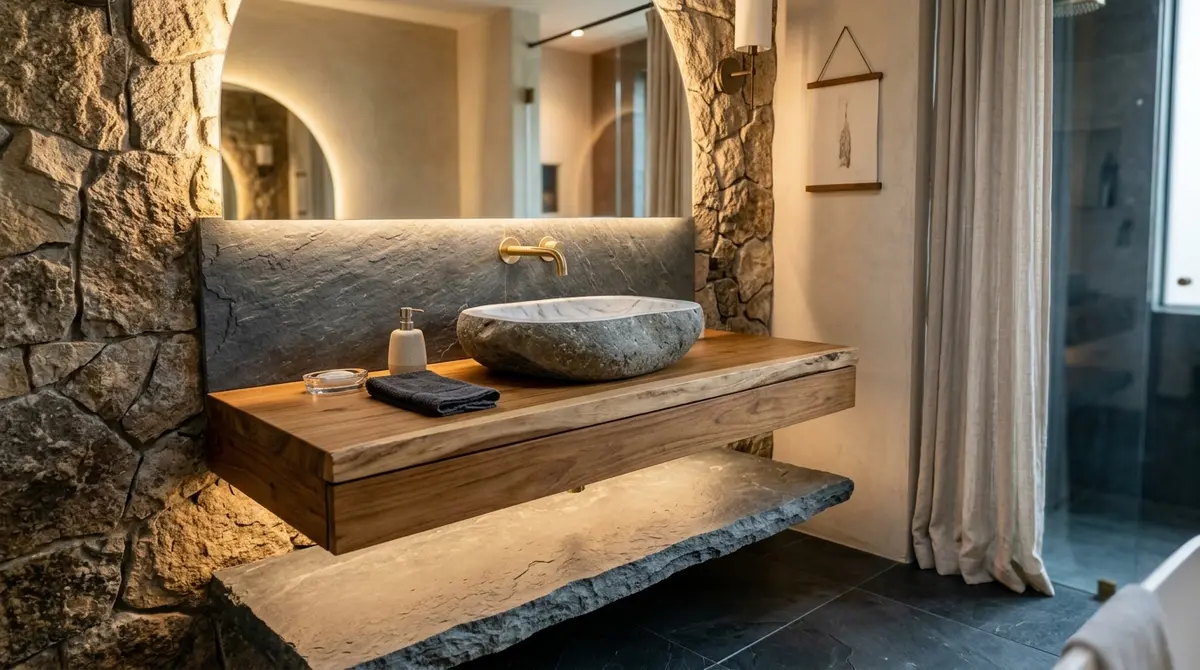
Choosing the right stone depends on who uses the bathroom daily, where the basin sits and your local water quality. Here is a clear look at the top five natural stones used for bathroom wash basins:
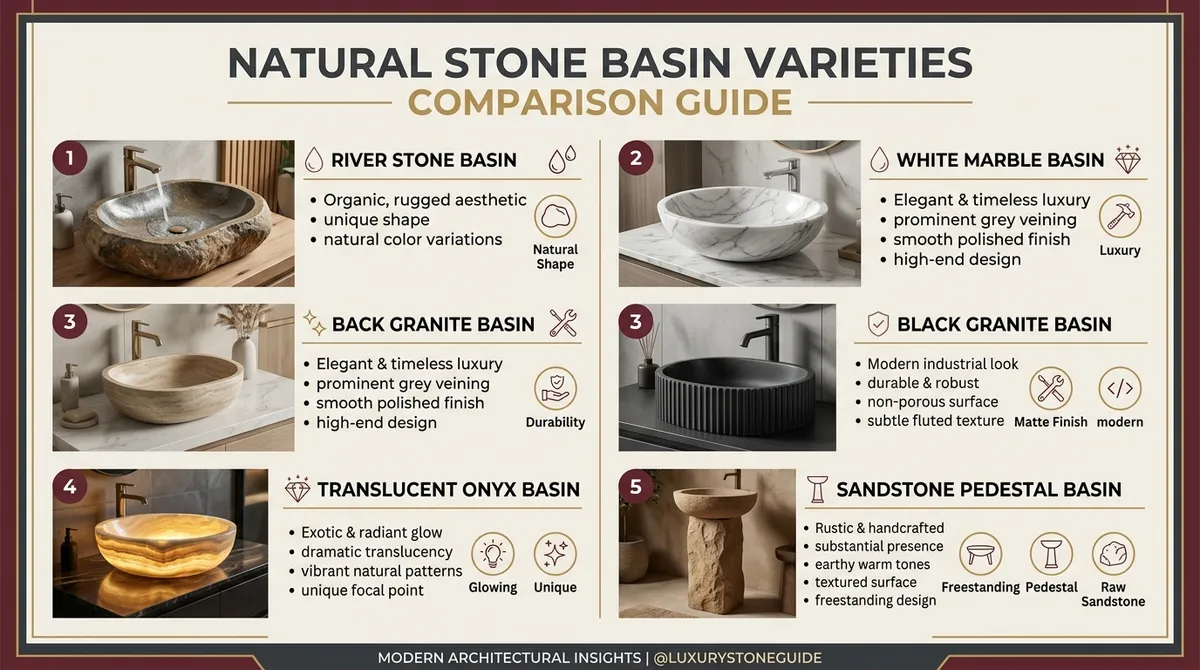
1. River Stone Basins (Raw Boulder Exterior with Polished Bowl)
Carved directly from natural river boulders, river stone wash basins keep their rough, weathered exterior skin while the inner bowl is hollowed out and polished smooth. Because every river rock has its own natural curves and mineral shades, no two pieces are ever identical. They are dense, tough against chipping and naturally hide dried water droplets.
2. Marble Stone Basins (Classic Beauty and Rich Natural Veining)
Weighing the marble stone basin pros and cons is important before finalizing your washroom fixtures. Marble basins crafted from premium natural varieties bring graceful veining and timeless elegance that pair naturally with wall stone cladding:
- Banswara Marble
- Vietnam White Marble
- Indian Statuario Marble
- Agaria White Marble
- Makrana White Marble
Because marble contains natural calcium carbonate, it needs simple care: avoid harsh acid toilet cleaners and keep the surface sealed against mineral absorption.
3. Black Granite and Basalt Basins (Tough, Non-Porous and Easy to Maintain)
For the main family bathroom where the tap runs throughout the day, black granite and basalt basins are hard to beat. Granite has very low porosity, so it will not soak up water or soap colors. It resists scratches from rings and metal watch straps and manages hard borewell water with simple daily wiping.
4. Translucent Onyx Basins (Warm Amber Glow and Exotic Patterns)
Onyx is a semi-translucent stone with fine mineral bands that allow light to pass through. When you fit a small warm LED light under a frosted vanity counter or directly beneath the bowl, honey onyx and green onyx basins glow softly in the evening, giving powder rooms a warm welcome for guests.
5. Handcrafted Sandstone Basins (Earthy Rajasthan Warmth)
Sourced from quarries in Rajasthan like Dholpur, Khatu and Jaisalmer, sandstone wash basins offer warm beige, mint and desert yellow tones. They match well with brass bib taps, wooden vanity cabinets and terracotta floor tiles in courtyard wash areas and garden powder rooms.
| Stone Material | Mineral Hardness (Mohs) | Water Absorption | Recommended Placement | Care Level |
|---|---|---|---|---|
| Natural River Boulder | 6.0 – 6.5 | Very Low (< 0.2%) | Powder rooms, master washrooms and open courtyard sinks | Low (Simple wipe with mild soap) |
| Indian & Vietnam White Marble | 3.0 – 4.0 | Moderate (0.3% - 0.6%) | Master suite vanities and guest washrooms | Moderate (Use neutral cleaners and seal annually) |
| Black Granite and Basalt | 6.5 – 7.0 | Extremely Low (< 0.1%) | Daily family bathrooms and dining area wash stations | Very Low (High resistance to marks and scratches) |
| Translucent Onyx | 3.0 – 3.5 | Low-Moderate (0.2% - 0.4%) | Backlit feature powder rooms and boutique suites | Careful (Gentle soap and avoid acidic splashes) |
| Rajasthan Sandstone | 4.5 – 5.5 | Moderate (1.0% - 2.5%) | Courtyard wash basins and rustic theme washrooms | Moderate (Requires initial deep hydrophobic sealing) |
To explore our handcrafted collection of solid stone and organic vessel basins, take a look at our dedicated natural stone wash basin collection.
Natural Stone Basin vs Ceramic Sink: Durability & Aesthetic Comparison
While factory ceramic sinks offer non-porous glazed surfaces at entry-level prices, natural stone basins deliver authentic organic texture, architectural value and lifetime structural durability that cannot chip or crack under moderate everyday impacts.
When renovating bathrooms, the classic choice between a natural stone basin vs ceramic sink comes up on every project. Factory ceramic sinks made from vitreous china are common everywhere. They are uniform, pocket-friendly and easy to wipe down. However, they look identical to standard sanitaryware and can chip or crack if a glass bottle drops into the sink.
| Feature | Carved Natural Stone Basin | Standard Glazed Ceramic Sink |
|---|---|---|
| Look and Uniqueness | Every piece has genuine natural veining, mineral shades and hand-chiseled craft. | Factory mould shapes with identical white glaze finish. |
| Strength and Long Life | Carved from solid natural rock; will not crack from small accidental drops. | Hollow ceramic body prone to surface hairline cracks and chipped enamel. |
| Custom Work | Custom size cutting, edge grooving, fluted lines, matte finishes and carved relief patterns. | Fixed catalogue sizes and rigid mould shapes. |
| Property Value | Adds noticeable luxury appeal and architectural character to the home. | Basic sanitary fitting with no luxury value. |
| Maintenance Routine | Requires simple neutral soap wiping and breathable sealant once a year. | Non-porous glaze cleans with common bathroom sprays. |
When you are planning an eye-catching guest powder room or a relaxing master bathroom, a natural stone basin serves as a natural centerpiece. For design ideas on matching stone finishes across the washroom, read our guide on natural stone flooring for bathrooms.
Looking for Custom Hand-Carved Stone Basins?
Whether you need an organic river boulder vessel or a custom-fluted white marble basin cut to exact vanity specifications, explore over 200+ exclusive stone designs at Stone World.
Connect With Stone WorldPedestal vs Countertop Stone Basin: Choosing the Right Format
Countertop vessel basins offer convenient vanity storage and flexible tap pairing for master bathrooms, while monolithic freestanding pedestal stone basins create striking sculptural features in powder rooms where vanity counter space is limited.
When planning your washroom layout, comparing a pedestal vs countertop stone basin helps you match your plumbing points, counter area and storage needs:
Countertop Vessel Stone Basins (Practical and Spacious)
Countertop vessel basins sit directly on a granite, marble or teak wood vanity slab. This setup gives you clear counter space around the bowl for soap bottles, hand towels and daily accessories. It also allows for vanity drawers underneath to store toiletries and cleaning supplies. You can pair vessel basins with tall deck-mounted mixer taps or concealed wall spouts.
Freestanding Pedestal Stone Basins (Solid Sculptural Look)
Freestanding pedestal basins are sculpted from a single tall stone monolith or fitted as two interlocking stone blocks. Standing 32 to 34 inches high, they stand directly on the floor without any wooden cabinet. In narrow guest powder rooms or entrance foyer wash areas, a sandstone or black granite pedestal basin creates an impressive look without taking up excess floor room.
- Under-Counter Storage: Opt for countertop vessel sinks if you need enclosed drawers for hair dryers, fresh towels and grooming items.
- Plumbing Connections: Freestanding pedestals hide the drain pipes inside the stone pillar, making them ideal for floor-trap drainage lines.
- Room Dimensions: Compact powder rooms (under 25 sq. ft.) feel much more open with a freestanding stone pedestal.
For more natural material ideas that match well with wooden vanity counters and organic stone, check out our guide on why bamboo basins complement modern interiors.
How to Install Vessel Stone Basin on Vanity Counters Safely
Fitting a natural stone vessel basin requires clean core drilling through the vanity countertop, applying neutral-cure mold-resistant silicone along the base rim and securing the pop-up waste coupling with rubber gaskets using hand tools to avoid micro-cracks.
Because a solid natural stone basin weighs between 15 kg and 40 kg, regular plumbing steps need careful attention. Knowing how to install vessel stone basin units properly guarantees zero water seepage, no wobbling and reliable long-term fitting:
Step 1: Check Vanity Counter Load Capacity
Make sure your vanity framework and wall supports easily bear the weight of the stone basin (20 to 35 kg) plus water fill. Floating wall-hung vanities should be anchored into solid brick walls or RCC bands using sturdy heavy-gauge steel brackets rather than simple plastic wall plugs.
Step 2: Core Drill Vanity Drain and Tap Outlets
Set the basin on your vanity top to check comfortable hand clearance. Mark the center waste hole (standard 45mm diameter). If you are using a tall counter-mounted mixer tap, keep a 4 to 6-inch spout clearance above the basin rim to avoid water splashing over the sides.
Step 3: Apply Neutral-Cure Silicone Bed
Run a continuous bead of clear, mold-resistant, neutral-cure silicone sealant along the flat underside of the stone basin. Never use plumber's putty or regular acetic silicone on marble or sandstone, because acetic chemicals leave permanent dark stains around the stone base.
Step 4: Fix Non-Overflow Pop-Up Waste Coupling
Most natural stone basins are single-bowl carvings without overflow slots. Use a standard non-overflow pop-up waste coupling. Place the soft silicone washer under the flange, pass the brass tailpiece through the counter hole and hand-tighten the lower locking nut with a gentle spanner turn. Avoid overtightening with heavy pipe wrenches.
To learn more about natural stone wall integration and matching surfaces, check our guide on different types of natural stone finishes explained.
How to Clean Hard Water Stains and Seal Natural Stone Basins
Maintain stone wash basins by wiping with microfiber cloths and pH-neutral cleaners, removing white mineral scale with baking soda poultices rather than harsh acids, and applying penetrating hydrophobic impregnating sealers every six to twelve months.
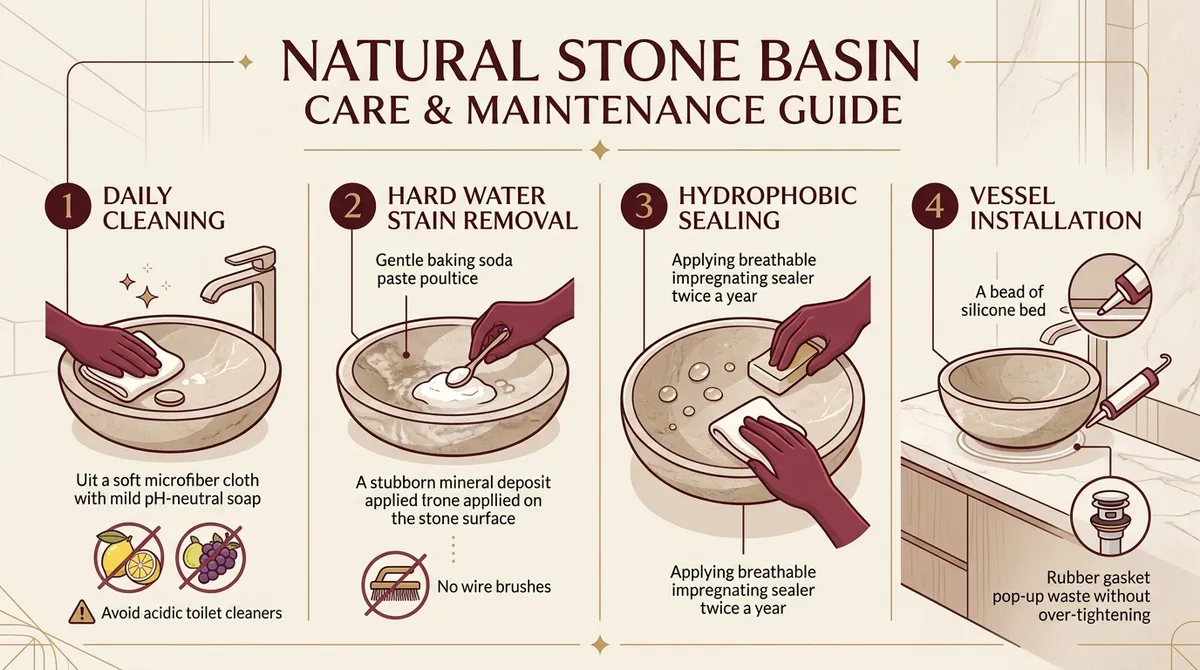
Across many Indian cities, borewell water or high-TDS municipal supply contains dissolved calcium and magnesium minerals. When water drops dry on the stone, they leave chalky white rings. Knowing how to clean hard water stains from stone basin surfaces without stripping the stone polish is very helpful.
Safe Hard Water Mineral Removal (The Baking Soda Method)
Never use Harpic, toilet acid, vinegar or lemon juice on marble, onyx or sandstone basins. The acid reacts with calcium minerals in the rock, leaving dull, rough patches. Instead, mix baking soda with water to make a smooth paste. Gently rub the paste over white mineral rings using a soft microfibre sponge, let it sit for 10 minutes, rinse with warm water and wipe dry.
River Stone Basin Cleaning Tips
Following simple river stone basin cleaning tips keeps the bowl fresh. Clean the polished interior bowl with regular coconut liquid dish soap or pH-neutral stone cleaner. For the rough natural outer rock skin, brush off any dust or dried soap lather once a month using a soft nylon brush and warm water.
Black Stone Basin Maintenance
For black stone basin maintenance on black granite, basalt or Kadappa stone, white water marks show up quickly if water pools inside the bowl. Keep a small dry microfibre towel on the vanity counter and wipe the bowl dry at the end of the day. To keep the deep matte black tone rich and fresh, wipe on a stone color enhancer once or twice a year.
How to Seal Natural Stone Wash Basin Surfaces (Step-by-Step)
Understanding how to seal natural stone wash basin units makes water bead up on the stone surface rather than soak into the pores. Here is the easy sealing process:
- Clean and Dry Fully: Wash the basin thoroughly and let it dry completely for 24 hours so no dampness remains trapped inside the rock pores.
- Apply Penetrating Sealer: Pour a breathable impregnating stone sealer onto a clean cotton cloth and wipe it evenly over the inside bowl and top rim.
- Allow Dwell Time: Let the sealer soak into the stone for 10 to 15 minutes.
- Buff Off Excess: Before the surface gets tacky, wipe off all excess liquid with a dry microfibre towel.
- Cure for 12 Hours: Keep the tap closed for 12 hours so the sealer cures properly and forms a protective water-repellent layer.
For more architectural concepts on stone walls that match your luxury basin, explore our guide on which white marble is best for walls.
Matte Finish Stone Basin Ideas and Where to Buy Carved Stone Basins
Matte and fluted stone basins paired with brushed gold, rose gold and matte black wall-mounted tapware are leading luxury bathroom trends, offering contemporary sophistication that resists fingerprints and reflections.
While high-gloss polished marble remains popular, many interior designers and homeowners now look for matte finish stone basin ideas to give their washrooms a softer, modern look. Here are popular design trends:
- Fluted and Ribbed Outer Cylinders: Vertical grooves carved on black basalt or white marble basins add tactile texture and pair well with reeded glass shower partitions.
- Honed and Leather Finishes: Brushed leather finishes offer a velvety matte feel that diffuses glare and hides water rings much better than mirror gloss.
- Asymmetrical Organic Contours: Free-form river rock shapes bring warm biophilic character to modern minimalist and Japandi-style washrooms.
- Hand-Chiseled Rims: Basins with textured rock-cut rims create an attractive contrast against clean quartz and polished vanity slabs.
If you are searching for where to buy carved stone basins in India, work with experienced stone suppliers who select solid rock blocks free from inner cracks and weak mineral seams. At Stone World, each basin is sculpted by hand, tested for proper water slope and treated with quality water repellents before delivery.
Explore our complete luxury bathroom architectural stone collection to discover matching wall claddings, vanity counters and stone accessories.
Upgrade Your Bathrooms With Hand-Carved Stone Basins
Visit the Stone World experience centre or consult with our stone specialists to view ready-to-dispatch natural river stone, marble, onyx and granite wash basins.
Request Stone Basin CatalogueFrequently Asked Questions
Practical answers to the most common queries regarding stone basin durability, hard water protection, faucet pairings, installation weights and daily maintenance routines.
Which stone basin is best for bathroom daily family use?
Black granite, basalt and natural river stone basins are the best choices for daily high-traffic family bathrooms. Their high Mohs mineral hardness (6.0–7.0) and near-zero porosity make them impervious to soap stains, cosmetic drops and scratch damage.
How do you remove stubborn hard water white stains from a natural stone basin?
Mix baking soda with clean water into a thick paste. Spread it over the mineral deposits, scrub gently with a soft microfibre cloth, let sit for 10 minutes and rinse thoroughly. Never use toilet cleaners, vinegar or lemon juice, as acidic chemicals etch and permanently dull stone surfaces.
How heavy is a natural stone vessel basin and can vanity counters hold it?
A standard stone vessel basin weighs between 18 kg and 35 kg depending on stone density and wall thickness. Solid plywood, granite, quartz or teak wood vanity counters easily support this weight when mounted with heavy-duty structural wall brackets.
How often should you seal a natural stone wash basin?
For high-traffic bathrooms, apply a penetrating breathable hydrophobic stone sealer every 6 to 12 months. For low-use guest powder rooms, sealing once every 18 to 24 months is sufficient. A simple test: if water droplets no longer bead up on the bowl surface, it is time to re-seal.
Which faucet type works best with a stone vessel basin?
Tall countertop-mounted pillar mixers (with a minimum height of 10 to 12 inches) or concealed wall-mounted basin spouts installed 4 to 6 inches above the basin lip work best. Ensure the water stream aligns with the center drain to avoid water splashing.